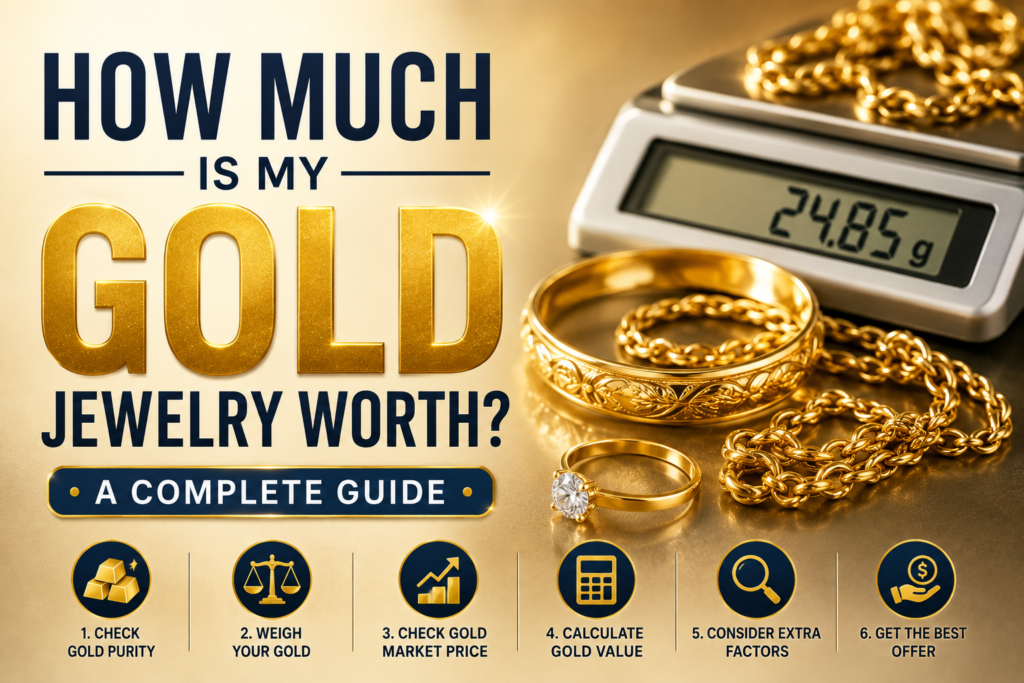
How Much Is My Gold Jewelry Worth? A Complete Guide
Determining how much your gold jewelry is worth involves more than stepping on a scale and checking the gold price. The true value of gold jewelry depends on five key factors: the weight of the piece, the purity (karat) of the gold, the current live gold spot price, the craftsmanship and brand premium, and the buyer’s margin. Understanding how these factors interact gives you an accurate valuation — whether you are selling, insuring, or simply curious. This guide walks you through the complete valuation process, from weighing your jewelry correctly to understanding why different buyers offer different prices. By the end, you will know exactly what your gold jewelry is worth and how to get the best price if you decide to sell.Gold Jewelry Valuation Formula:
Jewelry Value = (Weight × Purity Factor × Current Gold Spot Price) + Workmanship Premium – Buyer Margin
• Melt Value: Weight × Purity × Spot Price — the absolute minimum your gold is worth
• Retail Value: Melt Value + Workmanship + Brand Premium — what you would pay to buy it new
• Resale Value: Typically 70-90% of melt value when selling to a gold buyer; higher for branded or designer pieces
Factor 1: Weighing Your Gold Jewelry Correctly
The first and most fundamental step in valuing gold jewelry is determining its total weight. Gold is priced by weight, and even small errors in measurement can lead to significant valuation mistakes.Use the Right Scale
Kitchen scales are not accurate enough for gold valuation. A kitchen scale typically has a precision of ±1-5 grams — an error that could mean a $60-300 mistake at current gold prices. Invest in a digital jewelry scale with 0.01g precision. These cost $10-30 online or at jewelry supply stores and are essential for accurate gold weighing. Professional jewelers use scales with 0.001g precision for high-value items.What to Include and Exclude
- Weigh the entire piece as-is if you are valuing intact jewelry you plan to wear or sell as jewelry. The total weight includes both the gold and any gemstones.
- Remove non-gold components if you are selling for scrap. Remove gemstones, non-gold clasps, springs, string, and packaging. Gold buyers pay only for gold content — gemstones add no scrap value and inflate the weight reading.
- Weigh gemstones separately if they have independent value (diamonds, sapphires, rubies). These should be valued separately and added to the gold value.
Weight Units for Gold
Gold is traded internationally in troy ounces (31.1035 grams), but jewelry is typically weighed in grams. Always weigh in grams and convert mathematically to troy ounces if needed (divide grams by 31.1035). Never use regular (avoirdupois) ounces — they are lighter than troy ounces and will undervalue your gold by 9.7%. For quick conversions, use our gram to troy ounce converter.Factor 2: Determining Gold Purity (Karat)
The purity of your gold — expressed in karats — determines what percentage of the total weight is actual gold. A 10-gram 18K necklace contains 7.5 grams of pure gold. A 10-gram 14K ring contains only 5.83 grams. The purity factor is the single largest determinant of gold value after weight.How to Find Your Gold’s Purity
- Look for the hallmark: Check the inside of rings, the clasp of chains, or the back of pendants for stamps like 24K, 22K, 18K, 14K, 10K, 999, 916, 750, 585, or 417. Use our gold purity checker to decode any hallmark instantly.
- If no hallmark is visible: The item may be antique, handmade, or the hallmark may have worn off. In these cases, professional testing (acid test, electronic tester, or XRF analysis) is necessary to determine purity.
- For unmarked scrap or mixed items: A conservative estimate is to assume 14K (58.3% pure) or use the “mixed scrap” option in our scrap gold calculator which averages common purities.
Purity Factors by Karat
| Karat | Purity Factor | Pure Gold in 10g Piece | Value at $75/g Spot* |
|---|---|---|---|
| 24K | 0.999 | 9.99g | $749.25 |
| 22K | 0.916 | 9.16g | $687.00 |
| 18K | 0.750 | 7.50g | $562.50 |
| 14K | 0.583 | 5.83g | $437.25 |
| 10K | 0.417 | 4.17g | $312.75 |
*Hypothetical gold spot price of $2,333/oz (~$75/g). Use our gold value calculator for valuations at today’s live price.
Factor 3: The Current Gold Spot Price
The gold spot price is the wholesale market price for one troy ounce of pure gold. It changes continuously during market hours based on global supply and demand. The spot price is the foundation of all gold valuation — every calculation starts here. Gold is priced globally in US dollars and then converted to local currencies. The spot price you see on financial websites is the price for immediate delivery of pure (24K) gold. Your jewelry’s melt value is calculated by multiplying the pure gold content by the current spot price. For example, if you have 7.5 grams of pure gold (a 10-gram 18K piece) and spot gold is $75 per gram, your melt value is $562.50. Check live gold prices on our gold price page, updated daily for multiple countries and currencies. For historical valuations (inheritance, estate purposes), use our historical gold value calculator.Calculate Your Jewelry’s Exact Value
Enter your gold’s weight, purity, and any brand premium to get an instant, itemized valuation at today’s live gold price.
Jewelry Value Calculator → Gold Value Calculator →Factor 4: Workmanship, Brand, and Design Premium
The melt value — the pure gold content at spot price — is the minimum your gold jewelry is worth. But well-crafted, branded, or designer jewelry can be worth significantly more than its melt value. Understanding what adds premium above melt helps you get fair value when selling and avoid overpaying when buying.Craftsmanship Quality
Handcrafted jewelry with intricate details, filigree work, engraving, or complex stone settings commands premiums above melt value. Machine-made, mass-produced jewelry typically sells closer to melt value. The craftsmanship premium ranges from 5% for basic machine-made pieces to 35%+ for exceptional artisan work. Vintage and antique handcrafted pieces often carry the highest craftsmanship premiums, especially those from recognized eras (Art Deco, Victorian, Edwardian).Brand and Designer Premium
Jewelry from prestigious brands commands significant premiums above melt value:- Tiffany & Co., Cartier, Van Cleef & Arpels, Harry Winston: 50-200%+ above melt value. These brands have strong resale markets and their pieces often appreciate over time.
- Bvlgari, Boucheron, Chopard, Graff: 30-100% above melt. Recognized luxury brands with global demand.
- David Yurman, John Hardy, Roberto Coin: 10-40% above melt. Contemporary designer brands with loyal followings.
- Unbranded fine jewelry: Typically sells at or slightly above melt value, depending on craftsmanship and design appeal.
Gemstone Value
Diamonds and precious gemstones (rubies, sapphires, emeralds) add value above the gold content. The value depends on the 4Cs for diamonds (Carat, Cut, Color, Clarity) and similar quality factors for colored stones. A gold ring with a 1-carat high-quality diamond may be worth $5,000-10,000, while the gold alone might be worth $300-500. When selling jewelry with significant gemstones, have the stones professionally appraised — do not accept a gold buyer’s offer based on gold weight alone.Factor 5: Who You Sell To Determines What You Get
The same gold jewelry will receive dramatically different offers depending on who you sell it to. Understanding the buyer landscape helps you choose the right outlet and maximize your return.| Buyer Type | Typical Payout (% of Melt) | Best For |
|---|---|---|
| Private Sale (eBay, Facebook, direct) | 80-120% of melt (retail possible) | Branded, designer, or high-quality jewelry |
| Luxury Consignment (The RealReal, etc.) | 60-85% of sale price (consignment) | Luxury branded jewelry |
| Local Jeweler (resale) | 50-80% of melt | Intact, wearable jewelry |
| Gold Buyer / “We Buy Gold” Shop | 70-85% of melt | Scrap, broken, or unfashionable gold |
| Pawn Shop | 60-75% of melt | Quick cash; lowest payout |
| Refiner / Mail-In Service | 90-95% of melt (large quantities) | Large scrap lots, bullion |
Real-World Jewelry Valuation Examples
| Jewelry Piece | Weight / Purity | Melt Value | Likely Resale Range |
|---|---|---|---|
| 14K Gold Chain (20g) | 20g / 14K | ~$875 | $615-745 (70-85% of melt) |
| 22K Indian Wedding Necklace (50g) | 50g / 22K | ~$3,435 | $2,920-3,260 (85-95% — high purity) |
| 18K Tiffany Engagement Ring (5g + 1ct diamond) | 5g / 18K | ~$280 (gold only) | $5,000-8,000+ (brand + diamond value) |
| 10K Class Ring (8g) | 8g / 10K | ~$250 | $175-210 (70-85% of melt) |
*Based on hypothetical $75/g spot price for 24K gold. Actual values depend on live spot prices and buyer negotiations. Use our jewelry value calculator for real-time valuations.
Frequently Asked Questions About Gold Jewelry Value
How do I calculate the melt value of my gold jewelry?
Multiply the total weight (in grams) by the purity factor for your karat, then multiply by the current spot price per gram. Formula: Melt Value = Weight (g) × Purity Factor × Spot Price ($/g). For example, a 15-gram 18K necklace: 15 × 0.75 × $75 = $843.75 melt value. Use our gold value calculator for instant calculations at live prices.Why do jewelers pay less than melt value for gold?
Jewelers and gold buyers pay less than full melt value because they need to cover refining costs, operational expenses, and profit margins. They also take on market risk — gold prices can drop between when they buy and when they sell the refined gold. Typical payouts of 70-85% of melt value are standard in the industry. Refiners who process large quantities pay closer to 90-95%.Does gold-plated jewelry have any melt value?
Virtually none. The gold layer on plated jewelry is only 0.5-5 microns thick — far too little to recover economically. A ton of gold-plated items might yield only a few grams of actual gold. Gold-filled items (stamped GF) have slightly more gold content (5-10% by weight) but still negligible melt value for individual pieces. Only solid gold jewelry has meaningful scrap value.Should I remove gemstones before selling gold jewelry?
Yes, if you are selling for scrap. Gold buyers pay only for gold content. Gemstones add no value to a scrap transaction and will artificially inflate the weight, potentially leading to a lower per-gram offer. Remove stones and sell them separately if they have value. For intact, wearable jewelry being sold as jewelry (not scrap), leave gemstones in place — they add to the piece’s overall value.Is it better to sell gold jewelry online or locally?
For branded or designer jewelry: Online luxury consignment (The RealReal, Fashionphile) or private sale (eBay) typically yields the highest returns. For unbranded gold jewelry or scrap: Local gold buyers and jewelers offer immediate cash with no shipping risk. For large quantities: Mail-in refiners often pay the highest percentages (90%+). Always get multiple quotes before selling. Use our scrap gold calculator to estimate what different buyers will pay.How does the gold spot price affect my jewelry’s value?
The spot price directly determines your jewelry’s melt value — the minimum it is worth. When gold prices rise, your jewelry’s melt value rises proportionally. When prices fall, melt value falls. This is why many people track gold prices and choose to sell when prices are high. Check current prices on our live gold price page before selling.
About the author