How to Calculate Gold Jewelry Value: A Worked Example — The value of a piece of gold jewelry comes from one thing first: how much pure gold it contains. Everything else — stones, brand, design, resale demand — is separate, and mixing those into the metal calculation is how most wrong valuations happen. This guide shows the calculation itself, worked through four different items, so you can check any piece the same way. Key takeaway: fine gold weight = total weight x purity factor. Metal value = fine gold weight x price per gram. Use the example price below only as an illustration — replace it with a daily estimate from a calculator or dealer quote when you need a current figure.
The formula
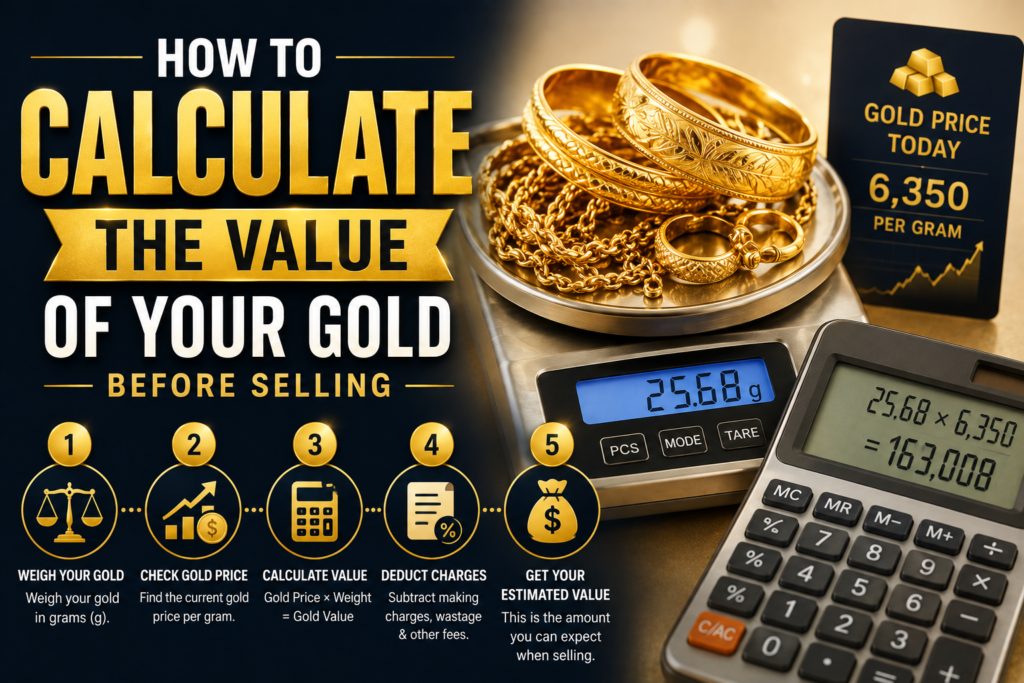
Metal value = (total weight in grams x purity factor) x price per gram. Purity factors: 24K / 999 = 1.000; 22K / 916 = 0.916; 18K / 750 = 0.750; 14K / 585 = 0.583; 10K / 417 = 0.417. Work in grams throughout. If a piece is weighed in another unit, convert first: 1 troy ounce = 31.1035 grams, 1 tola = 11.6638 grams. Never use a regular (avoirdupois) ounce for gold — it is 28.3495 grams and will undervalue the piece by about 10%. EXAMPLE ONLY: every worked example below uses $100 per gram for 24K gold. That is a labelled example price, not a current price, not a dealer quote, and not a prediction. The arithmetic is what matters; change the price per gram and the answers scale in proportion.
Worked example 1: a 10-gram 18K chain
Step 1 — total weight: 10 grams. Step 2 — purity factor for 18K: 0.750. Step 3 — fine gold weight: 10 x 0.750 = 7.5 grams of pure gold. Step 4 — metal value at the example price: 7.5 x $100 = $750. Answer: $750 of metal value at the example price. Note what is NOT in that figure: the clasp (if it is not gold), any stones, making charges, or a resale premium.
Worked example 2: a 5-gram 22K ring
Step 1 — total weight: 5 grams. Step 2 — purity factor for 22K: 0.916. Step 3 — fine gold weight: 5 x 0.916 = 4.58 grams. Step 4 — metal value: 4.58 x $100 = $458. Answer: $458 at the example price. A 22K piece of the same weight as an 18K piece is worth more metal value, because more of its weight is gold — compare example 1: 10 grams at 18K gave $750, while 10 grams at 22K would give 10 x 0.916 x $100 = $916.
Worked example 3: a 20-gram 14K bracelet
Step 1 — total weight: 20 grams. Step 2 — purity factor for 14K: 0.583. Step 3 — fine gold weight: 20 x 0.583 = 11.66 grams. Step 4 — metal value: 11.66 x $100 = $1,166. Answer: $1,166 at the example price. This is the trap most people fall into: the bracelet is the heaviest item here, but at 14K it contains less pure gold per gram than either example above. Weight alone does not decide value — weight times purity does.
Worked example 4: a mixed lot — three items together
Item A: 8-gram 18K pendant. Fine gold: 8 x 0.750 = 6.00 grams. Item B: 3-gram 22K earring pair (combined weight). Fine gold: 3 x 0.916 = 2.748 grams. Item C: 12-gram 10K brooch. Fine gold: 12 x 0.417 = 5.004 grams. Total fine gold: 6.00 + 2.748 + 5.004 = 13.752 grams. Total metal value at the example price: 13.752 x $100 = $1,375.20. Answer: $1,375.20 at the example price. Always calculate each item separately first — averaging the karats across a mixed lot gives the wrong answer, because the purity factor multiplies each weight individually.
What to subtract or keep separate
Gemstones — weigh the piece with stones, but the metal calculation counts gold only. If stones cannot be removed, a dealer will estimate their weight and deduct it — do not count stone weight as gold. Clasps, pins, and findings — check whether they are gold. If they are not, exclude their weight. Plating and filled gold — a plated item has only a thin gold layer. The formula above does not apply to it — its metal value is a small fraction of a solid piece of the same weight, and it needs a professional assessment. Resale and insurance values — these are different numbers from metal value. A branded or collectible piece may resell above metal value; an insurance valuation replaces the item, so it is usually higher still. Neither changes the metal calculation.
Calculation mistakes to avoid
1. Using gross weight instead of fine weight — forgetting the purity factor overstates value by 8% at 22K, 25% at 18K, and 42% at 14K. 2. Confusing troy ounces with regular ounces — a 10% error in the wrong direction. 3. Mixing units mid-calculation — convert everything to grams first. 4. Averaging karats across mixed items — calculate each item, then add. 5. Treating an example price as a quote — the $100/g figure here is illustrative only. For a current figure, use a daily estimate from the calculators linked below, and confirm with a dealer quote before selling.
Frequently asked questions
How do I calculate gold jewelry value without a scale? You cannot do it accurately. The whole calculation starts from weight. A jeweler can weigh the piece for you; a kitchen scale is not precise enough for small items.
What if there is no hallmark? Use the stated karat from the seller or paperwork if you trust it, and treat the result as an estimate only. A hallmark check or professional test is needed to confirm purity before relying on the figure.
Does the formula work for coins and bars too? Yes — same formula, and simpler, because coins and bars usually state their fine gold weight directly. Jewelry is harder only because of stones, clasps, and mixed karats.
Why is my piece worth less than the metal value when I sell it? Because a buyer deducts refining and handling costs and takes a margin. That deduction belongs to the selling process, not to this calculation — see the selling guide linked below for how payouts are compared.
Related guides and calculators
Gold Value Calculator — run the same calculation with a daily estimate instead of the example price. Jewelry Value Calculator — the same calculation with stones and findings handled separately. How to Value Gold Jewellery at Home — the step-by-step weighing and hallmark-checking companion to this calculation guide. Gold Purity Explained — karats, fineness, and hallmark limits in full. How Gold Is Measured — grams, troy ounces, tolas, and the other units used above. How to Sell Gold: From Item Checklist to Final Payment — the selling guide. This article covers calculation only; buyer quotes, fees, payment terms, and scams are covered there, not repeated here.
Estimates only: all figures in this article are worked examples using the labelled example price of $100 per gram for 24K gold. They are not current prices, not dealer quotes, and not personal financial advice. For a current figure, use a daily estimate and confirm with a dealer quote before buying or selling.

About the author