Table of Contents
- Gold Selling Fees & Dealer Margins: What You Need to Know
- Why Gold Selling Fees Create a Gap Between Spot Price and Your Payout
- Dealer Premiums: The Most Common Gold Selling Fee
- Refining Fees: What Gold Selling Fees Refiners Actually Charge
- Shipping and Insurance Costs When You Sell Gold
- Hidden Gold Selling Fees and How to Spot Them
- Gold Selling Fees Comparison: What Each Buyer Type Charges
- How to Minimize Gold Selling Fees and Keep More Money
- Frequently Asked Questions About Gold Selling Fees
Gold Selling Fees & Dealer Margins: What You Need to Know
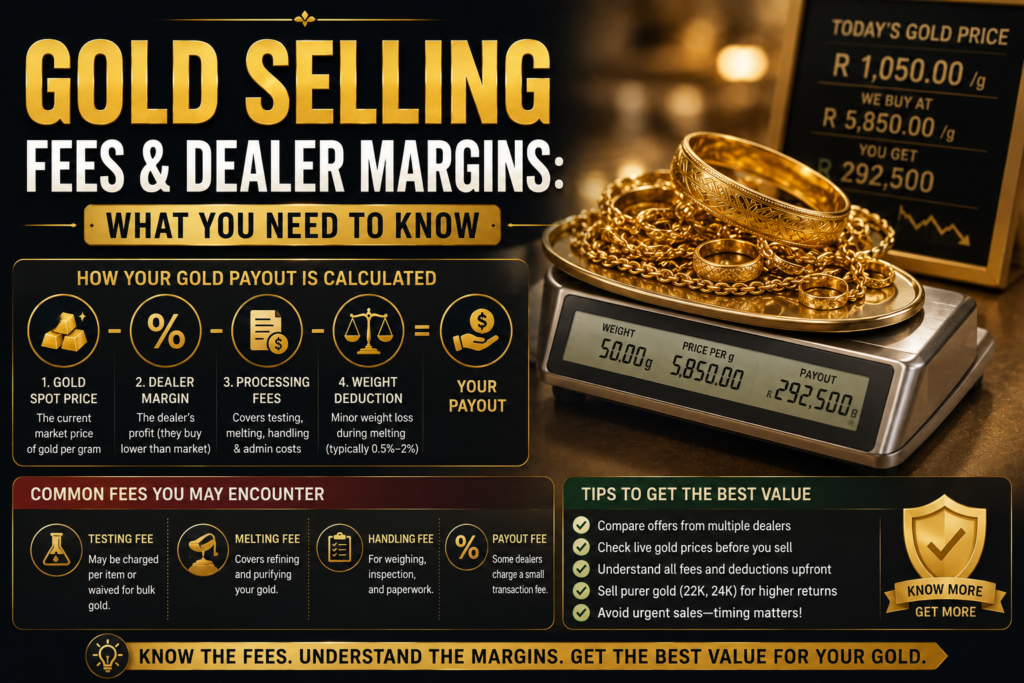
When you sell gold, the price you receive is almost always lower than the spot price you see on financial websites. This difference — the gold selling fees and dealer margins — can range from 5% to 40% depending on who you sell to, how much gold you are selling, and what form your gold takes. Understanding gold selling fees before you walk into a buyer’s shop is essential to getting a fair deal. Gold selling fees are not scams — they represent real costs that buyers incur when they purchase, process, refine, and resell your gold. However, some buyers charge excessive gold selling fees that go far beyond legitimate business expenses. Knowing the difference between reasonable gold selling fees and exploitative charges is what separates sellers who get 90-95% of spot value from those who walk away with only 60%.Gold Selling Fees at a Glance: • Reasonable total fees: 5-15% below spot — expect this from reputable refiners and gold buyers • High but acceptable: 15-25% below spot — common for small quantities, pawn shops, or convenience sales • Excessive: 25%+ below spot — you are being exploited; walk away immediately • Legitimate fees include: Dealer margin (5-15%), refining costs (1-3%), shipping/insurance (0.5-2%), assay fees ($25-50 flat) • Red flag fees: “Melt loss” over 5%, “handling fees,” “administrative charges,” “environmental fees”
Why Gold Selling Fees Create a Gap Between Spot Price and Your Payout
The spot price of gold — the number you see on financial news tickers and gold price websites — is the wholesale price for a 400-ounce London Good Delivery bar of pure (99.5%+) gold traded between banks and major institutions. When you sell a 5-gram 14K chain to a local gold buyer, you are not selling a 400-ounce institutional-grade bar. You are selling a small, mixed-purity consumer item that requires testing, sorting, melting, refining, and reselling before anyone can realize its gold value. Every step in that chain costs money, and those costs — the gold selling fees — are deducted from what the buyer can afford to pay you. The spot price is the starting point, not the ending point. Understanding gold selling fees helps you set realistic expectations and identify when a buyer’s charges cross the line from legitimate to predatory. For more context on how spot prices are determined and why they fluctuate, the London Bullion Market Association (LBMA) publishes the global benchmark gold price used by institutional traders worldwide.Dealer Premiums: The Most Common Gold Selling Fee
The dealer margin — also called the buy-back spread or dealer premium — is the largest and most universal of all gold selling fees. It represents the difference between what a dealer pays to acquire gold and what they can sell it for. This margin covers the dealer’s operating costs (rent, staff, insurance, licensing) and provides their profit. When you sell gold to a dealer, they typically pay 5-15% below the spot price for the pure gold content. This means if your gold’s melt value is $1,000, a dealer paying 85% of melt will offer $850 — the $150 difference is the gold selling fee that covers their business costs and profit margin.Why Dealer Margins Vary
- Quantity: Larger quantities mean lower percentage margins. A refiner buying 100 ounces may charge 3-5%. A pawn shop buying a single chain may charge 25-40%.
- Form of gold: Bullion coins and bars command the narrowest margins (1-5%) because they require no testing or refining. Scrap jewelry commands wider margins (10-25%) because of testing and processing costs.
- Location: Dealers in competitive markets (major cities, online) charge lower margins than those in areas with few competitors.
- Business model: High-volume refiners operate on thin margins (3-8%). Low-volume retail shops need wider margins (15-25%) to cover fixed costs.
Refining Fees: What Gold Selling Fees Refiners Actually Charge
When you sell gold that is not pure — which includes almost all jewelry — the buyer must send it to a refiner to be melted, assayed, and purified. This refining process incurs real costs that are passed back to you as gold selling fees.Legitimate Refining Costs
- Actual melt loss: 1-3% of gold content. During melting, a tiny fraction of gold is lost as vapor or trapped in slag. This is a genuine physical loss that refiners account for.
- Assay fees: $25-50 per batch. The chemical or XRF analysis that determines the exact purity of your gold. Some buyers absorb this cost; others pass it through.
- Processing costs: 2-5% for small lots. The labor, energy, and chemical costs of actually melting and refining your gold.
⚠️ Red Flag: If a buyer claims gold selling fees for “melt loss” of 10%, 15%, or 20%, they are lying. Actual melt loss during professional refining is 1-3% maximum. Anything above 5% is not a legitimate gold selling fee — it is the buyer padding their profit at your expense. Walk away immediately.
Shipping and Insurance Costs When You Sell Gold
If you sell gold by mail to an online refiner, shipping and insurance are additional gold selling fees to consider. Most reputable online gold buyers provide free, insured shipping labels — the cost is built into their margin. If a buyer asks you to ship gold at your own expense without insurance, do not use them.Typical Shipping-Related Gold Selling Fees
- Insured shipping (provided by buyer): $0 — most reputable online refiners include this
- Self-arranged insured shipping: $25-100+ depending on value, carrier, and speed
- Insurance only: Approximately 0.5-1% of declared value through third-party insurers or carrier insurance
Hidden Gold Selling Fees and How to Spot Them
Beyond legitimate gold selling fees, some buyers add spurious charges designed to confuse sellers and reduce payouts. Here are the most common hidden gold selling fees to watch for:“Handling” or “Administrative” Fees
Some buyers add flat fees of $10-50 for “handling,” “paperwork,” or “administration.” These are pure profit padding. Reputable buyers do not charge administrative gold selling fees — their margin already covers these costs. If you see a handling fee on your settlement statement, question it or walk away.“Environmental” or “Disposal” Fees
These fabricated gold selling fees claim to cover the cost of “environmentally responsible disposal” of non-gold materials. In reality, the non-gold metals in your jewelry (copper, silver, zinc) have value and are recovered and sold by the refiner — not disposed of at a cost. This is a deceptive gold selling fee with no basis in reality.“Stone Removal” Fees
If you bring gold jewelry with gemstones to a buyer who offers to remove the stones “as a service,” they may charge $5-25 per stone as a gold selling fee. Remove stones yourself before selling. If the stones have value, sell them separately. Do not pay a gold buyer to remove stones — this is almost always an unnecessary gold selling fee.“Minimum Lot” Fees
Some buyers charge a flat fee (typically $25-50) for lots under a certain weight — usually under 10 grams or 1 ounce. This gold selling fee can consume a significant percentage of your payout on small sales. Check minimum lot policies before selling small quantities. Consolidate small items to meet minimums and avoid this fee.Gold Selling Fees Comparison: What Each Buyer Type Charges
| Buyer Type | Total Gold Selling Fees | You Receive | Fee Breakdown |
|---|---|---|---|
| Online Refiner (100g+) | 5-10% | 90-95% of melt | Dealer margin 3-5%, refining 1-3%, shipping included |
| Local Gold Buyer | 15-25% | 75-85% of melt | Dealer margin 10-20%, refining 3-5% |
| Jewelry Store | 20-30% | 70-80% of melt | Dealer margin 15-25%, refining 3-5% |
| Pawn Shop | 25-40% | 60-75% of melt | Dealer margin 20-35%, refining 3-5% |
| Private Sale | 5-15% | 85-95% of market value | Platform fees 5-13%, shipping $5-20, no refining needed |
How to Minimize Gold Selling Fees and Keep More Money
1. Sell Larger Quantities at Once
Gold selling fees are largely fixed costs — it costs roughly the same to assay and refine 5 grams as it does 50 grams. By accumulating gold and selling in larger batches, you spread these fixed gold selling fees over more gold, reducing the percentage impact. Selling 100 grams at once typically yields a 5-10% higher payout than selling ten separate 10-gram lots.2. Sort and Separate by Karat
When you bring pre-sorted gold to a buyer, you eliminate their labor cost for sorting — and some of that saving should be passed to you. More importantly, pre-sorting prevents the buyer from mixing your 18K gold with 14K and paying the lower rate for everything. This is not technically a gold selling fee, but it has the same effect — reducing your payout.3. Compare Multiple Buyers
Gold selling fees vary dramatically between buyers. Getting three quotes can mean the difference between receiving 70% and 90% of melt value. Always compare offers before selling. Online refiners typically publish their current buy prices — use these as a benchmark for evaluating local offers.4. Remove Gemstones Before Selling for Scrap
If you are selling gold for its melt value, gemstones add nothing — and some buyers charge a gold selling fee for stone removal. Remove stones yourself. If they have value, sell them separately. If they are small and low-quality, they do not add value anywhere in the process.5. Sell Bullion Coins to Coin Dealers, Not Gold Buyers
Gold bullion coins (American Eagles, Krugerrands, Maple Leafs) should sell at 95-100% of spot — with minimal gold selling fees — because their purity and weight are guaranteed by sovereign governments. Selling a Krugerrand to a “We Buy Gold” shop that applies standard jewelry margins is throwing away 5-15% of its value. Sell coins to coin dealers or bullion dealers who specialize in them.Calculate What You Will Actually Receive
Use our free calculators to see your gold’s melt value and estimate what different buyers will pay after their fees and margins.
Gold Value Calculator → Scrap Gold Calculator →Frequently Asked Questions About Gold Selling Fees
What are typical gold selling fees?
Typical gold selling fees range from 5-25% depending on the buyer. Online refiners charge the lowest gold selling fees (5-10%), while pawn shops charge the highest (25-40%). Local gold buyers fall in the middle at 15-25%. The total gold selling fees include dealer margin, refining costs, and sometimes assay fees. For a $1,000 melt value, expect to receive $750-950 after all legitimate gold selling fees.Why do gold buyers charge fees?
Gold selling fees cover real business costs: the dealer’s rent, staff, insurance, and profit margin (typically 5-15%), refining costs to melt and purify your gold (1-3%), and sometimes assay fees to determine exact purity ($25-50). These gold selling fees are legitimate — the question is whether they are reasonable (5-15% total) or excessive (25%+).What is a fair percentage when selling gold?
A fair payout when you sell gold is 75-95% of melt value, depending on quantity and buyer type. For large quantities (100g+) sold to online refiners, expect 90-95%. For small quantities sold to local gold buyers, expect 75-85%. Anything below 70% is a lowball offer — the gold selling fees are excessive. Use our scrap gold calculator to estimate realistic payouts.Are there any fees when selling gold coins?
Gold selling fees for bullion coins are much lower than for jewelry — typically 1-5%. Because sovereign coins (American Eagles, Krugerrands, Maple Leafs) have guaranteed weight and purity, buyers do not need to test or refine them. Sell bullion coins to coin dealers or bullion dealers — not general gold buyers — to minimize gold selling fees and receive 95-100% of spot value.How can I avoid high gold selling fees?
Sell larger quantities at once (fixed gold selling fees spread over more gold), sort by karat before selling, get multiple quotes, remove gemstones yourself, sell coins to coin specialists rather than general gold buyers, and use online refiners for large quantities. The single biggest factor in gold selling fees is the type of buyer you choose — online refiners consistently charge the lowest fees.Do I have to pay tax on gold I sell?
In most countries, profits from selling gold are subject to capital gains tax, though this is not a gold selling fee charged by the buyer — it is a tax obligation you handle independently. In the US, physical gold is taxed as a collectible at up to 28%. In the UK, legal tender gold coins (Britannias, Sovereigns) are CGT-exempt. Some countries also apply VAT/GST to gold jewelry but exempt investment-grade bullion. Tax laws vary significantly — consult a local tax professional. The IRS provides guidance on capital gains tax on collectibles.
About the author