Karat to Fineness Conversion Table: 24K, 22K, 18K, 14K, 10K
Karat, fineness, and percentage are three ways of saying the same thing: how much of an item is gold. Confusion comes from switching between them without converting properly, especially between nominal karat and exact hallmark fineness. This guide gives you one table to use, explains the one small trap in it, and shows how to convert any weight with it.
The table
| Karat | Fineness (per 1,000) | Gold % | Purity factor | Hallmark you will see |
|---|---|---|---|---|
| 24K | 999 | 99.9% | 0.999 | 999 |
| 22K | 916 (nominal 917) | 91.6% | 0.916 / 0.9167 nominal | 916 |
| 18K | 750 | 75.0% | 0.750 | 750 |
| 14K | 585 | 58.5% | 0.585 / 0.5833 nominal | 585 |
| 10K | 417 | 41.7% | 0.417 / 0.4167 nominal | 417 |
Read the table left to right: karat tells you the traditional unit, fineness tells you parts per thousand, percentage is fineness divided by 10, and purity factor is percentage divided by 100. That factor is what you multiply by weight and price per gram.
Nominal karat vs exact hallmark — the small trap, stated plainly
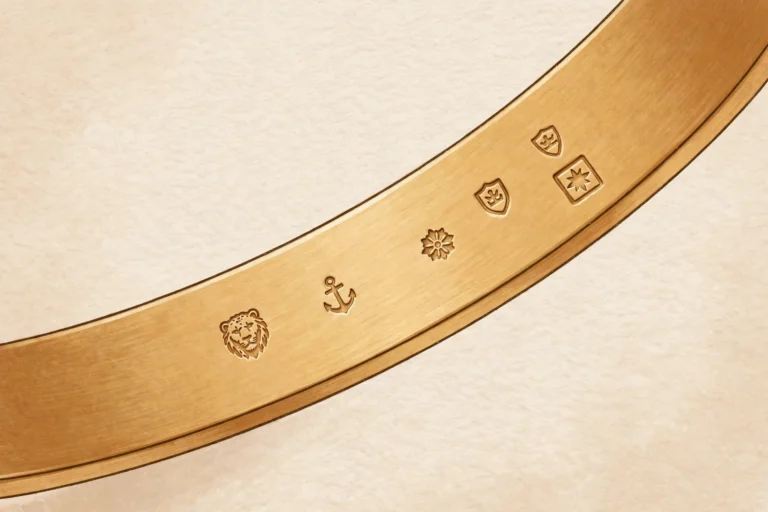
A nominal karat calculation divides karat by 24. So 22K nominal is 22 ÷ 24 = 0.9167, and 14K nominal is 14 ÷ 24 = 0.5833. A hallmark calculation uses the stamped fineness: 916 is 0.916, 585 is 0.585. The differences are 0.07 points for 22K and 0.17 points for 14K. On a 10-gram item at the example price below, that is less than $2. On a 500-gram lot, it is $35–$85. Neither method is dishonest; they are different conventions. State which one you used, and for a large lot, use an assay result instead of either.
How to convert a weight
EXAMPLE ONLY — not today’s price, using $100 per gram for 24K gold.
A 20-gram 18K chain: purity factor 0.75, so fine gold content is 20 × 0.75 = 15 grams of pure gold, and metal value is 15 × $100 = $1,500. A 20-gram 14K chain: fine content 20 × 0.585 = 11.7 grams (hallmark method), metal value $1,170. Using the nominal 0.5833 factor gives 11.67 grams and $1,167 — a $3 difference that shows the trap in action without changing the conclusion: the 18K chain holds substantially more gold.
To convert in the other direction — from fine gold weight to total weight at a given karat — divide fine weight by the purity factor. Ten grams of fine gold, made into 18K jewellery, weighs 10 ÷ 0.75 = 13.33 grams in total, because the other 3.33 grams are alloy.
Karat is not quality, colour, or durability by itself
Higher karat means more gold, but it does not automatically mean better for every purpose. 24K gold is soft and scratches easily, which is why jewellery is usually alloyed down to 22K, 18K, or 14K for strength. Colour also comes from alloy, not just karat: white gold is gold alloyed with white metals and often rhodium-plated, rose gold gets its colour from copper. Two 18K pieces can look different and wear differently while containing the same amount of gold.
For valuation, only the gold content matters. For wearing, alloy and construction matter too. Do not let a higher karat override a practical consideration — a soft 24K chain that breaks is not a better everyday piece than a sturdy 14K one — and do not let a beautiful design override the metal calculation when you are selling for melt.
Using the Karat Converter well
Enter the karat or fineness you actually read, not a rounded guess. If your item is stamped 916, enter 916 rather than “22K” if the converter allows fineness input, so you get the hallmark figure rather than the nominal one. If it only accepts karat, note the small difference in your own record. Run the conversion, then run the metal-value calculation with the factor the converter shows — do not mix a factor from one method with a price from another without noting it.
Frequently asked questions
What is the difference between 22K and 916? In practice, almost nothing for a consumer item: 916 is the hallmark fineness for 22K gold, and nominal 22K is 91.67% versus 91.6% for the hallmark. State which you used for large lots.
Is 10K gold worth valuing? Yes, if the weight is enough. It is 41.7% gold, so a heavy 10K item can still hold meaningful metal value — but a light 10K item may be worth less than the cost of testing and refining it.
Why do some countries not use karats? Many markets use fineness directly (999, 916, 750) because it is unambiguous. Karat is traditional in the US, UK, and parts of Asia; fineness is standard in much of Europe and in bullion markets. They convert exactly as in the table.
Can karat change over time? No, unless metal is added or removed by repair, re-plating, or wear. A repaired item may contain solder or new parts at a different fineness — another reason to treat repaired pieces as “check before selling”.
Estimates only. A calculator result is metal value, not a dealer payout or a retail price. This article is general information, not personal financial advice.
Related guide

About the author