Gold Hallmarks Explained: 999, 916, 750, 585, 417
A hallmark is a small stamp that states how much gold an item claims to contain. It is the fastest way to sort, value, and compare gold — and the easiest thing to misread. This guide explains the five hallmarks you will see most often, what each one means in karats and percentages, why 916 is not exactly the same as 22K in a calculator, and why a stamp alone never proves an item is genuine.
What the numbers mean
Hallmark numbers are millesimal fineness: parts of gold per 1,000 parts of metal. Divide by 10 to get the percentage.
| Hallmark | Gold content | Karat (nearest) | Purity factor |
|---|---|---|---|
| 999 | 99.9% | 24K | 0.999 |
| 916 | 91.6% | 22K | 0.916 |
| 750 | 75.0% | 18K | 0.750 |
| 585 | 58.5% | 14K | 0.585 |
| 417 | 41.7% | 10K | 0.417 |
A 999 item is essentially pure gold. A 916 item — the standard for much jewellery in Singapore, Malaysia, and India, often called “22K gold” in shops — is 91.6% gold and 8.4% other metals, usually copper and silver for strength. A 750 item is three-quarters gold. A 585 item is just over half gold. A 417 item is under half gold, and the rest is alloy.
The 916 vs 22K trap
Here is a detail that catches even careful sellers. A calculator that uses nominal karats divides 22 by 24 and gets 0.9167, or 91.67%. A 916 hallmark is 91.6% exactly. The difference is only 0.07 percentage points — tiny on a single ring, but it is a real difference, and it explains why a calculator result and a hallmark-based calculation can differ by a few dollars on a large lot without either being “wrong”. They are using slightly different inputs.
The rule is simple: if the item is hallmarked 916, use 0.916 for a hallmark calculation, and note that a nominal-22K calculator uses 0.9167. If the difference matters for a large sale, use an assay result, not either approximation. For most consumer items, the difference is smaller than weighing error, but it should be understood, not hidden.
Where to find the stamp
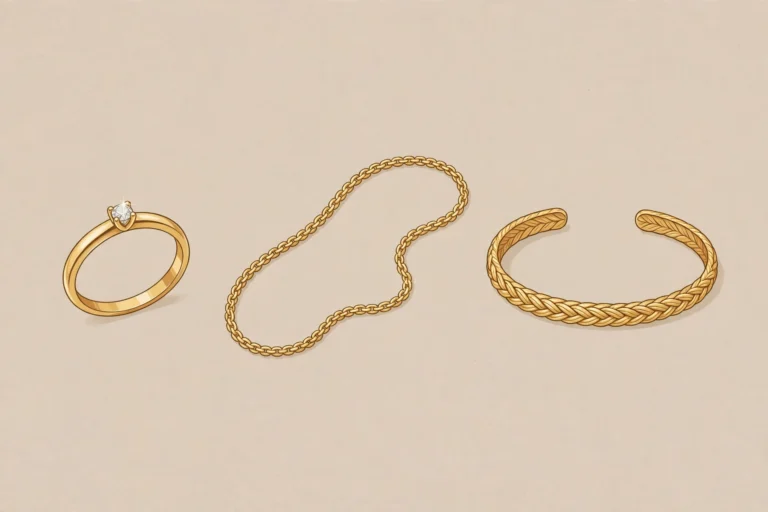
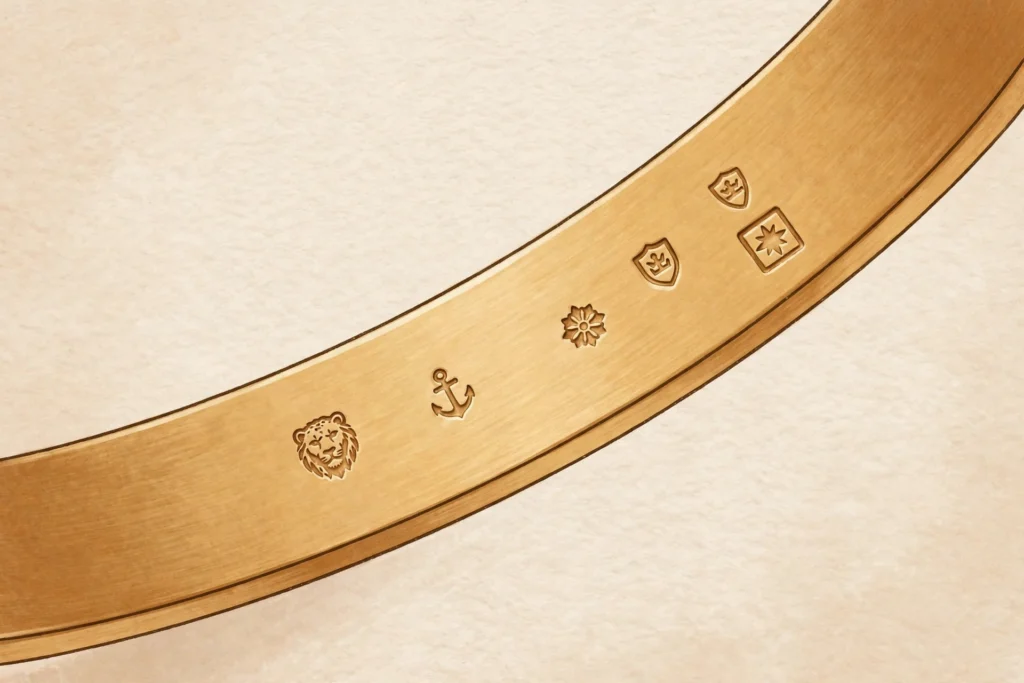
Hallmarks hide in consistent places: inside a ring band, on a chain clasp, on the back of a pendant bail, on an earring post or butterfly, and on the edge of a coin or bar. Use a loupe or a phone magnifier and good light. Worn items may have a faint or partial stamp; a stamp that reads “916” on one side and something else on the other should be treated as unknown until tested.
Some items carry two marks: a fineness mark and a maker’s or assay-office mark. The fineness mark is the number that matters for valuation. A maker’s mark tells you who made it, not how much gold it contains.
What a hallmark does NOT prove
A stamp states a claim. It does not test the metal. Plated items can carry misleading marks, filled items can be stamped as if solid, and counterfeit stamps exist. Colour, weight, and feel are clues, not tests. A magnet test, a density check, and an acid or XRF test each have limits, and no home test is a substitute for a professional assay when the value is material or authenticity is in doubt.
That limit matters for calculators too. The Gold Purity Checker helps you decode a stamp and convert it to a karat and a purity factor. It cannot confirm that the stamp is truthful. If purity is unknown, do not enter the highest plausible karat — enter the lowest plausible one as a conservative bound, or get the item tested first.
Worked examples
EXAMPLE ONLY — not today’s price, using $100 per gram for 24K gold.
A 10-gram 916 bracelet: 10 × 0.916 × $100 = $916 in metal value. The same weight in 750 gold is 10 × 0.75 × $100 = $750. The same weight in 585 gold is $585. Notice how the hallmark number, divided by 10, gives you the percentage, and the percentage times weight times price gives you the metal value. That is the whole calculation — no hidden step.
A 5-gram 999 coin or bar: 5 × 0.999 × $100 = $499.50. A 5-gram 417 item: 5 × 0.417 × $100 = $208.50. Two items of identical weight can differ by more than double in metal value, purely because of fineness. That is why “how heavy is it?” is only half the valuation question.
Singapore: 916 and 999 in practice
In Singapore, 916 (22K) jewellery and 999 (24K) bullion and jewellery are the two standards most buyers will encounter. Investment-grade bullion at 99.5% purity or above is GST-exempt in Singapore, while jewellery is generally subject to GST — a tax distinction that has nothing to do with melt value but a lot to do with the final shop price. A shop price for 916 jewellery will also include making charges, which melt value does not. When comparing a Singapore shop price with a calculator result, separate three things: metal value, making charges, and tax. Only the first is what a calculator estimates.
Frequently asked questions
Is 916 gold “real” gold? Yes. It is 91.6% gold by fineness. “Real” in the trade usually means solid gold of a stated fineness, as opposed to plated or filled — not “100% pure”.
What does 750 mean on a ring? It means 75% gold, equivalent to 18K. The remaining 25% is alloy metals that give the piece strength and colour.
Can I trust a hallmark on an old item? Treat it as a starting point. Wear, repair, and re-plating can all affect an old piece, and a professional test is worthwhile before a material sale.
Why does my calculator give a slightly different figure from my hallmark calculation? Most often because the calculator uses nominal karat (22K = 91.67%) while the hallmark is 91.6%, or because weights were rounded. Check the purity factor the calculator used.
Estimates only. A calculator result is metal value, not a dealer payout or a retail price. This article is general information, not personal financial advice.
Related calculator

About the author