Table of Contents
- 10 Common Mistakes to Avoid When Selling Gold
- Mistake 1: Not Knowing the Melt Value Before You Sell Gold
- Mistake 2: Accepting the First Offer When Selling Gold
- Mistake 3: Mixing Different Karats Together
- Mistake 4: Selling Jewelry as Scrap Without Checking Its Value
- Mistake 5: Using an Inaccurate Scale to Weigh Gold
- Mistake 6: Selling Gold Under Pressure or Time Constraints
- Mistake 7: Ignoring Gold Selling Fees in Your Calculations
- Mistake 8: Leaving Gemstones in Gold Sold for Scrap
- Mistake 9: Selling Gold Coins to the Wrong Type of Buyer
- Mistake 10: Not Checking the Buyer’s Reputation First
- Frequently Asked Questions About Selling Gold Mistakes
10 Common Mistakes to Avoid When Selling Gold
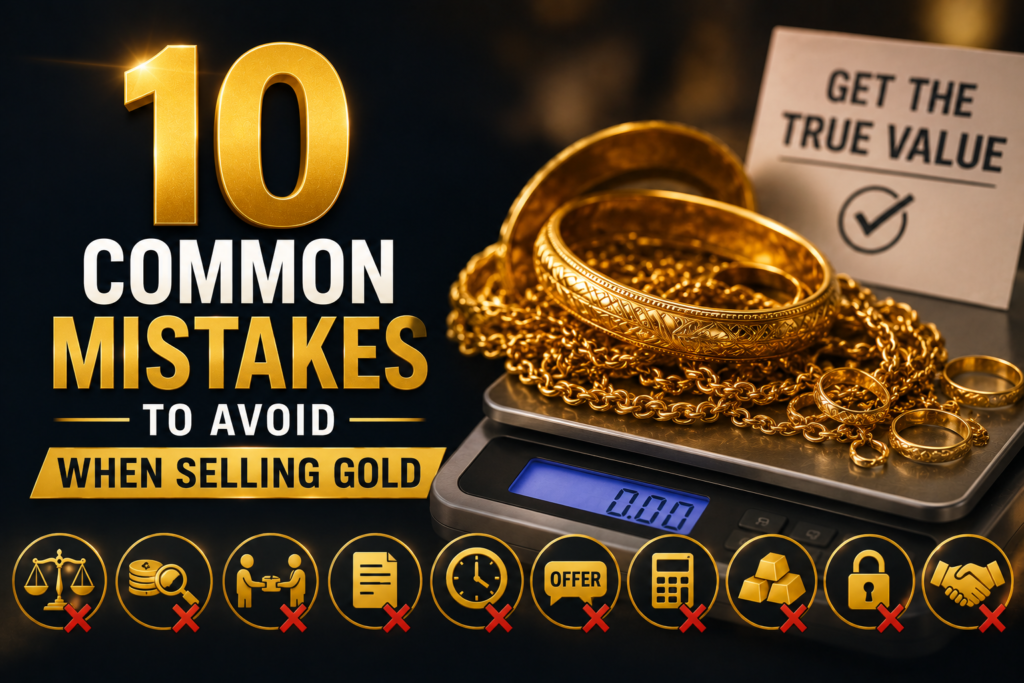
Selling gold should be a straightforward transaction — you hand over your gold, you receive fair compensation based on its weight and purity. But every day, sellers make avoidable mistakes when selling gold that cost them hundreds or even thousands of dollars. These mistakes when selling gold are not the result of bad luck — they happen because sellers walk into transactions unprepared, uninformed, or rushed. The good news is that every one of these mistakes when selling gold is preventable. By understanding the most common pitfalls before you sell, you can approach any gold buyer with confidence, negotiate from a position of knowledge, and walk away with the full value your gold deserves. Here are the ten most costly mistakes when selling gold — and exactly how to avoid each one.The 10 Biggest Mistakes When Selling Gold: 1. Not knowing your gold’s melt value before visiting a buyer 2. Accepting the first offer without comparing multiple quotes 3. Mixing different karat gold together in one pile 4. Selling intact, branded jewelry as scrap instead of as jewelry 5. Using a kitchen scale instead of a proper jewelry scale 6. Selling under pressure or when you are in a rush 7. Ignoring the impact of dealer margins and fees on your payout 8. Leaving gemstones in gold that is being sold for melt value 9. Selling bullion coins to a general gold buyer instead of a coin dealer 10. Not checking the buyer’s reputation, reviews, or credentials first
Mistake 1: Not Knowing the Melt Value Before You Sell Gold
The single biggest and most costly mistake when selling gold is walking into a buyer’s shop without knowing what your gold is worth. When you do not know the melt value — the raw value of the pure gold content at the current spot price — you have no way to evaluate whether an offer is fair or predatory. This is the foundation of all mistakes when selling gold. A buyer who realizes you do not know your gold’s value can offer you 50% of melt — and you would have no way of knowing you are being underpaid. This is not a rare occurrence. Undercover investigations by consumer protection agencies have repeatedly documented gold buyers offering 30-50% of melt value to uninformed sellers. These are not negotiation tactics — they are exploitation of sellers making the most fundamental of all mistakes when selling gold.How to Avoid This Mistake
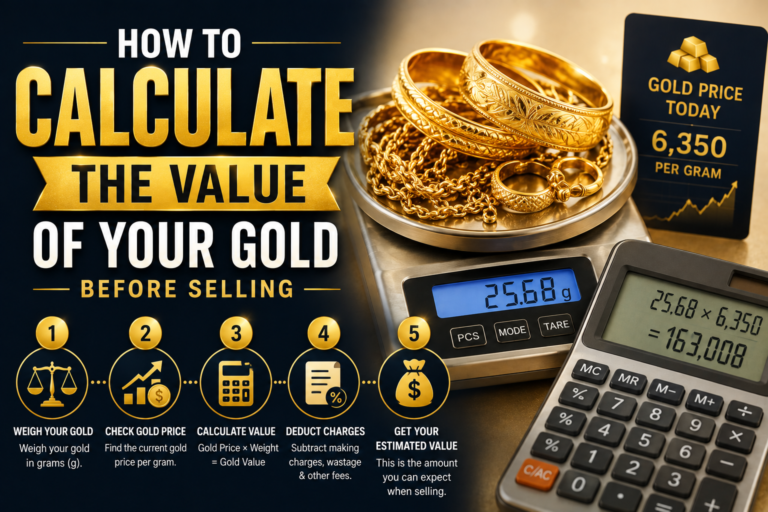
Before you visit any buyer, calculate your gold’s melt value using the formula: Weight (grams) × Purity Factor × Current Spot Price per Gram. Use our gold value calculator for instant results at live prices. Write the number down. When a buyer makes an offer, you will know immediately whether it is reasonable (75-95% of melt) or a lowball (below 70%). Read our complete guide to calculating gold value for a detailed walkthrough. Avoiding this mistake when selling gold puts you in control of the transaction.Mistake 2: Accepting the First Offer When Selling Gold
Gold buying is a competitive business. Offers for the exact same items can vary by 20-30% between different buyers in the same city. Accepting the first offer you receive is one of the most expensive mistakes when selling gold — you are essentially volunteering to be underpaid. The first buyer you visit may offer 70% of melt value. The third buyer, two blocks away, may offer 88% for the exact same gold. These price differences exist because different buyers have different business models. A pawn shop with high overhead and a focus on quick turnover needs wide margins. An online refiner processing hundreds of ounces daily can operate on thin margins. A jewelry store may pay more for pieces they can resell rather than melt. None of these buyers will tell you their competitors pay more — it is your responsibility to find out.How to Avoid This Mistake
Get at least three quotes from different types of buyers before you sell. Visit a local gold buyer, a jewelry store, and check an online refiner’s published buy prices. Tell each buyer you are getting multiple quotes — this signals that you are informed and encourages them to lead with their best offer rather than their most profitable one. For more detailed guidance, read our complete guide on how to sell gold. Avoiding this mistake when selling gold can increase your payout by 15-25%.Mistake 3: Mixing Different Karats Together
One of the most common mistakes when selling gold is throwing all your gold items — rings, chains, earrings of different purities — onto the scale as one mixed pile. When you do this, the buyer will pay you at the lowest karat rate in the pile. Your 18K chain and 22K bangle get priced at the 14K rate because there is a 14K ring mixed in. This is not necessarily dishonesty on the buyer’s part — once gold of different purities is mixed, determining the exact composition requires melting and assaying the entire batch, which is expensive. The buyer defaults to the lowest karat as a conservative estimate. But the result is the same: you lose money. This is one of the easiest mistakes when selling gold to prevent.How to Avoid This Mistake
Before you visit any buyer, sort your gold by karat. Check every piece for a hallmark. Create separate piles: all 24K together, all 22K together, all 18K together, all 14K together. Weigh each pile separately. When you present your gold to the buyer, present each karat pile individually and insist each is weighed and priced at its own rate. Use our gold purity checker if you are unsure about any hallmarks. Avoiding this mistake when selling gold ensures you get paid the correct rate for every piece.Mistake 4: Selling Jewelry as Scrap Without Checking Its Value
Not all gold should be melted down. Intact, wearable jewelry — especially from recognized brands or with significant gemstones — can be worth far more than its melt value. Selling a Tiffany & Co. necklace or a Cartier ring for scrap gold price is one of the most financially painful mistakes when selling gold. A 10-gram 18K gold chain might have a melt value of $562. That same chain from Tiffany & Co. might sell for $1,500-3,000 as a branded piece. The difference is not in the gold — the gold content is identical — but in the brand, design, and resale market. Sending branded jewelry to a refiner destroys that premium value forever. Avoiding this mistake when selling gold means taking time to identify what you have.How to Avoid This Mistake
Before selling any gold jewelry for scrap, ask: Is this piece from a recognized brand? Does it have significant gemstone value? Is it vintage or antique? Is it in wearable condition? If the answer to any of these is yes, get the piece evaluated as jewelry — not just as metal. For branded pieces, consider selling through luxury consignment platforms or directly to collectors. Use our jewelry value calculator to estimate the full value including brand and gemstone premiums. For a deeper understanding, read our jewelry valuation guide.Mistake 5: Using an Inaccurate Scale to Weigh Gold
Kitchen scales are designed for measuring flour and sugar, not gold. A typical kitchen scale has a precision of ±1-5 grams. At current gold prices of approximately $75 per gram for pure gold, a 3-gram error means a $225 mistake. Using the wrong scale is one of the most preventable mistakes when selling gold — yet it happens constantly. Even more problematic, some kitchen scales default to regular (avoirdupois) ounces rather than grams or troy ounces. A regular ounce is 28.35g; a troy ounce is 31.10g. If you weigh in regular ounces and calculate using troy ounce prices, you undervalue your gold by 9.7%. Avoiding this mistake when selling gold requires the right tool for the job.How to Avoid This Mistake
Invest in a digital jewelry scale with 0.01g precision. They cost $10-30 online and are the single best investment you can make before selling gold. Weigh everything in grams — grams are unambiguous and convert cleanly to troy ounces (divide by 31.1035). Weigh your gold at home before visiting any buyer, and watch the buyer’s scale when they weigh your items. If their numbers do not match yours, ask questions. For quick unit conversions, use our weight converter.Mistake 6: Selling Gold Under Pressure or Time Constraints
Desperation is expensive. When you need cash urgently, you lose your most powerful negotiation tool: the ability to walk away. Buyers can sense when a seller is under pressure — and many will adjust their offers accordingly. Selling gold because you need money for rent tomorrow is a fundamentally different transaction from selling gold as part of a planned financial decision. This is one of the mistakes when selling gold that is most difficult to avoid when circumstances are tight. High-pressure sales tactics from buyers compound this problem. “This offer is only good right now.” “Gold prices are about to drop.” “I am doing you a favour at this price.” These are all designed to prevent you from comparison shopping. Legitimate gold buyers do not use pressure tactics — their offers stand regardless of when you accept them. Recognizing these tactics helps you avoid mistakes when selling gold driven by emotion rather than logic.How to Avoid This Mistake
If possible, plan your gold sale before you urgently need the money. If you must sell under time pressure, at least know your melt value and get two quotes before accepting any offer. Never tell a buyer you need cash urgently — this immediately weakens your negotiating position. Be suspicious of any “limited time” offers. A fair price today will still be a fair price tomorrow. The Federal Trade Commission advises sellers to take their time and avoid rushed decisions when selling valuables.Mistake 7: Ignoring Gold Selling Fees in Your Calculations
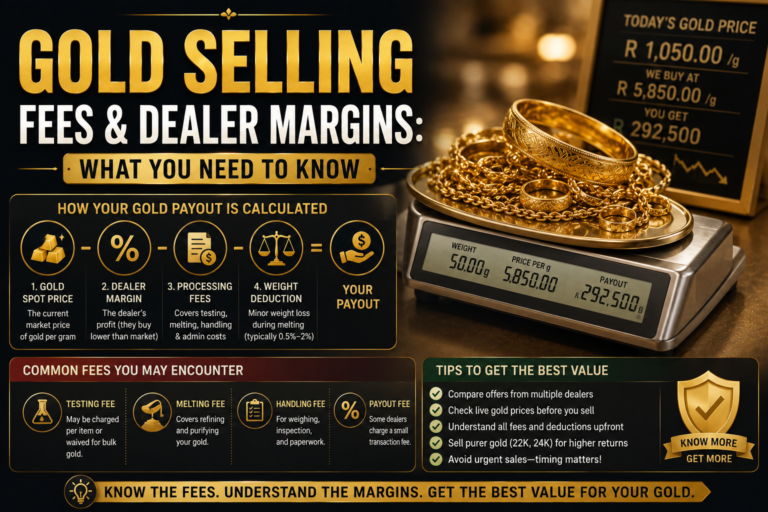
Many first-time sellers calculate their gold’s melt value and expect to receive that full amount from a buyer. When the offer comes in 15-25% lower, they feel cheated. Understanding that dealer margins and refining fees are real costs — and knowing what is reasonable versus excessive — prevents this disappointment and helps you identify genuinely unfair offers. This is one of the mistakes when selling gold that stems from unrealistic expectations. Legitimate gold buyers have real costs: refining fees (1-3%), business overhead, staff, insurance, and profit margin. These legitimate costs typically total 5-15% for large quantities and 15-25% for small retail transactions. The problem is not that fees exist — it is when buyers inflate these fees far beyond reasonable levels. A buyer claiming 25% “melt loss” is lying. Avoiding this mistake when selling gold means understanding the difference between legitimate and predatory fees.How to Avoid This Mistake
Read our detailed guide on gold selling fees and dealer margins to understand exactly what fees are legitimate and what is excessive. Use our scrap gold calculator to estimate realistic payouts after fees for different buyer types. Expect 75-85% of melt from local buyers and 90-95% from online refiners for larger quantities. Anything below 70% is a lowball offer regardless of the buyer’s claimed fees.Mistake 8: Leaving Gemstones in Gold Sold for Scrap
When you sell gold for its melt value, gemstones add zero value — and they may actually reduce your payout. The buyer weighs your item, and the gemstone’s weight is included in the total. But the buyer only pays for the gold content. So you are effectively giving away your gemstones for free. In some cases, buyers even charge a “stone removal fee” as an additional deduction. This is one of the most overlooked mistakes when selling gold. Even small diamonds have value. A 0.25-carat diamond of decent quality is worth $200-400. That is more than the gold value of many rings. Throwing that diamond into a scrap gold transaction is literally throwing money away. Avoiding this mistake when selling gold requires a few extra minutes of preparation.How to Avoid This Mistake
Remove all gemstones before selling gold for scrap. If the stones have value (diamonds 0.10ct+, quality colored gemstones), have them appraised and sell them separately. If the stones are very small or low quality, they may not be worth selling individually — but removing them still ensures you are not paying for their weight in the gold transaction. For jewelry with significant gemstones, use our jewelry value calculator to see the full value including stones.Mistake 9: Selling Gold Coins to the Wrong Type of Buyer
Gold bullion coins — American Eagles, Krugerrands, Maple Leafs, Britannias — are not jewelry. They are sovereign-guaranteed investment products with known weight and purity. They require no testing, no refining, and no assaying. They should sell at 95-100% of spot price. Selling them to a “We Buy Gold” shop that applies standard jewelry margins of 20-30% is one of the most unnecessary mistakes when selling gold. A local gold buyer who typically pays 75-80% of melt for jewelry may offer the same percentage for your Krugerrands — because that is their standard margin. They are counting on you not knowing that coins command much higher percentages. The difference between selling a 1-ounce Gold Eagle to a general gold buyer (80% of spot = $1,866 at $2,333/oz) versus a coin dealer (98% of spot = $2,286) is $420 — on a single coin. Avoiding this mistake when selling gold coins means going to the right specialist.How to Avoid This Mistake
Sell gold bullion coins to coin dealers, bullion dealers, or online precious metals platforms — not general gold buyers, pawn shops, or jewelry stores. These specialists understand coin values, pay closer to spot, and have customers actively seeking the coins you are selling. Use our gold coin value calculator to value specific coins including their typical mint premiums. For more on coin investing, see our gold investment guide.Mistake 10: Not Checking the Buyer’s Reputation First
Not all gold buyers are honest. Some systematically underweigh gold, apply fraudulent fees, switch scales, or use other deceptive practices to underpay sellers. Selling to an unreputable buyer is the most damaging of all mistakes when selling gold — because once the transaction is complete and you have accepted the payment, you have very little recourse. In most jurisdictions, gold buyers are required to be licensed and to follow specific weighing and disclosure regulations. Buyers who operate outside these regulations should be avoided entirely. Even among licensed buyers, reputation varies enormously. Some have decades of positive reviews and transparent pricing. Others have patterns of complaints about undervaluation and deceptive practices. Avoiding this mistake when selling gold is about doing your homework before you walk in the door.How to Avoid This Mistake
- Check online reviews: Google, Yelp, Trustpilot, and the Better Business Bureau. Look for patterns of complaints, not just overall ratings. A few negative reviews are normal; repeated complaints about undervaluation are a red flag.
- Verify licensing: In many jurisdictions, gold buyers must be licensed. Ask to see their license. If they cannot produce one, leave.
- Watch the weighing process: The scale should be visible to you, calibrated to zero before your gold is placed on it, and the weight should match your pre-measured weights within a small margin of error.
- Get everything in writing: The weight, purity, price per gram, and total payout should be documented on a receipt or settlement statement before you accept payment. The Better Business Bureau provides additional guidance on vetting gold buyers.
Frequently Asked Questions About Selling Gold Mistakes
What is the biggest mistake when selling gold?
The biggest of all mistakes when selling gold is not knowing your gold’s melt value before visiting a buyer. Without this knowledge, you have no way to evaluate offers and no foundation for negotiation. Every other mistake when selling gold flows from this one. Calculate melt value first: Weight × Purity Factor × Spot Price per Gram. Use our gold value calculator for instant results.How can I avoid mistakes when selling gold for the first time?
To avoid mistakes when selling gold as a first-time seller: calculate your melt value before visiting any buyer, sort gold by karat, weigh each pile on a proper jewelry scale, get at least three quotes, remove gemstones, sell coins to coin dealers (not general gold buyers), check buyer reviews, and never sell under pressure. Preparation prevents nearly all mistakes when selling gold. Our complete selling guide walks through every step.Do gold buyers always try to underpay you?
No. Reputable gold buyers offer fair prices based on weight, purity, and current spot price — minus their legitimate business margin. The problem is that unreputable buyers significantly outnumber reputable ones in many markets, particularly in the “We Buy Gold” segment. This is why avoiding mistakes when selling gold — especially getting multiple quotes and knowing your melt value — is so important. Honest buyers expect you to be informed and will offer fair prices regardless.What should I never do when selling gold?
Never sell gold without knowing its melt value. Never accept the first offer. Never mix different karats together. Never sell branded or antique jewelry as scrap. Never use a kitchen scale. Never sell under time pressure if you can avoid it. Never leave gemstones in gold sold for scrap. Never sell bullion coins to general gold buyers. And never sell to a buyer you have not researched. These are the cardinal mistakes when selling gold that cost sellers thousands.How do I know if a gold buyer is reputable?
Check online reviews (Google, BBB, Trustpilot). Look for consistent positive feedback over years, not just a handful of recent reviews. Verify their business license. Watch how they weigh and test your gold — the process should be transparent and visible to you. Reputable buyers explain their pricing, provide written documentation, and never use high-pressure tactics. If anything feels wrong, trust your instincts and leave. Avoiding mistakes when selling gold starts with choosing the right buyer.
About the author