Gold Coin Premiums Explained: Why the Same Gold Costs Different Prices
Two coins can contain exactly the same amount of gold and cost different amounts. That is not a mistake or a scam — it is a premium, and understanding it is the difference between buying gold efficiently and overpaying for packaging, size, or collectibility without realising it. This guide explains what a premium is, why it varies by size and type, and how to compare coins fairly.
What a premium is
Premium = (Coin price − Melt value of its fine gold content) ÷ Melt value, expressed as a percentage. If a coin’s fine gold is worth $3,110.35 at an example price and the coin sells for $3,265.87, the premium is ($3,265.87 − $3,110.35) ÷ $3,110.35 = 5%. You are paying 5% above metal value for minting, distribution, dealer margin, and, in some cases, collectibility.
Premium is not a fee you get back automatically when you sell. A coin bought at a 15% premium and sold at a 5% premium has lost 10 percentage points even if the gold price did not move. That is why premium matters more than most buyers realise: it is the hurdle gold must clear before you break even.
Why size drives premium
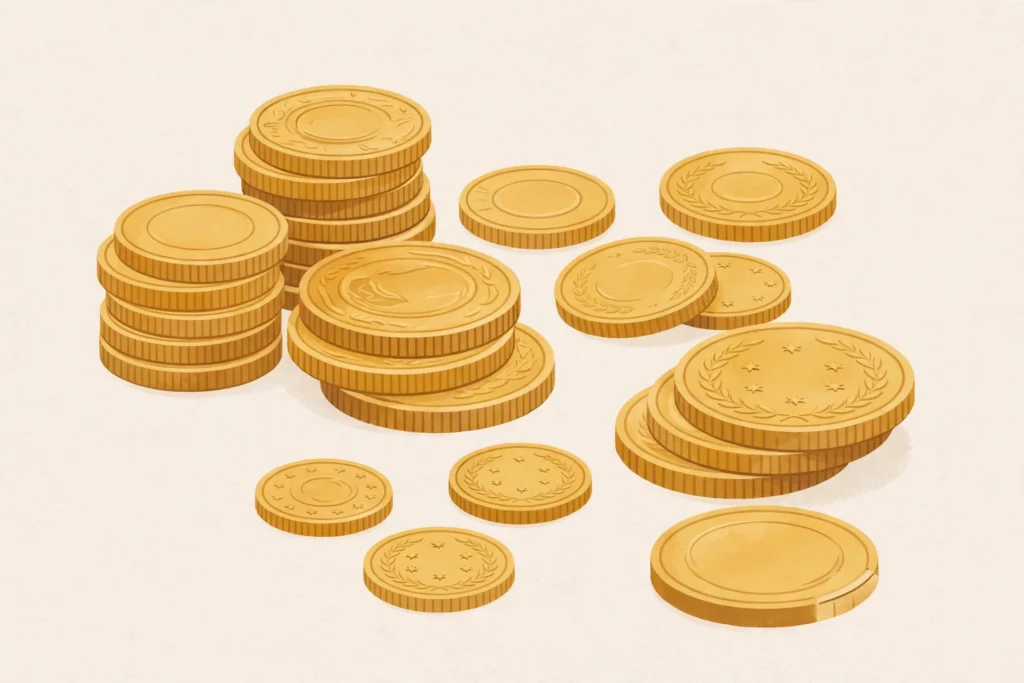
Minting cost is roughly fixed per coin, whatever its size. Striking, packaging, and handling a 1/10 oz coin costs nearly as much as striking a 1 oz coin, but that fixed cost is spread over one-tenth the gold. The result is a predictable pattern, shown here with typical ranges — not promises for any dealer or date:
| Coin size | Fine gold | Typical premium range |
|---|---|---|
| 1 oz | 31.1035 g | 3–8% |
| 1/2 oz | 15.5517 g | 5–10% |
| 1/4 oz | 7.7759 g | 8–13% |
| 1/10 oz | 3.1103 g | 10–20% |
| 1 gram | 1 g | 15–30% |
EXAMPLE ONLY — not today’s price, using $100 per gram for 24K gold. A 1 oz coin’s metal value is $3,110.35; at a 5% premium it costs $3,265.87. A 1/10 oz coin’s metal value is $311.04; at a 15% premium it costs $357.69. Per gram of gold, the small coin costs $114.96 versus $104.99 for the large coin in the example — a $10 per gram difference for the same metal, purely because of size.
22K vs 24K: premium is on fine gold, not total weight
A 1 oz American Eagle or Krugerrand weighs 33.931 grams in total but contains 31.1035 grams of fine gold, because it is 22K. A 1 oz Maple Leaf weighs 31.1035 grams in total and contains the same 31.1035 grams of fine gold, because it is 24K. Both have the same melt value at any given spot price. Premium should be calculated on fine gold in both cases — never on total weight for a 22K coin, or you will understate its premium and think you got a better deal than you did.
Use the Gold Coin Value Calculator to compare coins on fine gold, not total weight, and to see the premium explicitly rather than as a hidden gap between coin price and spot.
Bullion, proof, and collectible: three different premiums
Bullion coins are made for investors: standard designs, high mintages, premiums close to the ranges above. Proof coins are struck specially for collectors, with a polished finish and lower mintages, and they carry higher premiums that may or may not hold on resale. Collectible or numismatic coins are priced on rarity, condition, and demand, not just metal — their premium can be 50% or more, and it can fall sharply if collector demand fades.
The mistake is buying a proof or collectible coin while thinking you bought bullion, then being surprised when a bullion dealer offers only near-melt for it. Before buying, ask: “Is this priced as bullion, proof, or collectible, and what premium am I paying over melt?” If the seller cannot answer in those terms, do not buy at a premium price.
Liquidity follows the same pattern as premium, in reverse
The most liquid coins are standard 1 oz bullion coins from major mints: Eagles, Maple Leafs, Krugerrands, Britannias, Philharmonics. Every dealer recognises them and will buy them quickly. Fractional coins are also liquid, but you may recover less of your premium on resale. Large and collectible coins have thin buyer pools and can take weeks to sell at a fair price. For most investors, a core of 1 oz bullion with a small fractional allocation for flexibility is more efficient than a collection of small, high-premium pieces.
How to compare two coins fairly
Write down, for each coin: fine gold weight, melt value at a stated price basis, coin price, premium in dollars and percent, and whether it is bullion, proof, or collectible. Compare premiums, not coin prices — a $3,500 coin and a $400 coin cannot be compared until both are expressed as a percentage over melt. And compare premiums from the same dealer on the same day, because premiums move with supply, demand, and dealer stock, not just with spot price.
Frequently asked questions
Is a lower premium always better? For bullion bought as an investment, usually yes — but check authenticity, dealer reputation, and buy-back policy too. An implausibly low premium from an unknown seller is a warning sign, not a bargain.
Do premiums disappear when I sell? No. A dealer buying from you will usually pay melt plus a small premium for standard bullion, or melt only for less liquid coins. Assume you recover little of a high proof or collectible premium unless you sell to a collector.
Why do gram coins have such high premiums? Because minting and handling costs are spread over very little gold. They are useful for gifts and small savings, but inefficient as a core investment.
Should I buy coins or bars for the lowest premium? Bars usually carry lower premiums than coins of the same weight, because they are cheaper to produce. Coins offer better divisibility and recognisability. The right choice depends on whether you value low premium or easy resale of small amounts more.
Estimates only. A calculator result is metal value, not a dealer payout or a retail price. This article is general information, not personal financial advice.
Related guide

About the author