Table of Contents
- Gold Coin Sizes & Weights Explained: From 1 Gram to 1 Ounce
- The Troy Ounce: The Standard Gold Coin Weight
- Fractional Gold Coins: 1/2 oz, 1/4 oz, 1/10 oz Explained
- Gram-Based Gold Coins: 1g, 5g, and 10g Sizes
- Large Gold Coins: 2 oz, 5 oz, and Kilo Coins
- Gold Coin Weight vs Size: The 22K vs 24K Difference
- How Gold Coin Size Affects Premiums and Price
- Gold Coin Size and Liquidity: What Is Easiest to Sell
- Frequently Asked Questions About Gold Coin Sizes
Gold Coin Sizes & Weights Explained: From 1 Gram to 1 Ounce
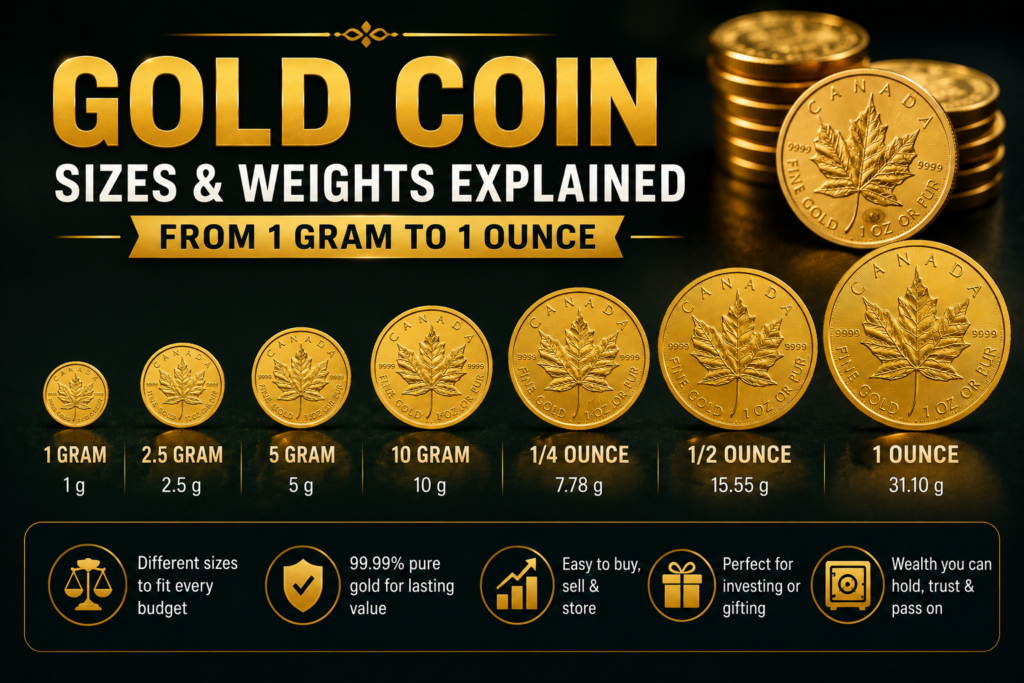
Gold coins come in a wide range of sizes and weights — from tiny 1-gram coins smaller than a fingernail to massive 1-kilogram coins worth over $75,000. Understanding gold coin sizes and weights is essential for making informed buying decisions. The size of a gold coin affects its price, its premium over spot, its liquidity, and its suitability for different investment goals. This guide explains every major gold coin size and weight: the standard 1 troy ounce coin, fractional coins (1/2 oz, 1/4 oz, 1/10 oz), gram-based coins (1g, 5g, 10g), and large-format coins (2 oz, 5 oz, 1 kg). We also explain the critical difference between a coin’s total weight and its fine gold content — a distinction that confuses many first-time buyers — and how coin size affects premiums and liquidity.Gold Coin Sizes: Quick Reference
• 1 troy ounce (31.1035g): The standard gold coin — best value, lowest premium, most liquid
• Fractional coins (1/2 oz, 1/4 oz, 1/10 oz): Smaller sizes for flexibility; higher premiums
• Gram coins (1g, 5g, 10g): Very small denominations; highest percentage premiums
• Large coins (2 oz, 5 oz, 1 kg): Collector and special-issue coins; limited liquidity
• Key distinction: 22K coins (Eagles, Krugerrands) weigh MORE than 1 oz total but contain exactly 1 oz fine gold
• Key distinction: 24K coins (Maple Leafs, Britannias) weigh exactly 1 oz total — essentially pure gold
The Troy Ounce: The Standard Gold Coin Weight
The 1 troy ounce coin is the benchmark for gold bullion — the size most investors think of when they say “gold coin.” A troy ounce equals 31.1035 grams, which is different from a regular (avoirdupois) ounce of 28.35 grams. All precious metals — gold, silver, platinum, palladium — are measured in troy ounces.The Two Types of 1 oz Gold Coins
There is a critical distinction between two types of 1 oz coins that confuses many buyers:- 24K Pure Gold Coins (Maple Leafs, Britannias, Philharmonics, Kangaroos): These coins are .9999 fine gold. A 1 oz Maple Leaf weighs exactly 31.1035 grams — essentially all of it is pure gold. Total coin weight = fine gold weight.
- 22K Gold Coins (American Eagles, Krugerrands): These coins are .9167 fine gold with copper and silver added for durability. A 1 oz American Eagle weighs 33.931 grams total — but contains exactly 31.1035 grams (1 troy ounce) of fine gold. The extra 2.83 grams is the copper-silver alloy.
Why 1 oz Coins Are the Best Choice for Most Investors
- Lowest percentage premium: 3-8% for 1 oz coins vs. 10-20% for fractional coins
- Maximum liquidity: The most widely traded and recognized gold coin size worldwide
- Best value: You get the most gold content per dollar spent
- Easy to track: One coin equals one ounce — simple portfolio accounting
Fractional Gold Coins: 1/2 oz, 1/4 oz, 1/10 oz Explained
Fractional gold coins are smaller denominations of the major bullion coins, designed for investors who want to buy or sell gold in smaller increments. They offer greater flexibility but carry higher premiums due to their higher production costs relative to gold content.| Coin Size | Fine Gold Content | Typical Premium | Best For |
|---|---|---|---|
| 1 oz | 31.1035g | 3-8% | Best overall value; core investment holding |
| 1/2 oz | 15.5517g | 5-10% | Moderate budgets; some divisibility |
| 1/4 oz | 7.7759g | 8-13% | Gifts; smaller savings increments |
| 1/10 oz | 3.1103g | 10-20% | Very small budgets; emergency barter |
When Fractional Coins Make Sense
Despite their higher premiums, fractional coins serve specific purposes:- Dollar-cost averaging on a small budget: If you can only afford $300-500 per month, a 1/10 oz coin lets you invest regularly without saving for months to afford a 1 oz coin.
- Gifts: A 1/10 oz coin makes an excellent gift — meaningful gold content at an accessible price point.
- Divisibility: If you may need to sell or trade small amounts of gold in the future, fractional coins provide that flexibility.
- Emergency preparedness: Small denomination coins are easier to use for small transactions in a barter or emergency scenario.
Gram-Based Gold Coins: 1g, 5g, and 10g Sizes
Some gold coins — particularly from Asian mints and private refiners — are produced in gram denominations rather than troy ounce fractions. These gram-based coins are popular in countries where the metric system is standard for gold trading.Common Gram Coin Sizes
- 1 gram coin: The smallest gold coin widely available. Tiny — about the size of a small button. Popular in China and Singapore as gifts and savings. High premium (15-30%).
- 5 gram coin: A practical small coin. Popular in Asia for gifting and savings. Moderate premium (10-20%).
- 10 gram coin: Roughly one-third of a troy ounce (0.3215 oz). A meaningful denomination in Asian gold markets. Moderate premium (8-15%).
- 20 gram coin: Approximately two-thirds of a troy ounce. Less common but available from some mints. Moderate premium (6-12%).
Gram Coins vs Troy Ounce Coins
Gram-based coins are most common in Asian markets — China, Singapore, Malaysia, Thailand, and India — where gold is traditionally measured in grams rather than troy ounces. Western mints (US Mint, Royal Canadian Mint, Royal Mint) primarily produce troy ounce-based coins, though some also offer gram coins for the international market. When buying gram coins, verify whether the stated weight is the total coin weight or the fine gold content — this distinction matters for valuation.Large Gold Coins: 2 oz, 5 oz, and Kilo Coins
Beyond the standard 1 oz coin, mints produce large-format gold coins — primarily as collector’s items, commemorative pieces, and high-denomination legal tender. These coins are spectacular in size and visual impact but have limited investment utility compared to standard 1 oz coins.Common Large Coin Sizes
- 2 oz coins: Produced by the Perth Mint (Kangaroo), Royal Mint (Queen’s Beasts series), and others. Larger premium (8-15%) but more reasonable than truly massive coins.
- 5 oz coins: Primarily collector pieces from the Perth Mint and Royal Mint. Significant premium (15-25%). Limited liquidity — specialist buyers only.
- 1 kg coins: The largest gold coins regularly produced. The Australian 1 kg Kangaroo is perhaps the most famous. Massive premium (20-40%). Extremely limited liquidity — these are collectibles, not practical investments.
- 100g coins: A popular large-format option in Asian markets. More practical than 1 kg coins. Moderate premium.
Are Large Gold Coins Good Investments?
For most investors, large gold coins are not recommended. Their high premiums, limited liquidity, and specialized buyer base make them poor investment vehicles compared to standard 1 oz coins or gold bars. Large coins appeal primarily to collectors who value the numismatic and aesthetic aspects of these pieces above their gold content. If your goal is gold investment, stick to 1 oz coins or bars. If you appreciate the artistry of large-format coins, they can be enjoyable additions to a collection — but understand you are paying for collectibility, not gold efficiency.Gold Coin Weight vs Size: The 22K vs 24K Difference
One of the most confusing aspects of gold coin sizes and weights is the difference between a coin’s total weight and its fine gold content. This distinction is particularly important when comparing 22K coins (Eagles, Krugerrands) with 24K coins (Maple Leafs, Britannias).| 1 oz Coin | Total Coin Weight | Fine Gold Content | Diameter |
|---|---|---|---|
| American Gold Eagle (22K) | 33.931g | 31.1035g (1 oz) | 32.70mm |
| Krugerrand (22K) | 33.930g | 31.1035g (1 oz) | 32.77mm |
| Canadian Maple Leaf (24K) | 31.110g | 31.1035g (1 oz) | 30.00mm |
| British Britannia (24K) | 31.104g | 31.1035g (1 oz) | 32.69mm |
How Gold Coin Size Affects Premiums and Price
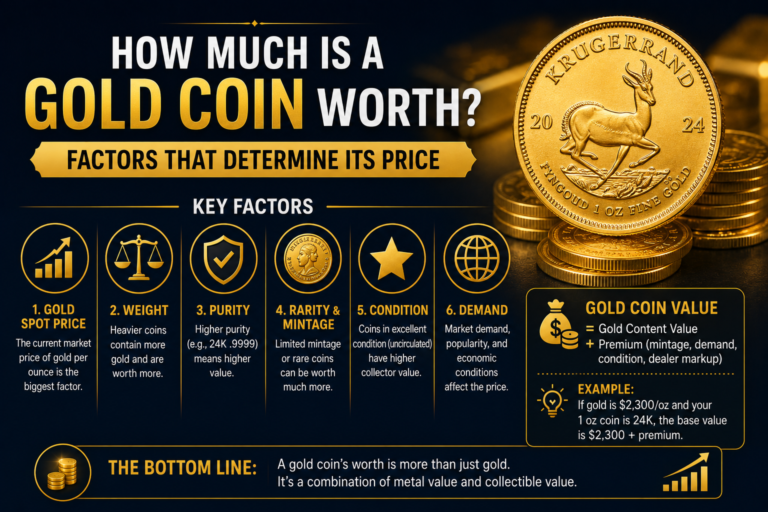
The single most important economic factor in gold coin sizes and weights is how size affects the premium — the amount you pay above the spot price for the coin’s gold content.The Premium Size Relationship
Smaller coins carry higher percentage premiums for a simple reason: the manufacturing cost of producing a coin is roughly the same regardless of size. A 1/10 oz coin costs nearly as much to design, strike, and package as a 1 oz coin — but that fixed cost is spread over one-tenth the gold. The result:- 1 oz coin: 3-8% premium — the most efficient size
- 1/2 oz coin: 5-10% premium — moderate efficiency
- 1/4 oz coin: 8-13% premium — declining efficiency
- 1/10 oz coin: 10-20% premium — the least efficient size
- 1 gram coin: 15-30% premium — very high cost per gram
How Premiums Affect Your Investment
Premiums represent an initial cost you must recover through gold price appreciation before breaking even. A 1 oz coin with a 5% premium needs gold to rise 5% before you are profitable. A 1/10 oz coin with a 15% premium needs gold to rise 15% just to break even. For investment efficiency, larger coins are better. For flexibility and small-budget investing, fractional coins serve a purpose despite their higher relative cost. Compare premiums across sizes using our gold coin value calculator.Gold Coin Size and Liquidity: What Is Easiest to Sell
When considering gold coin sizes and weights, liquidity — how easily you can sell a coin — is a crucial factor that many buyers overlook.Most Liquid: 1 oz Coins
The 1 oz coin is the most liquid gold coin size in the world. Every coin dealer, bullion dealer, and gold buyer recognizes and purchases 1 oz coins immediately. The market for 1 oz coins is deep and competitive, meaning you can sell quickly at close to spot price. This is why 1 oz coins are the preferred choice for serious gold investors.Moderately Liquid: Fractional Coins
Fractional coins (1/2 oz, 1/4 oz, 1/10 oz) are also highly liquid — there is strong demand for small gold coins for gifting, micro-investing, and divisibility. However, the market is slightly less competitive than for 1 oz coins, and you may not recover as much of your initial premium when selling.Limited Liquidity: Large Coins
Large-format coins (2 oz, 5 oz, 1 kg) have limited liquidity. The buyer pool for a $75,000 gold coin is very small — primarily specialist coin dealers and wealthy collectors. Selling a large coin may take weeks or months, and you will likely accept a larger discount to spot price to complete the sale. These are collector’s items, not liquid investment vehicles.Gram Coins: Variable Liquidity
Gram coins (1g, 5g, 10g) have good liquidity in Asian markets where gram-based gold is standard, but limited liquidity in Western markets where troy ounces dominate. A 10-gram coin that sells easily in Singapore or Malaysia may be harder to sell in the United States or Europe. For maximum liquidity, stick with 1 oz coins from major sovereign mints — American Eagles, Maple Leafs, Krugerrands, Britannias, and Philharmonics. These are recognized and traded worldwide. Read our gold coins vs gold bars guide for a complete liquidity comparison.Frequently Asked Questions About Gold Coin Sizes
What is the standard size of a gold coin?
The standard gold coin size is 1 troy ounce (31.1035 grams of fine gold). This is the benchmark size for all major bullion coins: American Eagles, Canadian Maple Leafs, South African Krugerrands, British Britannias, and Austrian Philharmonics. The 1 oz coin offers the best combination of low premiums, high liquidity, and practical size for most investors.How many grams is a 1 oz gold coin?
A 1 oz gold coin contains exactly 31.1035 grams of fine gold. However, the total coin weight varies depending on purity. 24K coins (Maple Leafs, Britannias) weigh approximately 31.10 grams total — essentially all gold. 22K coins (American Eagles, Krugerrands) weigh approximately 33.93 grams total — 31.10 grams of gold plus 2.83 grams of copper-silver alloy. The fine gold content is identical for both types.What is the smallest gold coin you can buy?
The smallest widely available gold coins are 1 gram coins (0.0322 troy ounces). These are produced by various mints, particularly in Asia. Some mints also produce 1/25 oz coins (1.244 grams) — the Austrian Philharmonic is available in this size. Very small coins (under 1 gram) exist as novelty or collectible items but are not practical investments due to their extremely high premiums (30%+) and handling difficulty.Are fractional gold coins worth buying?
Fractional gold coins are worth buying if you need small denominations — for gifts, micro-investing on a tight budget, or maintaining divisibility in your gold holdings. However, they carry significantly higher percentage premiums than 1 oz coins (10-20% vs. 3-8%). For maximizing gold content per dollar, 1 oz coins are superior. The best approach for most investors is a mix: primarily 1 oz coins for value, with some fractional coins for flexibility. Read our gold investment guide for allocation strategies.Do larger gold coins have lower premiums than 1 oz coins?
This depends on the size. Moderately larger coins (2 oz, 100g) sometimes have slightly lower premiums than 1 oz coins because the production cost is spread over more gold. However, very large coins (5 oz, 1 kg) are produced in limited quantities as collector’s items and actually carry higher premiums (15-40%) due to their numismatic appeal and limited production runs. For the lowest premiums, gold bars — not coins — are the better choice for larger investments. See our gold coins vs gold bars comparison.How do I know if a gold coin is the right weight?
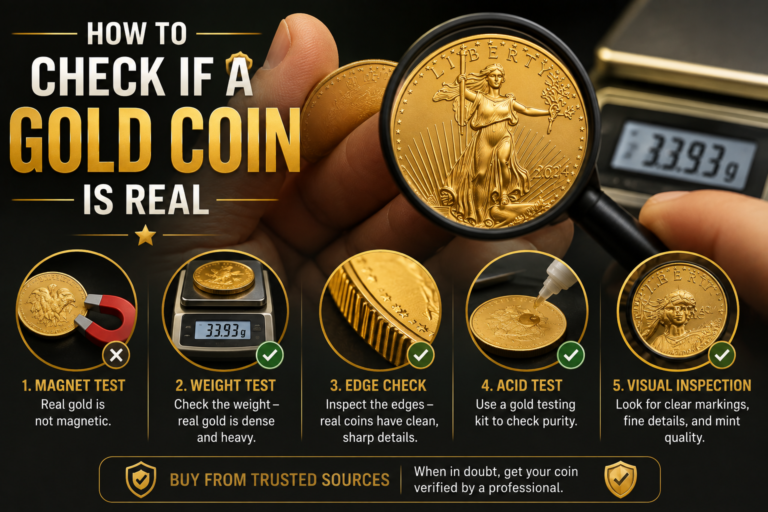
Weigh the coin on a 0.01g precision digital scale and compare against official mint specifications. For 24K coins (Maple Leafs, Britannias), the total weight should be approximately 31.10 grams for 1 oz coins. For 22K coins (Eagles, Krugerrands), the total weight should be approximately 33.93 grams. Any deviation of more than 0.05 grams is a red flag for counterfeit coins. Also measure diameter with calipers and compare to official specifications. For more verification methods, read our gold coin authenticity guide.
About the author