How to Sort Mixed Scrap Gold by Karat Before You Sell
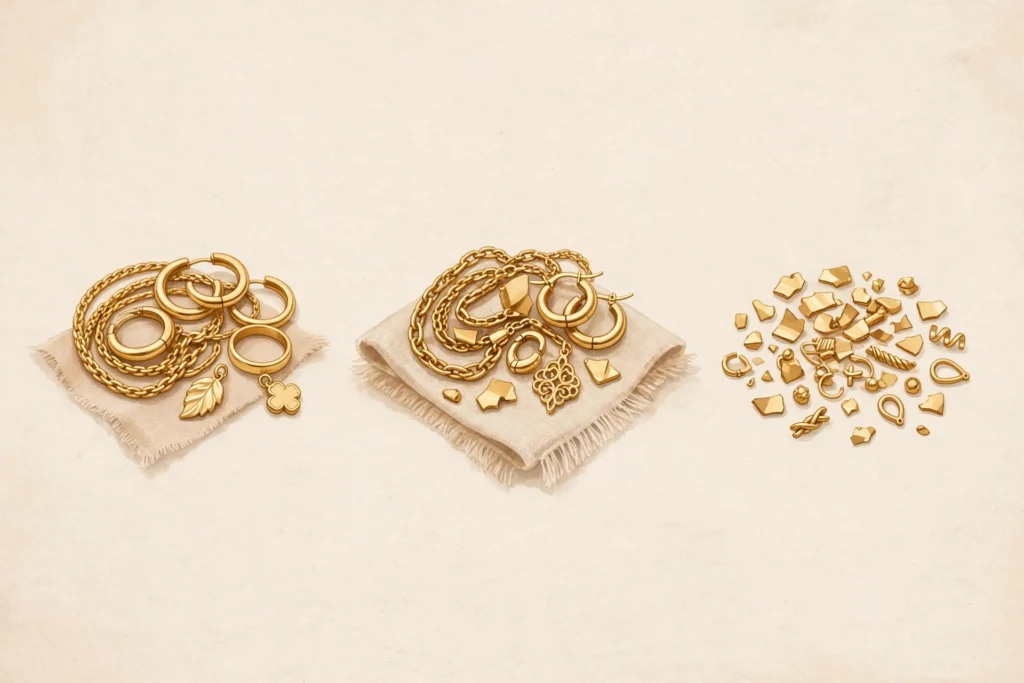
Mixed scrap is where sellers lose the most money without realising it. A bag of broken chains, single earrings, clasps, and dental gold is not one item. It is several purities mixed together, and if a buyer weighs it as one lot, they will usually pay the lowest rate for the whole bag. Sorting by karat before you sell is unglamorous work, but it is the single most effective way to protect a scrap payout.
Why buyers love unsorted lots
A buyer who cannot tell 18K from 14K at a glance has to allow for testing time, assay cost, and the risk that some pieces are plated or filled. The simplest way to cover that risk is to price the lot at the lowest plausible purity. That is not necessarily dishonest — it is how uncertainty is priced — but it means your 18K pieces subsidise your 14K pieces, and your plated pieces drag the whole lot down if they are included at all.
Sorting removes that uncertainty. When you present labelled piles, a buyer can test quickly, weigh separately, and price each pile on its own merits. You also protect yourself: if a buyer mixes your piles back together at the counter, you can see it happening and stop the sale.
Step 1: Remove what is not scrap gold
Take out anything with stones you want to keep, anything that is clearly costume jewellery, and anything marked gold-plated, gold-filled, or vermeil. Plated and filled items contain very little gold by weight and should not go into a scrap pile at all. If a stone has value, remove it before selling or agree its treatment in writing first — a scrap buyer pays for gold only, and a stone left in the lot adds weight without adding gold value.
Keep dental gold separate. It is often a different alloy and may need a separate assay. Do not mix it with jewellery scrap and expect a jewellery rate.
Step 2: Sort by hallmark
Make one labelled bag or envelope per purity: 22K/916, 18K/750, 14K/585, 10K/417, and one marked “unknown”. Read every stamp with a loupe or a phone magnifier. Stamps hide inside clasps, on earring posts, and on the inner band of rings. If a piece has two different marks, or a mark you cannot read, it goes in “unknown” — do not guess it into a higher pile.
Weigh each pile separately in grams and write the weight on the bag. That written record is your protection if weights are disputed later. Photograph each pile with its label before you leave home.
Step 3: Value each pile separately
EXAMPLE ONLY — not today’s price, using $100 per gram for 24K gold.
Suppose you have 20 g of 18K and 10 g of 14K. The 18K pile is 20 × 0.75 × $100 = $1,500 in metal value. The 14K pile is 10 × 0.5833 × $100 = $583.30. Together, $2,083.30. If the whole 30 g lot were priced as 14K, the metal value would be shown as $1,750 — a $333 difference in the example, before any payout rate is applied. That is the cost of not sorting.
Now apply a payout rate to see what you might actually receive. At an 85% payout rate with no extra fee, the sorted example pays $1,770.81. At the same rate, the unsorted-as-14K example pays $1,487.50. The difference is not a fee you can negotiate away afterwards; it is created by the way the lot was presented.
Use the Scrap Gold Calculator to run each pile separately, with the payout rate and any refining fee the buyer has quoted. Do not run one mixed weight at one purity and treat the result as accurate — the calculator is only as honest as the inputs you give it.
What to do with the “unknown” pile
Get it tested, or accept that it will be priced conservatively. A common mistake is to put unknown pieces into the highest pile “because they look like 18K”. Colour is not a test. If testing costs more than the pile is likely to be worth, sell it as unknown and take the lower rate knowingly, rather than contaminating a sorted pile and losing money on the good pieces as well.
At the counter
Ask for a separate weight, purity result, price basis, and payout for each pile, in writing. If a buyer refuses to itemise, that is information in itself — get another quote. Keep your own weights to compare. A small difference for scale calibration is normal; a large difference on one pile is a reason to pause. And never accept a first offer on the spot for a large lot without a second quote, especially for dental gold or a mixed estate lot.
Frequently asked questions
Can I mix 18K and 14K if they are both gold? You can, but you will usually be paid at the lower rate for the whole lot. Sorting is what stops that.
Should I melt scrap myself before selling? No. Home melting does not increase gold content, it creates safety and assay problems, and most buyers prefer to test and refine themselves.
What about gold-plated items? Keep them out of scrap piles. Their gold content is a thin layer and is not valued as solid gold by weight.
Is sorting worth it for a small lot? For a few grams, the absolute saving is small, but the habit still matters: you learn what you actually own, and you avoid a buyer pricing everything at the lowest rate by default.
Estimates only. A calculator result is metal value, not a dealer payout or a retail price. This article is general information, not personal financial advice.
Related guide

About the author