Before You Invest — Key Principles: • Gold is a preservation asset, not a growth asset — think insurance, not speculation • Most advisors recommend 5-15% of your portfolio in gold • Physical gold = no counterparty risk; paper gold = convenience and liquidity • Always buy from reputable dealers — check credentials, compare premiums, read reviews • Gold investing is a long-term strategy — measure returns in decades, not days
Why Invest in Gold? The Case for Gold
Before diving into how to invest, it is worth understanding why gold deserves a place in your portfolio. Gold serves several distinct investment purposes that no other asset class provides:Portfolio Diversification
Gold has a low or negative correlation with stocks and bonds over long periods. When equities fall, gold often rises — this was clearly demonstrated in 2008, 2020, and 2022. Adding gold to a portfolio of stocks and bonds can reduce overall volatility and improve risk-adjusted returns. The World Gold Council’s research suggests that a 5-10% gold allocation optimizes risk-adjusted returns for most portfolios.Inflation Protection
Gold has preserved purchasing power for centuries while paper currencies have consistently lost value. Since 1971, when the US abandoned the gold standard, gold has risen from $35 to over $2,000 per ounce while the dollar has lost over 85% of its purchasing power. During the high-inflation 1970s, gold returned over 30% annually. For a deeper understanding, read Why Is Gold Valuable?.Currency Hedge
Gold is priced globally in US dollars, which means it serves as a hedge against your local currency weakening. For investors in India, Pakistan, South Africa, Turkey, or any country where the currency has depreciated against the dollar, gold held in local currency terms has delivered exceptional returns — sometimes exceeding 100% over a few years during currency crises.Safe-Haven Asset
During geopolitical crises, financial panics, and economic uncertainty, gold tends to hold or increase its value. It is the asset investors flee to when confidence in governments, banks, and financial systems wavers. This “crisis insurance” function is one of gold’s most valuable — and most difficult to quantify — investment characteristics.8 Ways to Invest in Gold
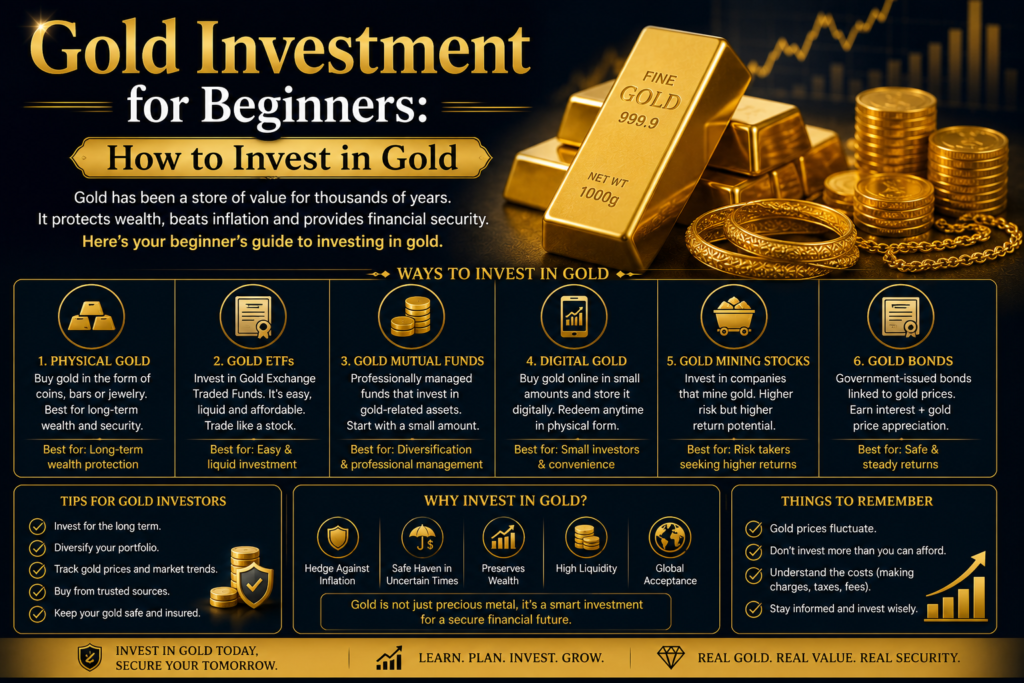
There are multiple ways to gain exposure to gold, each with different trade-offs in terms of cost, convenience, security, and counterparty risk. Here is every major option, explained clearly.| Method | Ownership | Best For | Risk Level |
|---|---|---|---|
| Gold Bars | Direct physical | Large investments, lowest premiums | Low |
| Gold Coins | Direct physical | Moderate investments, recognizability | Low |
| Gold ETFs | Paper (fund units) | Convenience, liquidity, small amounts | Low-Medium |
| Gold Mining Stocks | Equity shares | Leveraged gold exposure, dividends | High |
| Gold Futures | Contract-based | Professional traders only | Very High |
| Digital Gold | Vault-backed | Micro-investing, beginners | Medium |
| Sovereign Gold Bonds | Government-backed | India-specific, tax benefits | Very Low |
| Gold Jewelry | Direct physical | Dual-purpose (wear + invest) | Medium |
Investing in Physical Gold: Bars, Coins & Jewelry
Physical gold is the most traditional and widely held form of gold investment. It offers direct ownership with no counterparty risk — the gold is yours, in your possession, independent of any financial institution. Physical gold comes in three main forms: bars, coins, and jewelry.Gold Bars
Gold bars are the most cost-effective way to own physical gold. They carry the lowest premiums over spot price (typically 1-5% depending on size) and are available in sizes from 1 gram to 1 kilogram and beyond. Bars from LBMA-approved refiners (PAMP Suisse, Valcambi, Argor-Heraeus, Perth Mint, Royal Canadian Mint) are globally recognized and easily resold. Best for: Investors prioritizing maximum gold for their money. Larger bars (100g, 1kg) offer the lowest percentage premiums. Smaller bars (1g-20g) are more affordable but carry higher relative premiums. Bars require secure storage and may need assay testing when resold.Gold Coins
Gold bullion coins are minted by sovereign governments and carry guaranteed weight and purity. The most popular gold coins include the American Gold Eagle (22K), Canadian Gold Maple Leaf (24K), South African Krugerrand (22K), British Gold Britannia (24K), and Austrian Philharmonic (24K). Coins typically carry slightly higher premiums than bars (3-8%) but offer advantages: they are instantly recognizable, harder to counterfeit, and often exempt from certain tax reporting requirements. Best for: Investors who want recognizable, easily resold gold. Coins in 1 oz sizes offer the best liquidity. Fractional coins (1/2 oz, 1/4 oz, 1/10 oz) are convenient for smaller sales but carry higher premiums. Use our gold coin value calculator to compare coin premiums.Gold Jewelry — Is It an Investment?
Gold jewelry is the most common form of gold ownership globally, but it is not an efficient investment vehicle. Jewelry includes making charges (typically 5-25% of the gold value) that are almost entirely lost on resale. A gold chain bought for $1,000 may have a melt value of only $750. However, in countries like India where gold jewelry serves both cultural and financial purposes, it remains the dominant form of gold accumulation. Best for: Those who want to wear and enjoy their gold while it retains some investment value. Not recommended as a primary investment strategy. Use our jewelry value calculator to understand the investment value of jewelry versus its purchase price.Calculate Your Gold Investment Returns
Model different gold investment strategies — lump sum, dollar-cost averaging, and portfolio allocation — to see potential returns.
Investment Calculator → Gold Value Calculator →Paper Gold: ETFs, Futures & Digital Gold
“Paper gold” refers to financial products that track the gold price without requiring you to hold physical metal. These products offer convenience and liquidity but introduce counterparty risk — your gold exposure depends on the solvency and integrity of the issuing institution.Gold ETFs (Exchange-Traded Funds)
Gold ETFs are the most popular paper gold vehicle. They trade on stock exchanges like regular shares and track the gold price closely (minus management fees). Major gold ETFs include SPDR Gold Shares (GLD), iShares Gold Trust (IAU), and Aberdeen Physical Gold Shares (SGOL). ETFs are highly liquid, easy to buy and sell, and can be held in tax-advantaged accounts (IRAs, ISAs, RRSPs, TFSAs depending on your country). Annual expense ratios typically range from 0.12% to 0.50%. Best for: Investors who want gold exposure without storage concerns, need high liquidity, or want to hold gold in retirement accounts. Not suitable for those who prioritize direct ownership and zero counterparty risk.Gold Mining Stocks
Investing in gold mining companies offers leveraged exposure to gold prices. When gold rises 10%, mining stocks may rise 20-30% (or more) because mining company profits are highly sensitive to gold prices. However, this leverage works both ways. Mining stocks also carry company-specific risks: management quality, operational issues, geopolitical risk in mining jurisdictions, and debt levels all affect returns independently of gold prices. Best for: Experienced investors willing to accept higher volatility in exchange for potentially higher returns. Major gold miners include Newmont, Barrick Gold, Agnico Eagle, and Franco-Nevada (royalty company). Gold ETFs like GDX provide diversified mining exposure.Digital Gold Platforms
Digital gold platforms allow investors to buy fractional amounts of physical gold stored in professional vaults. Companies like BullionVault, GoldMoney, and various country-specific platforms (HelloGold in Malaysia, Paytm Gold in India) have made gold investing accessible with very small minimum investments. The gold is allocated to you and stored in secure vaults, but you rely on the platform’s operational integrity. Best for: Beginners, micro-investors, and those who want the benefits of physical gold ownership without handling and storing it themselves. Verify platform reputation, storage arrangements, and fee structures carefully.Understanding Gold Investment Costs
Every form of gold investment involves costs that affect your net returns. Understanding these costs upfront prevents unpleasant surprises when you buy or sell.| Cost Type | Typical Range | Applies To |
|---|---|---|
| Dealer Premium (Buy) | 1-8% above spot | Physical bars, coins |
| Buy-Back Spread (Sell) | 1-5% below spot | Physical bars, coins |
| ETF Expense Ratio | 0.12-0.50% annually | Gold ETFs |
| Storage Fees | 0.3-1.5% annually | Vault storage, digital gold |
| Insurance | 0.2-0.5% annually | Physical gold (home/vault) |
| Making Charges | 5-25% of gold value | Gold jewelry |
| Taxes (Capital Gains) | Varies by country (0-28%) | All gold (on profitable sales) |
| VAT / GST / Sales Tax | 0-15% depending on country | Physical gold (varies by country) |
Gold Investment Strategies for Beginners
Dollar-Cost Averaging (DCA)
Dollar-cost averaging — investing a fixed amount regularly regardless of the gold price — is the best strategy for beginners. By buying the same dollar amount each month, you automatically buy more gold when prices are low and less when prices are high. This smooths out price volatility and removes the stress of trying to time the market. DCA is ideal for long-term gold accumulation. Example: Investing $200 per month in a gold ETF or digital gold platform. Over 10 years, you invest $24,000. If gold averages 7% annual returns, your investment would grow to approximately $34,600 — all achieved with no market timing required. Use our gold investment calculator to model your DCA strategy.The 5-15% Portfolio Allocation
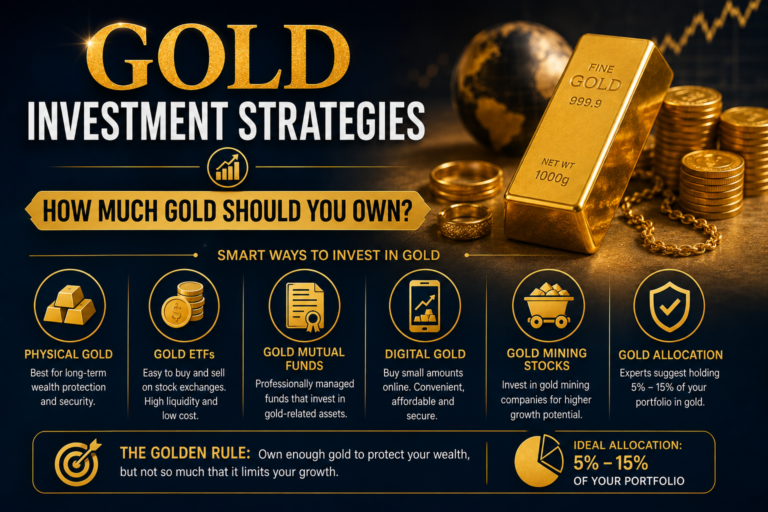
Most financial advisors and research (including the World Gold Council) suggest allocating 5-15% of your investment portfolio to gold. The exact percentage depends on your risk tolerance, economic outlook, and local currency stability. Conservative investors in countries with stable currencies might allocate 5%. Investors concerned about inflation or living in countries with volatile currencies might allocate 10-15%.Physical + Paper Combination
Many experienced gold investors use a hybrid approach: physical gold (coins and small bars) for long-term wealth preservation and emergency access, combined with gold ETFs or digital gold for portfolio rebalancing and tactical allocation. This provides the security of direct ownership with the convenience of paper gold.Risks of Gold Investing
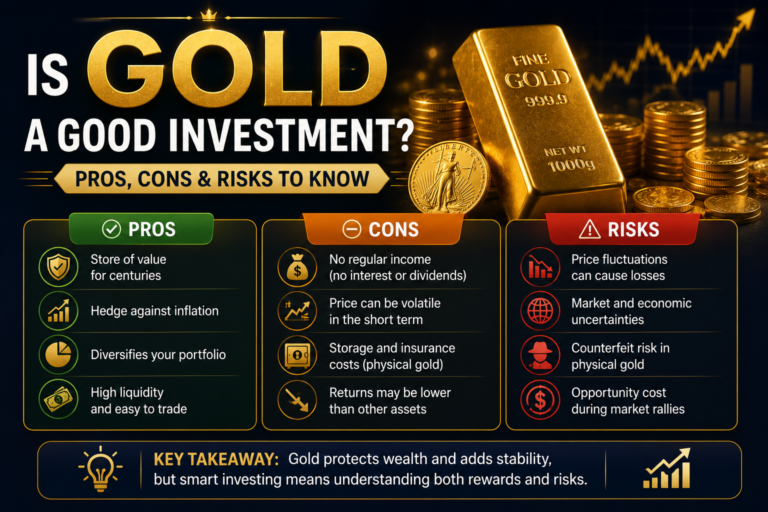
- Price volatility: Gold can experience significant price swings. From 2011 to 2015, gold fell 44%. Investors need the stomach to hold through corrections.
- No yield: Gold pays no interest or dividends. Your total return depends entirely on price appreciation. This is the trade-off for gold’s safety and inflation-hedging properties.
- Storage and insurance costs: Physical gold requires secure storage and insurance, which add ongoing costs that reduce net returns.
- Counterparty risk (paper gold): ETFs, digital gold platforms, and futures introduce institutional risk. In a severe financial crisis, these vehicles may not perform as expected.
- Theft risk: Physical gold held at home is vulnerable to theft. Professional vault storage mitigates this risk but adds cost.
- Liquidity risk: While gold is generally liquid, selling large quantities of physical gold quickly may result in less favourable pricing than selling ETF shares.
Frequently Asked Questions About Gold Investing
How much gold should a beginner buy?
Start small. A 5-10 gram gold bar or a 1/10 oz gold coin is an excellent first purchase. This lets you experience the buying process, understand premiums and storage, and build confidence before making larger investments. There is no minimum amount — even micro-investments through digital gold platforms (as little as $10) can begin your gold journey.Is it better to buy gold coins or bars?
For pure investment, bars offer lower premiums — you get more gold for your money. For recognizability, ease of resale, and potential tax advantages, coins are often better. A mix of both is common. For 1 oz purchases, coins and bars are similarly priced. For larger purchases (100g+), bars are significantly cheaper per gram.Should I buy physical gold or a gold ETF?
Physical gold offers direct ownership with no counterparty risk. Gold ETFs offer convenience, liquidity, and the ability to hold gold in tax-advantaged retirement accounts. Many investors use both: physical gold for core long-term holdings, ETFs for portfolio rebalancing and tactical allocation.What is the best gold coin for beginners?
The 1 oz American Gold Eagle, Canadian Gold Maple Leaf, or South African Krugerrand are the most popular and liquid gold coins globally. They are recognized everywhere, easy to buy and sell, and carry moderate premiums. For smaller budgets, 1/10 oz or 1/4 oz coins are excellent starting points.How do I store gold safely?
Options include: home safe (bolted down, fireproof), bank safe deposit box (affordable but limited access), professional vault storage (highest security, insured, ~0.3-1% annually), or allocated storage through a dealer. Never store significant gold in obvious places or tell many people about your holdings.When should I sell my gold?
Gold is best viewed as a long-term holding — a form of insurance, not a trading vehicle. Consider selling when: you need the cash for a specific purpose, gold has become an outsized portion of your portfolio (rebalancing), or your original reason for buying gold no longer applies. Avoid panic selling during price dips — gold corrections are normal and historically temporary.Do I pay tax on gold profits?
In most countries, yes — gold profits are subject to capital gains tax. In the US, physical gold is taxed as a collectible at up to 28%. In the UK, gold coins that are legal tender (Britannias, Sovereigns) are CGT-free. In India, holding gold for over 3 years qualifies for long-term capital gains tax with indexation benefits. Tax laws vary significantly by country — consult a local tax professional.
About the author