Is Gold a Good Investment? An Honest Assessment
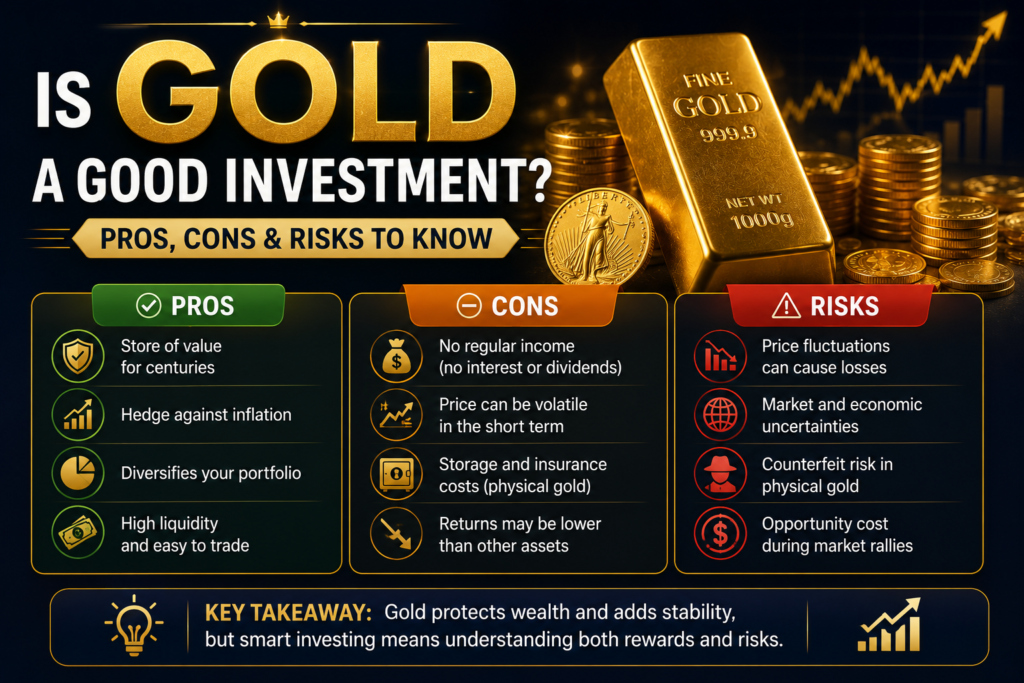
The question “is gold a good investment?” does not have a simple yes or no answer. Gold is an exceptional investment for specific purposes — preserving wealth, hedging against inflation, diversifying a portfolio, and providing insurance against economic crises. It is a poor investment for other purposes — generating income, chasing short-term gains, or replacing a growth-oriented stock portfolio. This guide provides a balanced, evidence-based assessment of gold as an investment. We examine the pros, cons, risks, historical performance data, and the specific scenarios where gold excels — and where it falls short. By the end, you will know whether gold belongs in your portfolio and, if so, in what proportion.The Bottom Line Up Front: Gold is a wealth preservation asset, not a wealth creation asset. It protects what you have rather than growing what you have. For a balanced portfolio, most financial advisors recommend allocating 5-15% to gold. Gold has delivered positive returns over every 15-year rolling period since 1971. It has also experienced multiple drawdowns of 40%+ — it is not a smooth ride.
The Pros: 8 Reasons Gold Is a Good Investment
1. Inflation Protection That Actually Works
Gold is one of the most reliable hedges against inflation available to individual investors. When paper currencies lose purchasing power — as they have in every fiat currency system in history — gold tends to maintain or increase its real value. During the high-inflation 1970s, when US CPI averaged 7.1% annually, gold delivered annualized returns of over 30%. During the 2020-2023 inflation surge, gold reached new all-time highs. This is not coincidence — it is a fundamental property of an asset with tightly constrained supply facing growing demand. Central banks cannot print gold. Its supply grows at roughly 1.5% annually, regardless of economic conditions or policy decisions. For a deeper understanding of why gold holds value, read our guide on why gold is valuable.2. Portfolio Diversification That Reduces Risk
Gold has a low or negative correlation with stocks and bonds over most time periods. This means that when equities fall, gold often rises or holds its value — providing a cushion for your overall portfolio. The World Gold Council’s research shows that adding 5-10% gold to a standard 60/40 stock-bond portfolio has historically improved risk-adjusted returns. The 2008 financial crisis provides a stark example: while the S&P 500 fell 38%, gold rose 5%. In 2022, when both stocks and bonds fell simultaneously (the worst year for a 60/40 portfolio in decades), gold was essentially flat — preserving capital while traditional diversification failed.3. No Counterparty Risk — Truly Your Asset
Physical gold is one of the few assets with zero counterparty risk. A gold bar in your possession does not depend on any bank’s solvency, any government’s promise, or any company’s management. It is a tangible asset — you can hold it, store it, transport it, and pass it to your heirs without intermediaries. In a world where most wealth exists as digital entries in institutional databases, physical gold represents true financial sovereignty.4. Universal Liquidity — Valued Everywhere
Gold is instantly recognizable and universally valued in every country on Earth. You can sell a gold coin in Mumbai, New York, London, Dubai, or Shanghai and receive fair market value within hours. This universal liquidity is unique among assets — try selling real estate, fine art, or even stocks with the same speed and certainty in a foreign country.5. Central Banks Are Buying — Follow the Smart Money
Central banks globally have been net buyers of gold every year since 2010, collectively holding over 35,000 tonnes. The largest recent buyers include China, Poland, India, Turkey, and Singapore. These are the institutions responsible for managing paper currencies — and they are choosing to hold gold. When the people who print money are buying gold, individual investors should pay attention.6. Long-Term Track Record of Positive Returns
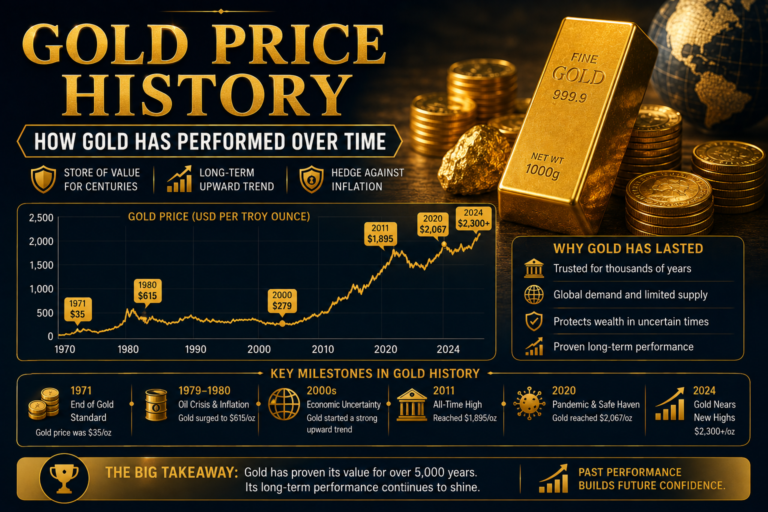
Gold has delivered positive returns over every 15-year rolling period since the US abandoned the gold standard in 1971. From $35 per ounce in 1971 to over $2,000 today, gold has appreciated approximately 57x — a compound annual growth rate of roughly 8%. Over 20 years (2004-2024), gold returned approximately 474%, or about 9.1% annualized. These are not speculative returns — they are consistent, long-term appreciation.7. Crisis Insurance for Your Portfolio
Gold serves as financial insurance against extreme events: currency crises, sovereign debt defaults, banking system failures, wars, and geopolitical disruptions. Like all insurance, you hope never to need it — but if you do, you will be grateful to have it. During the 2008 global financial crisis, the 2020 COVID pandemic, and the 2022 Russian invasion of Ukraine, gold preserved wealth while other assets experienced extreme volatility.8. Tangible Asset in a Digital World
In an era where most wealth exists as digital entries, physical gold provides something unique: a real asset you can touch, hold, and verify independently. It requires no internet connection, no password, no functioning banking system. This tangibility has psychological value — gold owners consistently report feeling more financially secure — and practical value in scenarios where digital systems fail.The Cons: 7 Reasons Gold Might Not Be Right for You
1. No Yield — Gold Pays No Interest or Dividends
Gold is a sterile asset — it produces no income. Unlike stocks (dividends), bonds (interest), or real estate (rent), gold’s total return depends entirely on price appreciation. If gold’s price is flat for a decade, your return is zero — minus storage and insurance costs. This is the fundamental trade-off for gold’s safety: you sacrifice yield for security. This is particularly relevant when interest rates are high. If you can earn 5% on a government bond or savings account, gold’s lack of yield becomes a significant opportunity cost. This explains why gold prices often struggle during periods of high real interest rates.2. Significant Price Volatility
Despite its reputation as a “safe” asset, gold can be highly volatile in the short to medium term. Gold has experienced multiple corrections of 20-40% in the modern era. From its 2011 peak of $1,895 to its 2015 low of $1,050, gold lost 44% of its value — and took nearly 9 years to reclaim its previous high. Investors who bought near the 2011 peak experienced a lost decade of returns.| Gold Drawdown | Peak to Trough | Recovery Time |
|---|---|---|
| 1980–2000 Bear Market | $850 → $255 (-70%) | ~28 years to reclaim $850 |
| 2011–2015 Correction | $1,895 → $1,050 (-44%) | ~9 years to reclaim $1,895 |
| 2020 Flash Crash | $1,700 → $1,450 (-15%) | ~3 months |
| 2022 Correction | $2,050 → $1,630 (-20%) | ~14 months |
3. Storage and Insurance Costs
Physical gold requires secure storage, which costs money. Home safes ($100-1,000+), bank safe deposit boxes ($50-300/year), or professional vault storage (0.3-1.5% annually) all reduce net returns. Insurance adds another 0.2-0.5% annually. For a $10,000 gold holding in professional vault storage, expect to pay $50-200 per year in combined storage and insurance costs.4. Dealer Premiums Reduce Returns
When you buy physical gold, you pay a dealer premium above the spot price — typically 1-8% depending on the product. When you sell, you receive slightly below spot. This bid-ask spread means gold must appreciate by 2-10% just to break even on a physical gold investment. Gold ETFs and digital gold have lower transaction costs but introduce counterparty risk.5. Tax Treatment Can Be Punitive
In many countries, gold is taxed less favourably than stocks or bonds. In the United States, physical gold is classified as a collectible and taxed at a maximum rate of 28% on long-term gains — significantly higher than the 15-20% rate for stocks. In other countries, gold may be subject to VAT/GST, wealth taxes, or import duties. Always understand the tax implications in your jurisdiction before investing.6. Underperformance During Strong Economic Growth
Gold tends to underperform during periods of strong economic growth, low inflation, and rising interest rates. From 2013 to 2015, as the US economy recovered and the Fed signalled rate hikes, gold fell over 40% while the S&P 500 rose 50%+. If your investment thesis is built on continued economic prosperity and stable inflation, gold may not be the best allocation.7. No Compounding or Reinvestment
Unlike stocks (where dividends can be reinvested to buy more shares) or real estate (where rent can pay down a mortgage), gold’s returns do not compound organically. Your 1-ounce gold coin will always be 1 ounce. Its value may increase over time, but the quantity never grows through dividends, splits, or distributions.Gold vs Other Investments: A Comparison
| Feature | Gold | Stocks | Real Estate | Bonds |
|---|---|---|---|---|
| Income | None | Dividends | Rental income | Interest |
| Counterparty Risk | None (physical) | Company risk | Tenant, market risk | Issuer default risk |
| Liquidity | Very high | Very high | Low | High |
| Storage Cost | 0.3-1.5%/yr | None (digital) | 1-3% of value/yr | None (digital) |
| Inflation Hedge | Excellent | Good (long-term) | Excellent | Poor (fixed rate) |
| 20-Yr Annual Return | ~9.1% | ~10% (S&P 500) | ~4-8% (varies) | ~3-5% |
Who Should — and Should Not — Invest in Gold
Gold Is a Good Investment If You Are:
- A long-term investor seeking portfolio diversification and wealth preservation across decades
- Concerned about inflation eroding the purchasing power of your cash and bond holdings
- Worried about currency risk, particularly if you live in a country with a weakening currency
- Building a balanced portfolio and want an asset with low correlation to stocks and bonds
- Seeking financial insurance against extreme events — currency crises, sovereign defaults, banking failures
- Saving for intergenerational wealth transfer — gold’s permanence makes it an excellent inheritance asset
Gold Is NOT a Good Investment If You Are:
- Seeking short-term gains — gold is not a get-rich-quick vehicle
- Depending on investment income — gold pays no dividends or interest
- Unwilling to tolerate 20-40% drawdowns — gold corrections are normal and can last years
- Investing money you may need within 3-5 years — gold is a long-term asset
- Unable to store physical gold securely — paper gold alternatives carry different risks
- Looking to replace a growth stock portfolio — gold complements stocks; it does not replace them
How Much Gold Should You Own?
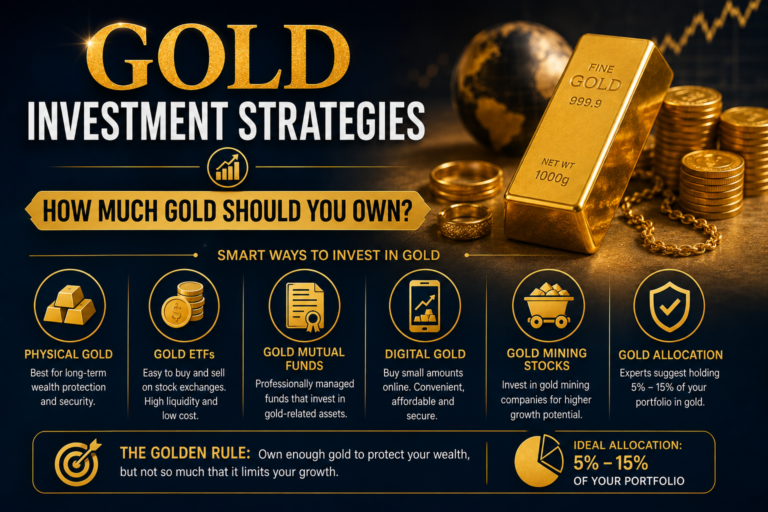
Most financial research suggests a 5-15% allocation to gold within a diversified portfolio. The World Gold Council’s analysis shows that this range has historically improved risk-adjusted returns. The exact percentage depends on your circumstances:- 5% — Conservative baseline: Suitable for investors in stable economies who want modest diversification and inflation protection.
- 10% — Balanced allocation: The most commonly recommended percentage. Provides meaningful diversification and insurance without significantly reducing growth potential.
- 15%+ — Inflation/currency concern: Appropriate for investors in countries with high inflation, weakening currencies, or political instability. Also suitable for those who believe we are entering a prolonged inflationary period.
Calculate Your Gold Investment Potential
Model different gold investment strategies to see how gold could perform in your portfolio over time.
Investment Calculator → Gold Value Calculator →Frequently Asked Questions About Gold as an Investment
Is gold a good investment in 2024?
Gold’s attractiveness depends on the economic environment, not the calendar year. In 2024, with persistent inflation concerns, geopolitical tensions, central bank buying at record levels, and potential interest rate cuts on the horizon, gold presents a compelling case for portfolio inclusion. However, gold’s role is consistent across years — it is a long-term wealth preservation asset, not a short-term trade based on current conditions.What is the biggest risk of investing in gold?
The biggest risk is opportunity cost during strong equity bull markets. During periods like 2013-2015 or the late 1990s, gold can underperform stocks by 50% or more. The second biggest risk is buying near a cyclical peak and being forced to sell during a correction. Gold requires a long time horizon — ideally 10+ years — to reliably deliver positive returns.Can gold make you rich?
Gold is unlikely to “make you rich” in the way that successful stock picking, entrepreneurship, or real estate development can. Gold’s historical annualized return of 7-9% can build significant wealth over decades through compound appreciation, but it is not a path to rapid wealth creation. Gold protects and gradually grows wealth — it does not multiply it quickly.Is gold safer than stocks?
Gold is safer than stocks in the sense that it has never gone to zero, has preserved purchasing power across centuries, and tends to perform well during the periods when stocks perform worst. However, gold is not “safe” in the sense of being low-volatility — it can and does experience 20-40% drawdowns. Government bonds are lower-risk in the short term; gold is lower-risk in the long term and during systemic crises.Should I buy gold now or wait for a price drop?
Timing any market is notoriously difficult, and gold is no exception. For long-term investors, dollar-cost averaging — investing a fixed amount regularly regardless of price — removes the stress and risk of timing. If you believe gold belongs in your portfolio (and you should have conviction about this before investing), the best time to start is now, in a measured, consistent way.What is better: physical gold or a gold ETF?
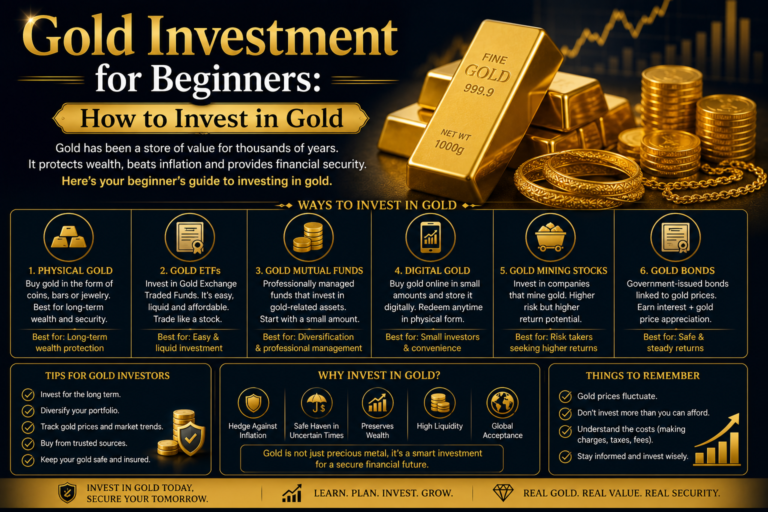
Physical gold offers direct ownership with no counterparty risk. Gold ETFs offer convenience, liquidity, and lower transaction costs. Many investors use both: physical gold for core long-term holdings (the “insurance” portion of your gold allocation) and ETFs for tactical allocation and portfolio rebalancing. For a complete comparison, read our gold investment for beginners guide.Does gold perform well during a recession?
Gold has historically performed well during recessions, particularly those accompanied by financial system stress, high inflation, or aggressive monetary easing. During the 2008 financial crisis, gold rose while stocks collapsed. During the 2020 COVID recession, gold reached all-time highs. However, gold’s recession performance depends on the nature of the recession — it performs best when confidence in the financial system is shaken and central banks respond with accommodative policy.
About the author