Why Is Gold Valuable? Understanding Gold’s Enduring Worth
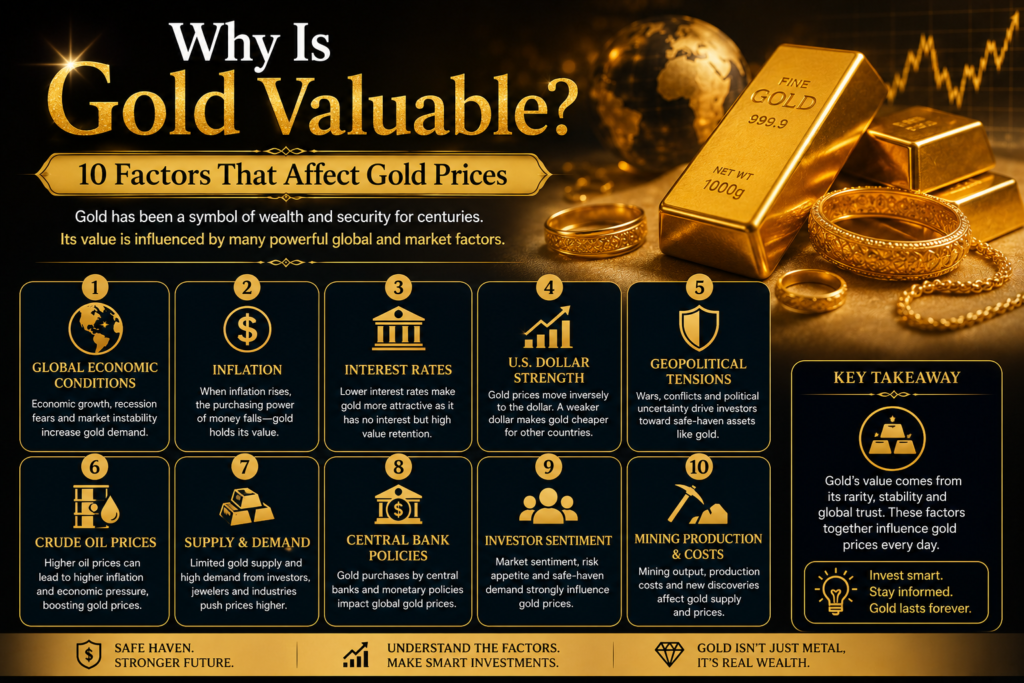
Gold has held value for over 6,000 years — longer than any currency, empire, or financial system in human history. But why is gold valuable? The answer is not simply “because it’s rare” or “because people like it.” Gold’s value stems from a unique convergence of physical properties, economic fundamentals, historical precedent, and collective human agreement that no other asset has replicated. This guide examines the 10 key factors that give gold its value and drive gold prices in global markets. Understanding these factors helps you make informed decisions about buying, selling, and investing in gold — whether you are purchasing jewelry, trading bullion, or allocating a portion of your portfolio to precious metals.Gold’s Value in Numbers: • All the gold ever mined: approximately 205,000 tonnes — fits into a 23-meter cube • Annual mine production: ~3,000 tonnes — adds only ~1.5% to existing supply annually • Central bank gold reserves: 35,000+ tonnes held globally • Gold has outperformed inflation over every 50-year rolling period since 1971 • The gold price has risen from $35/oz in 1971 to over $2,000/oz today — a 57x increase
1. Scarcity: Limited Supply, Growing Demand
Scarcity is the foundation of gold’s value. Unlike paper currency, which central banks can create at will, gold cannot be manufactured, synthesized, or printed. All the gold that exists was created in supernova explosions billions of years ago and deposited in Earth’s crust. What we have is what we have. Global gold production adds only about 3,000 tonnes per year — approximately 1.5% of existing above-ground stocks. New gold discoveries are increasingly rare: the last major gold rush was in the 1890s. Most of the world’s accessible gold deposits have already been found and mined. The remaining deposits are deeper, lower-grade, and more expensive to extract. Meanwhile, global demand continues to grow. India and China — representing over 2.8 billion people — have deep cultural gold traditions and rapidly expanding middle classes. Central banks have been net buyers of gold every year since 2010. Technology applications for gold in electronics and medicine continue to expand. Supply is constrained; demand is not.2. Durability: Gold Lasts Forever
Gold is chemically nearly indestructible. It does not rust, corrode, tarnish, or degrade under any natural environmental conditions. Gold artifacts recovered from ancient Egyptian tombs, sunken Spanish galleons, and buried Viking hoards emerge in near-pristine condition after thousands of years. This permanence has profound economic implications. Nearly all the gold ever mined still exists — whether in jewelry, bullion bars, central bank vaults, or electronic components. Unlike oil (which is burned), wheat (which is consumed), or steel (which rusts), gold’s supply is permanent. Every ounce mined adds to the cumulative human gold stock. This means gold is not just scarce today — it becomes relatively scarcer as population and wealth grow while the gold supply remains fixed.3. Universal Acceptance: Valued Everywhere on Earth
Gold is universally recognized and valued in every country, culture, and economic system on the planet. There is no currency risk with gold. A gold coin in Mumbai has the same value as one in New York, London, or Tokyo. This universal acceptance is unique — no other asset, currency, or commodity enjoys truly global, borderless recognition. This universality means gold functions as a global currency without a government. It requires no central bank guarantee, no legal tender law, and no institutional backing. People value gold because other people value gold — a self-reinforcing consensus that has held for six millennia. In countries with unstable currencies, capital controls, or limited banking access, gold is often the preferred — and sometimes the only reliable — store of value.4. No Counterparty Risk: You Own It, It’s Yours
Physical gold is one of the few assets with zero counterparty risk. When you hold a gold bar or coin, its value does not depend on any institution’s promise, any government’s solvency, or any company’s management. It is a tangible asset — you can hold it, store it, transport it, and pass it to your heirs without intermediaries. Compare this to other assets: stocks depend on corporate performance and management integrity; bonds depend on the issuer’s ability to repay; bank deposits depend on the bank’s solvency and government deposit insurance; real estate depends on property rights enforcement and market liquidity. Gold’s value is self-contained — it exists independently of any third party’s promise or performance.5. Inflation Hedge: Preserving Purchasing Power
Gold is historically one of the most reliable hedges against inflation. When the purchasing power of paper currency declines — as it has in every fiat currency system in history — gold tends to maintain or increase its real value. Consider this: in 1971, an ounce of gold cost $35. A high-quality men’s suit also cost about $35. Today, an ounce of gold trades at over $2,000 — and a comparable high-quality men’s suit costs roughly $2,000. Gold has preserved its purchasing power while the dollar has lost over 98% of its value relative to gold. This is not a coincidence — it is the mechanism by which gold functions as a store of value across generations.Gold vs. Inflation: Key Examples • During the high-inflation 1970s (CPI averaging 7.1%), gold rose from $35 to $850/oz — a 2,329% increase • During 2020-2023, as US inflation peaked at 9.1%, gold reached new all-time highs • Over 50 years (1971-2021), US CPI increased ~600%. Gold increased ~5,700% • Gold’s purchasing power relative to oil, wheat, and real estate has remained remarkably stable over centuries
6. Interest Rates: The Opportunity Cost of Gold
Interest rates are one of the most immediate drivers of gold prices because they determine the opportunity cost of holding gold. Gold pays no interest or dividends — its return comes entirely from price appreciation. When interest rates are high, investors can earn significant yield from bonds and savings accounts, making non-yielding gold less attractive. When interest rates are low or negative, gold becomes relatively more attractive. This relationship explains much of gold’s price action over the past two decades. Gold’s historic bull run from 2001-2011 coincided with the Federal Reserve cutting rates from 6.5% to near zero and maintaining them there for years after the 2008 financial crisis. The 2020 gold price surge to record highs occurred as the Fed slashed rates to zero and launched massive quantitative easing. Conversely, the Fed’s aggressive rate hikes in 2022 created headwinds for gold. Real interest rates (nominal rates minus inflation) are particularly important. When real rates are negative — meaning inflation exceeds interest rates — gold tends to perform strongly because holding cash or bonds guarantees a loss of purchasing power.7. US Dollar Strength: The Currency Relationship
Gold is priced globally in US dollars. This creates an inverse relationship: when the dollar strengthens against other currencies, gold becomes more expensive for non-US buyers, reducing global demand. When the dollar weakens, gold becomes cheaper for international buyers, increasing demand. The US Dollar Index (DXY), which measures the dollar against a basket of major currencies, is one of the most closely watched indicators by gold traders. Periods of dollar weakness — such as 2002-2008 and 2017-2018 — have coincided with strong gold rallies. Periods of dollar strength — such as 2014-2015 and 2022 — have created headwinds for gold prices. However, this relationship is not absolute. During periods of extreme global uncertainty, both the dollar and gold can rise simultaneously as investors seek safety in both assets. This occurred during the 2008 financial crisis and the 2020 COVID pandemic.8. Central Bank Demand: The Ultimate Vote of Confidence
Central banks are among the world’s largest gold buyers, collectively holding over 35,000 tonnes of gold — approximately 17% of all above-ground gold. When central banks buy gold, it sends a powerful signal: the institutions responsible for managing paper currencies are choosing to hold gold as a reserve asset. Since 2010, central banks have been net buyers of gold every year. The largest recent buyers include China, Poland, India, Turkey, and Kazakhstan. These purchases represent a strategic shift away from US dollar reserves toward gold — a trend that accelerated after Western sanctions on Russia’s foreign reserves in 2022 demonstrated the political risk of holding reserves in other countries’ currencies.Top Central Bank Gold Holdings (approximate): • United States: 8,133 tonnes — the largest gold reserve in the world • Germany: 3,352 tonnes • Italy: 2,452 tonnes • France: 2,437 tonnes • Russia: 2,333 tonnes • China: 2,192 tonnes (officially; actual holdings may be higher) • India: 800+ tonnes (with significant recent additions)
9. Geopolitical Uncertainty: The Crisis Hedge
Gold is often called a “safe-haven” asset because it tends to hold or increase its value during periods of geopolitical crisis, war, terrorism, and economic turmoil. When the world becomes uncertain, investors and individuals turn to gold — an asset that has survived every crisis in human history. This pattern has repeated consistently. Gold spiked during the 1979 Iranian Revolution and Soviet invasion of Afghanistan. It surged after 9/11. It rallied during the 2008 global financial crisis. It reached record highs during the 2020 COVID pandemic. And it strengthened during the 2022 Russian invasion of Ukraine and subsequent sanctions. The reason is psychological as much as economic. In times of crisis, people seek assets that are tangible, portable, and independent of any government or financial system. Gold satisfies all three criteria. When confidence in institutions, governments, and financial systems wavers — gold’s appeal strengthens.10. Jewelry & Industrial Demand: The Consumption Factor
While investment demand drives gold’s price narrative, jewelry demand is the largest single source of gold consumption, accounting for approximately 45-50% of annual gold demand. India and China alone represent over 50% of global gold jewelry consumption. This demand is deeply cultural, driven by weddings, festivals, and traditions that span centuries. Jewelry demand provides a price floor for gold. When gold prices drop, jewelry demand typically increases as consumers take advantage of lower prices. This creates natural support levels in gold markets — a dynamic not present in purely financial assets. Additionally, technology and industrial applications account for approximately 8% of annual gold demand, using gold in electronics, medical devices, and satellite components.How Gold Prices Are Actually Set
Understanding the factors that influence gold prices is one thing — understanding how the price is actually determined in real time is another. The global gold price is set through two primary mechanisms:The London OTC Market & LBMA Gold Price
The London Bullion Market is the world’s largest wholesale gold market, with billions of dollars in gold trading hands daily. The LBMA Gold Price is set twice daily (10:30 AM and 3:00 PM London time) through an electronic auction process. This price serves as the global benchmark for gold contracts, central bank transactions, and physical gold pricing worldwide.COMEX Futures (New York)
The COMEX division of the CME Group in New York is the world’s largest gold futures exchange. COMEX gold futures trade nearly 24 hours a day and provide the continuous price discovery that feeds into gold dealer systems, ETF pricing, and retail gold platforms. The COMEX price is what you see when you check “live gold prices” on financial websites.Track Live Gold Prices & Calculate Value
See what gold is worth today and calculate the exact value of your gold holdings with our free tools.
Live Gold Prices → Gold Value Calculator → Investment Calculator →Frequently Asked Questions About Gold’s Value
Why is gold valuable when it has no practical use?
Gold actually has many practical uses — electronics, dentistry, medicine, aerospace — but its value primarily comes from its role as a store of value and medium of exchange, not its industrial utility. Gold’s value is based on its scarcity, durability, universal acceptance, and 6,000-year historical track record. This is similar to how paper currency has value — not because the paper itself is useful, but because of collective agreement and trust.What drives gold prices up or down?
The main drivers are: US dollar strength (weaker dollar = higher gold), interest rates (lower rates = higher gold), inflation (higher inflation = higher gold), central bank buying, geopolitical crises, and jewelry demand from India and China. Gold prices reflect the complex interaction of all these factors simultaneously.Is gold a good investment during a recession?
Historically, gold has performed well during recessions, particularly those accompanied by high inflation or financial system stress. During the 2008 financial crisis, gold rose while stocks and real estate collapsed. During the 2020 COVID recession, gold reached all-time highs. However, gold’s recession performance depends on the nature of the recession — it performs best when confidence in the financial system is shaken.Why do central banks hold gold?
Central banks hold gold as a diversification asset that is not dependent on any other country’s economic policy. Gold provides a hedge against currency depreciation, geopolitical risk, and financial system instability. It also signals national financial strength — a country with substantial gold reserves is seen as more creditworthy.How does inflation affect gold prices?
Inflation typically drives gold prices higher because gold preserves purchasing power when paper currencies lose value. During periods of high inflation (1970s, 2020-2023), gold has significantly outperformed inflation rates. However, the relationship is not mechanical — it depends on whether central banks raise interest rates enough to produce positive real (inflation-adjusted) returns on bonds.Does gold always go up in value?
No. Gold has experienced significant bear markets. From 1980 to 2000, gold fell from $850 to $255 — a 70% decline over 20 years. From 2011 to 2015, gold fell from $1,895 to $1,050 — a 44% decline. Gold is a long-term store of value, not a guaranteed short-term profit vehicle. Over multi-decade periods, gold has preserved and increased purchasing power.How does the US dollar affect gold prices?
Gold and the US dollar generally move in opposite directions. When the dollar weakens, gold becomes cheaper for buyers using other currencies, increasing demand. When the dollar strengthens, gold becomes more expensive internationally, reducing demand. The US Dollar Index (DXY) is one of the most important indicators for gold traders.What is the difference between gold’s spot price and its value?
The spot price is the wholesale price for one troy ounce of pure gold for immediate delivery. The value of a specific gold item is its gold content multiplied by the spot price, minus any discount for lower purity. For example, a 14K gold ring weighing 10 grams contains 5.83 grams of pure gold. Its melt value is 5.83 × (spot price per gram). Use our gold value calculator for exact valuations.
About the author