24K vs 22K vs 18K Gold: The Complete Comparison
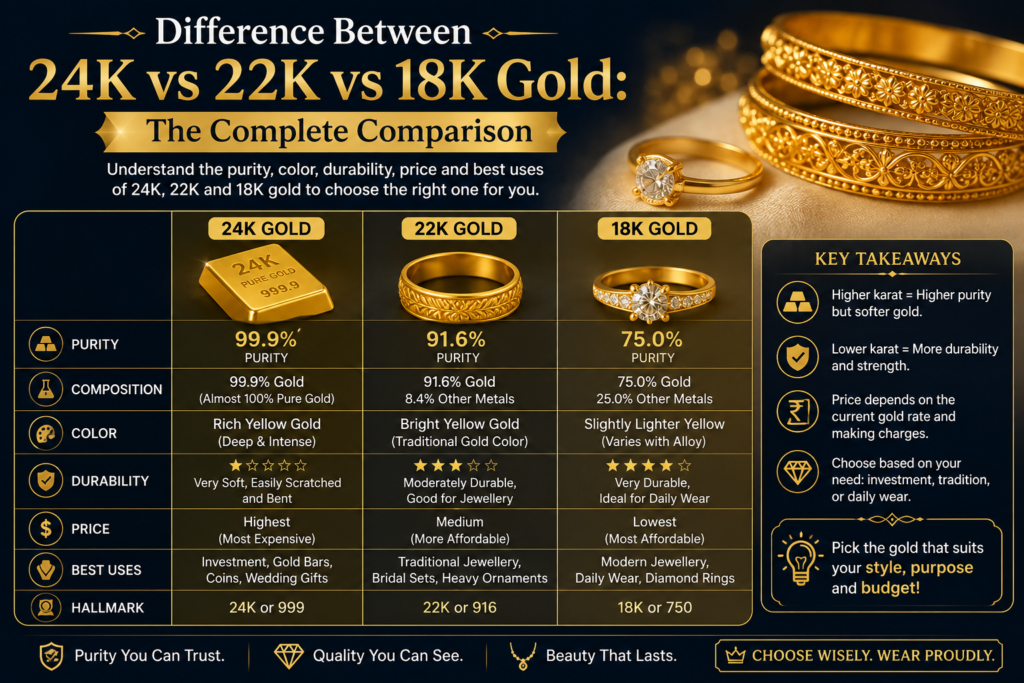
Choosing between 24K, 22K, and 18K gold is one of the most important decisions in gold buying. Each karat level represents a fundamentally different balance between purity, durability, colour, and value. This guide provides a detailed, side-by-side comparison to help you make the right choice whether you are buying jewelry, investing in bullion, or selling gold. The core difference is simple: 24K is pure gold (99.9%), 22K is 91.6% pure, and 18K is 75% pure. But the practical implications of these differences affect everything from how the gold looks and feels to how much it is worth and how long it will last. Understanding these trade-offs is essential for making informed gold purchases.Quick Summary: 24K vs 22K vs 18K Gold • 24K — Pure gold. Brightest colour, highest value, but too soft for daily jewelry. Best for investment. • 22K — 91.6% pure. Excellent colour, higher value, durable enough for traditional jewelry. Standard in India and Asia. • 18K — 75% pure. Warm colour, very durable, the luxury jewelry standard. Used by Cartier, Tiffany & Co., and Bvlgari.
Detailed Comparison: 24K, 22K, and 18K Gold
This table provides a comprehensive side-by-side view of the three most important gold purities. Use it as a quick reference when comparing gold items.| Feature | 24K Gold | 22K Gold | 18K Gold |
|---|---|---|---|
| Purity | 99.9% | 91.6% | 75.0% |
| Millesimal Mark | 999 / 999.9 | 916 | 750 |
| Gold Parts/24 | 24/24 | 22/24 | 18/24 |
| Alloy Content | 0.1% | 8.4% | 25% |
| Hardness (Mohs) | 2.5 — Very soft | ~3.0 — Moderate | ~3.5 — Durable |
| Colour | Deep yellow-orange | Bright yellow | Warm yellow |
| Scratch Resistance | Very low | Moderate | Good |
| Daily Wear Suitability | Not suitable | Limited (pendants, earrings) | Excellent |
| Resale Value | Highest (near spot) | Very high | High |
| Best For | Investment, special jewelry | Traditional jewelry, coins | Luxury jewelry, daily wear |
| Common Regions | China, Middle East, Thailand | India, Pakistan, Bangladesh | Europe, USA, luxury brands |
24K Gold: The Purest Form of Gold
24K gold is gold in its purest commercially available form — 99.9% pure gold with only trace amounts of other elements. It has a deep, rich yellow-orange colour that is unmistakable and cannot be replicated by any lower-karat alloy. This is the natural colour of gold as it comes from the earth. However, pure gold’s beauty comes with a significant practical limitation: it is extremely soft. At just 2.5 on the Mohs hardness scale, 24K gold can be scratched with a fingernail and bent with minimal pressure. A 24K ring worn daily would deform significantly within months. For this reason, 24K gold is almost never used for engagement rings or everyday jewelry in Western markets.Where 24K Gold Excels
- Investment bullion: 24K gold bars and coins (American Buffalo, Canadian Maple Leaf, Chinese Panda) contain the maximum gold per gram. They command the lowest premiums and the highest liquidity in global markets.
- Gold savings: In countries like China and Thailand, 24K gold is the standard for wealth preservation. Chinese “999” gold bars and ornaments are bought specifically for their investment value.
- Cultural jewelry: In parts of China, the Middle East, and Southeast Asia, 24K jewelry is worn for weddings and special occasions. These pieces are typically heavy, simple designs that are worn infrequently and stored carefully.
- Maximum resale value: When you sell 24K gold, you receive nearly the full spot price because there are no alloy metals to discount. The melt value is essentially the market value.
24K Gold at a Glance: • Purity: 99.9% (hallmarked 999) • Colour: Deep, rich yellow-orange • Durability: Very soft — not for daily-wear jewelry • Value: Highest — nearly 100% of gold spot price • Buy for: Investment, wealth preservation, cultural ornaments • Don’t buy for: Engagement rings, bracelets, everyday jewelry
22K Gold: The Traditional Standard
22K gold contains 22 parts pure gold and 2 parts other metals — typically silver, copper, or a combination. This small 8.4% alloy addition significantly improves hardness while retaining a bright yellow colour that is visually very close to 24K. Most people cannot distinguish between 22K and 24K gold by sight alone. 22K gold is the dominant standard for jewelry in India, where it accounts for over 70% of all gold jewelry sold. It is also the purity used in the world-famous South African Krugerrand, the first modern gold bullion coin. In the Middle East, Pakistan, Bangladesh, and Southeast Asia, 22K is the preferred purity for bridal jewelry and traditional ornaments.The Practical Sweet Spot
Many gold experts consider 22K to be the ideal balance between purity and practicality. It contains enough gold (91.6%) to serve as a genuine store of wealth — a 22K necklace is a real financial asset — while being hard enough to be worn as earrings, pendants, bangles, and occasional-wear rings. It is not, however, recommended for engagement rings or bracelets that face constant abrasion.Why 22K Dominates in India
India is the world’s largest gold consumer, and the preference for 22K is deeply cultural. Gold jewelry in India serves dual purposes: it is both adornment and a financial safety net. Indian families accumulate gold over generations as a form of inheritance and emergency savings. 22K provides high gold content for this savings function while being durable enough for the intricate designs of Indian jewelry craftsmanship.22K Gold at a Glance: • Purity: 91.6% (hallmarked 916) • Colour: Bright yellow — nearly identical to 24K visually • Durability: Moderate — suitable for pendants, earrings, bangles • Value: Very high — 91.6% of gold spot price • Buy for: Traditional jewelry, gold coins, wedding ornaments • Don’t buy for: Engagement rings worn daily, active wear jewelry
18K Gold: The Luxury Jewelry Standard
18K gold contains 75% pure gold and 25% alloy metals. This higher proportion of alloy metals makes 18K gold significantly harder and more durable than higher-karat alternatives while retaining a warm, rich gold colour that clearly distinguishes it from lower-karat jewelry. 18K gold is the standard for luxury jewelry worldwide. Every major luxury brand — Cartier, Tiffany & Co., Bvlgari, Van Cleef & Arpels, Harry Winston — uses 18K gold almost exclusively. It is also the most common purity for fine jewelry in Europe, where 18K has been the traditional standard for centuries.The Luxury Brand Standard
Luxury brands choose 18K for specific reasons. The 75% gold content provides genuine precious metal value — an 18K piece is a real asset, not a fashion accessory. The 25% alloy content allows jewelers to create intricate, detailed designs that would be impossible in softer high-karat gold. And the colour of 18K gold — whether yellow, white, or rose — has a depth and warmth that lower karats cannot match.18K for Engagement Rings
18K gold is an excellent choice for engagement rings and wedding bands. It is hard enough to withstand decades of daily wear while holding diamonds and gemstones securely. The higher gold content (compared to 14K) means it retains more intrinsic value and has a noticeably richer colour. The trade-off is that 18K rings cost more and may show light scratches slightly more readily than 14K.18K Gold at a Glance: • Purity: 75.0% (hallmarked 750) • Colour: Warm, rich yellow — also available in white and rose gold • Durability: Good — suitable for daily wear including rings • Value: High — 75% of gold spot price • Buy for: Engagement rings, luxury jewelry, fine watches • Don’t buy for: Maximum investment value (24K is better for that)
Gold Value Comparison: What Your Gold Is Worth
The resale value of gold is directly proportional to its purity. Here is how the three purities compare in terms of melt value — the actual gold content value at current market prices.| Weight | 24K Value | 22K Value (91.6%) | 18K Value (75%) |
|---|---|---|---|
| 1 Gram | 100% of spot | 91.6% of spot | 75% of spot |
| 5 Grams | 5 × spot price/g | 4.58 × spot price/g | 3.75 × spot price/g |
| 10 Grams | 10 × spot price/g | 9.16 × spot price/g | 7.5 × spot price/g |
| 1 Troy Ounce | Full spot price | 91.6% of spot | 75% of spot |
Calculate Your Gold’s Exact Value
Enter your gold’s weight and purity to get an instant, itemized valuation at today’s live gold price.
Gold Value Calculator → Melt Value Calculator →Which Gold Purity Should You Choose?
The right gold purity depends entirely on what you are buying and why. Here is a practical decision guide based on the most common gold purchasing scenarios.| Your Goal | Recommended Purity | Reason |
|---|---|---|
| Pure investment / wealth preservation | 24K bars or coins | Maximum gold per dollar, lowest premiums, most liquid |
| Traditional Indian / Asian jewelry | 22K | Cultural standard, excellent colour, high resale value |
| Engagement ring (daily wear) | 18K or 14K | Durable enough for decades of daily wear |
| Luxury branded jewelry | 18K | Standard for Cartier, Tiffany, Bvlgari, Van Cleef |
| Wedding jewelry (occasional wear) | 22K or 18K | 22K for tradition/value, 18K for design flexibility |
| Gift for children / active person | 14K or 10K | Hardest wearing, most affordable, still real gold |
| Sell scrap gold for cash | Any — higher is better | All gold has melt value; purity determines payout |
Colour Differences Between 24K, 22K, and 18K Gold
The colour of gold changes noticeably across different purities because of the different alloy metal compositions. Understanding these colour differences helps you identify gold purity by sight and make informed aesthetic choices.24K Gold Colour
24K gold has the deepest, richest yellow-orange colour — the natural colour of pure gold. It is unmistakably “gold” in appearance and has a slight orange undertone that lower karats lack. This colour is so distinctive that it is often described as “rich gold” or “pure gold colour” in jewelry contexts.22K Gold Colour
22K gold is bright yellow, very close to 24K in appearance. The small 8.4% alloy addition (typically silver or a silver-copper mix) slightly lightens the colour but most people cannot distinguish 22K from 24K by sight alone. The colour remains warm and rich.18K Gold Colour
18K gold has a noticeably lighter, more subtle yellow compared to 24K and 22K. The 25% alloy content — typically a mix of copper, silver, and sometimes palladium — tones down the intense yellow of pure gold. This is often considered more elegant and wearable for fine jewelry, especially in Western markets. 18K gold is also available in white gold (alloyed with palladium/nickel and rhodium-plated) and rose gold (extra copper for a pink hue).Frequently Asked Questions
Which is better: 24K or 22K gold?
Neither is universally “better” — it depends on your purpose. 24K is better for investment because it contains more gold per gram and commands higher resale value. 22K is better for jewelry because it is harder and more durable while retaining excellent gold colour and very high value. For investment, choose 24K. For traditional jewelry, choose 22K.Is 18K gold real gold?
Absolutely. 18K gold is 75% pure gold — it is very much real gold. Luxury brands like Cartier, Tiffany & Co., and Bvlgari use 18K gold almost exclusively. It is the standard for fine jewelry in Europe and among high-end jewelers worldwide. The 25% alloy content is added for durability and design flexibility, not to dilute value.Can I wear 24K gold every day?
No. 24K gold is far too soft for daily wear. Rings will bend, bracelets will deform, and the surface will accumulate scratches rapidly. 24K jewelry should be reserved for special occasions and stored carefully. For daily-wear jewelry, choose 18K or 14K gold.Does 22K gold tarnish?
22K gold tarnishes very little, if at all. The 91.6% gold content means only 8.4% of the metal can react with air or moisture. Over very long periods (decades), the copper or silver in the alloy may develop a slight patina, but this is minimal compared to lower-karat gold. A simple polish restores the original shine.Why is Indian gold 22K?
Indian gold jewelry serves dual purposes: adornment and financial savings. 22K provides high gold content (91.6%) for wealth preservation while being hard enough for traditional jewelry craftsmanship. It is deeply embedded in Indian culture — gold is both a financial safety net passed through generations and an essential part of wedding traditions.What is the difference between 22K and 18K gold price?
22K gold contains 91.6% pure gold, while 18K contains 75% pure gold. At the same weight, 22K gold is worth approximately 22% more than 18K gold based on melt value alone. For example, if 18K gold is worth $50 per gram, 22K gold of the same weight would be worth approximately $61 per gram. Use our gold value calculator for exact pricing at live rates.How can I tell 24K, 22K, and 18K gold apart?
Check the hallmark stamp: 999 or 999.9 = 24K, 916 = 22K, 750 = 18K. Visually, 24K is deepest orange-yellow, 22K is bright yellow, and 18K is lighter warm yellow. An acid test kit or electronic gold tester can provide definitive identification. Professional jewelers use XRF analysis for instant, non-destructive purity verification.Explore Our Free Gold Tools
Calculate values, check purity, convert karats, and track live prices — all free and private, no sign-up required.
Gold Value Calculator Purity Checker Live Gold Prices
About the author