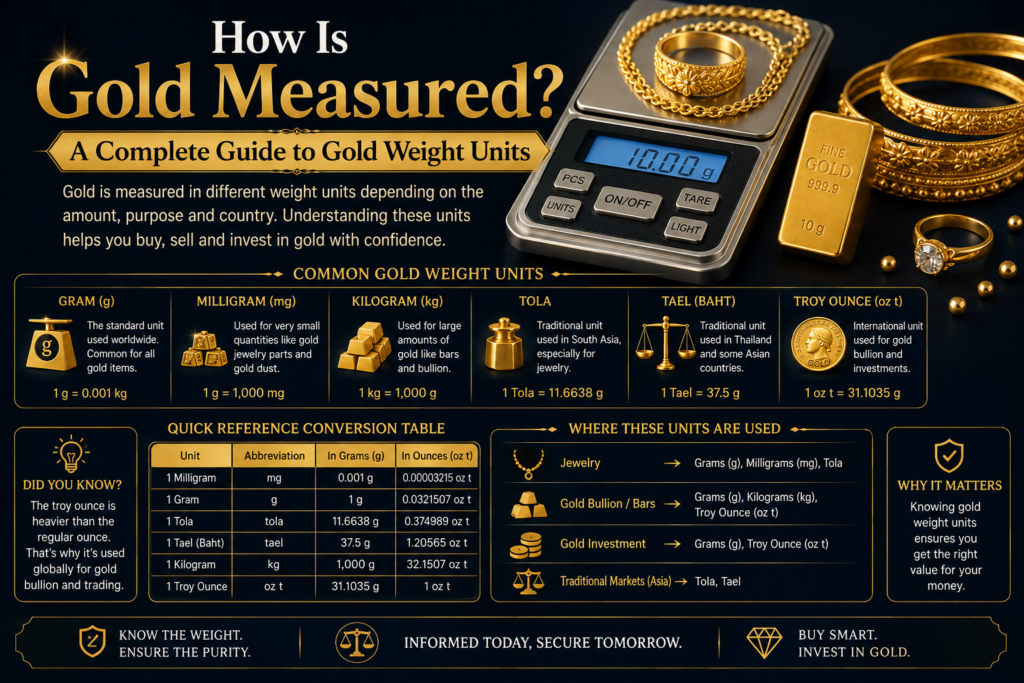
Key Takeaway: • The troy ounce (31.1035g) is the international standard — all gold prices are quoted per troy ounce • The gram is the most common retail unit globally for jewelry and small bars • The tola (11.66g) is the standard in India, Pakistan, and the Middle East • A regular ounce (28.35g) is never used for gold — always use troy ounces
The Troy Ounce: The Global Gold Standard
The troy ounce is the universal unit for pricing gold. Every gold price you see — whether on financial news, commodity exchanges, or gold dealer websites — is quoted in US dollars (or local currency) per troy ounce of pure gold. The troy ounce weighs exactly 31.1034768 grams. The troy weight system originated in the French city of Troyes during the Middle Ages, where it was used for weighing precious metals and gemstones at trade fairs. It was adopted by the British Royal Mint and later became the international standard through the London Bullion Market and COMEX.Troy Ounce vs Regular Ounce: The Critical Difference
This is the most common and costly mistake in gold measurement. A regular (avoirdupois) ounce — the one used for food, postal weights, and everyday items in the United States — weighs 28.3495 grams. A troy ounce weighs 31.1035 grams. The troy ounce is approximately 9.7% heavier than a regular ounce.⚠️ Warning: If someone quotes you an “ounce of gold” and does not specify “troy ounce,” clarify immediately. Using a regular ounce instead of a troy ounce would undervalue the gold by nearly 10%. Kitchen scales measure regular ounces — never use them for gold valuation. Always use a scale calibrated in grams or troy ounces.
Key Facts About the Troy Ounce
- Weight: 31.1034768 grams
- Used for: Gold, silver, platinum, palladium — all precious metals
- Symbol: oz t (to distinguish from regular oz)
- Subdivisions: 1 troy ounce = 20 pennyweight (dwt) = 480 grains
- Where quoted: COMEX, LBMA, all major gold exchanges, all gold price websites
The Gram: The Most Common Retail Unit
The gram is the standard metric unit for gold and is the most widely used unit in retail gold markets worldwide. Most gold jewelry is weighed and priced per gram, and small gold bars (1g, 5g, 10g, 20g, 50g) are sold in gram denominations. The gram is part of the International System of Units (SI) and is used universally across all countries that have adopted the metric system — which is virtually the entire world outside the United States. Gold prices per gram are calculated by dividing the troy ounce price by 31.1035. For example, if gold is trading at $2,000 per troy ounce, the price per gram is $2,000 ÷ 31.1035 = $64.30 per gram. This is the price for 24K pure gold — lower karat gold is worth proportionally less.Common Gram-Based Gold Products
- 1 gram bars: The smallest widely available gold bar — popular for gifting and micro-savings
- 5 gram bars: A common entry-level investment size, affordable but with moderate premiums
- 10 gram bars: One of the most popular gold bar sizes globally — a standard in India and China
- 20 gram bars: Popular in European and Middle Eastern markets
- 50 gram bars: A substantial investment bar with lower premiums than smaller sizes
- 100 gram bars: Professional investment grade — approximately 3.215 troy ounces
- Gold jewelry: Chains, rings, bangles, and earrings are all priced per gram plus making charges
The Kilogram: Large-Scale Gold Measurement
The kilogram (1,000 grams) is used for large gold bars and institutional gold trading. A 1 kilogram gold bar contains exactly 32.1507466 troy ounces of pure gold, making it a significant investment asset. At a gold price of $2,000 per troy ounce, a 1kg gold bar is worth approximately $64,300. Kilogram bars are the standard large-format bar for professional investors, gold dealers, and central banks (though central banks also hold the larger 400-ounce London Good Delivery bars). They offer the lowest premiums of any physical gold format because manufacturing costs are spread over a larger gold value.Key Facts About Gold Kilograms
- Weight: 1,000 grams = 32.1507 troy ounces
- Purity: Typically .9999 fine (99.99% pure gold)
- Dimensions: Roughly 117mm × 53mm × 8.9mm (varies by refiner)
- Premium: 0.5–2% above spot — the lowest of any physical format
- Best for: Professional investors, gold IRAs, institutional holdings
Convert Any Gold Weight Instantly
Switch between grams, troy ounces, tolas, taels, baht, and more with our free weight converter.
Weight Converter → Gold Value Calculator →The Tola: South Asia’s Gold Standard
The tola is the traditional gold weight unit of South Asia, used throughout India, Pakistan, Bangladesh, Nepal, and the Middle East. One tola equals exactly 11.6638038 grams, which is precisely 3/8 of a troy ounce. The tola originated in ancient India during the Vedic period and was standardized under British rule in 1833. In South Asian gold markets, prices are quoted per tola, not per gram or ounce. Gold bars are commonly produced in 1 tola, 5 tola, and 10 tola sizes. A 10 tola bar weighs 116.64 grams — approximately 3.75 troy ounces. When you see gold prices in Indian rupees (INR) or Pakistani rupees (PKR), the quoted rate is typically per tola for 24K gold.Why the Tola Remains Important
Despite the global dominance of the metric system and troy ounces, the tola persists because gold is deeply cultural in South Asia. Generations of families have bought and sold gold in tolas. Jewelry is weighed in tolas. Inheritance is measured in tolas. Changing to grams would require a cultural shift that has not happened despite decades of metrication efforts.Key Tola Conversions
- 1 tola = 11.6638 grams
- 1 tola = 0.375 troy ounces (exactly 3/8 oz t)
- 1 tola = 7.5 pennyweight (dwt)
- 10 tolas = 116.64 grams (a standard gold bar in South Asia)
- 1 troy ounce = 2.6667 tolas
- 1 gram = 0.08574 tolas
Tola Quick Reference: If gold is ₹60,000 per 10 grams (a common Indian quote), it is approximately ₹69,984 per tola. Our weight converter handles all tola conversions instantly.
The Tael: Chinese Gold Measurement
The tael is a traditional Chinese weight unit still used in gold markets throughout China, Hong Kong, Taiwan, and Chinese communities in Southeast Asia. One tael equals approximately 37.7994 grams in Hong Kong and most international gold markets, though different regions have slight variations. The tael is approximately 21.5% heavier than a troy ounce. In Hong Kong gold shops, prices are often displayed per tael alongside per-gram prices. Chinese gold bars and ornaments are frequently cast in tael denominations. The tael originated during the Han Dynasty as a unit for measuring grain and was later adopted for silver and gold during the Tang and Song dynasties.Key Tael Conversions
- 1 tael (Hong Kong gold standard) = 37.7994 grams
- 1 tael = 1.2153 troy ounces
- 1 tael = 3.24 tolas
- 1 troy ounce = 0.8229 taels
- Regional variations: Mainland China (31.25g for some purposes), Taiwan (37.5g), Singapore/Malaysia (37.8g)
The Baht: Thailand’s Gold Unit
The baht is the traditional gold weight unit of Thailand. One baht equals exactly 15.244 grams. Thai gold is traded and priced per baht, and gold jewelry in Thailand is typically sold in baht-weight denominations — 1 baht, 2 baht, and 5 baht being the most common. Thai gold is distinctive for being 23K (96.5% pure), a unique standard not found in most other countries. This gives Thai gold a particularly rich yellow colour that is highly prized in Southeast Asian markets. The baht weight system is so deeply integrated into Thai culture that even modern gold shops in Bangkok’s Chinatown (Yaowarat Road) display prices per baht rather than per gram.Key Baht Conversions
- 1 baht = 15.244 grams
- 1 baht = 0.4901 troy ounces
- 1 baht = 1.3067 tolas
- 1 troy ounce = 2.0408 baht
- Common sizes: 1 baht, 2 baht, 5 baht, 10 baht
The Pennyweight: US & UK Jewelry Unit
The pennyweight (dwt) is a traditional unit used primarily in the United States and United Kingdom jewelry industries. One pennyweight equals exactly 1.55517384 grams or 1/20 of a troy ounce. The name comes from the weight of a medieval silver penny — 240 pennies weighed one troy pound. While grams have largely replaced pennyweight in most retail contexts, many American jewelers still use pennyweight for scrap gold buying and pricing. If you are selling scrap gold to a US jeweler, you may hear a price quoted “per dwt” rather than per gram. Twenty pennyweight (20 dwt) equals one troy ounce exactly.Key Pennyweight Conversions
- 1 dwt = 1.5552 grams
- 1 dwt = 0.05 troy ounces (1/20 oz t)
- 1 dwt = 0.1333 tolas
- 20 dwt = 1 troy ounce
- 1 gram = 0.6430 dwt
Complete Gold Weight Conversion Table
This comprehensive table shows the relationship between every major gold weight unit. Use it as a quick reference for any gold weight conversion.| Unit | Grams | Troy Ounces | Tolas | Baht | DWT | Region |
|---|---|---|---|---|---|---|
| 1 Gram | 1.0000 | 0.03215 | 0.08574 | 0.06560 | 0.6430 | Global metric |
| 1 Troy Ounce | 31.1035 | 1.0000 | 2.6667 | 2.0408 | 20.000 | Intl. Gold Trade |
| 1 Tola | 11.6638 | 0.3750 | 1.0000 | 0.7653 | 7.500 | India, Pakistan |
| 1 Baht | 15.2440 | 0.4901 | 1.3067 | 1.0000 | 9.800 | Thailand |
| 1 Tael | 37.7994 | 1.2153 | 3.2400 | 2.4800 | 24.300 | China, Hong Kong |
| 1 DWT | 1.5552 | 0.0500 | 0.1333 | 0.1020 | 1.000 | USA, UK jewelry |
| 1 Kilogram | 1000.0 | 32.1507 | 85.735 | 65.599 | 643.015 | Global bullion |
| 1 Regular Oz | 28.3495 | 0.9115 | 2.4300 | 1.8600 | 18.229 | ⚠️ NOT for gold |
Common Gold Measurement Mistakes to Avoid
1. Confusing Troy Ounces with Regular Ounces
This is the single most common — and most expensive — mistake in gold measurement. A regular ounce is 28.35g. A troy ounce is 31.10g. If you weigh gold on a kitchen scale set to ounces, you are using regular ounces and will undervalue your gold by 9.7%. Always use a scale calibrated in grams and convert to troy ounces mathematically (divide by 31.1035).2. Using Kitchen Scales for Gold
Kitchen scales are not accurate enough for gold. They typically have a precision of ±1-5 grams, which could mean a valuation error of $60-300 at current gold prices. For gold, use a digital jewelry scale with 0.01g precision. These are inexpensive and widely available.3. Not Accounting for Purity When Weighing
The weight of a gold item is its total weight, not its pure gold weight. A 10-gram 18K chain contains 7.5 grams of pure gold. Always multiply total weight by the purity factor (0.75 for 18K, 0.583 for 14K) to calculate actual gold content. Our gold value calculator does this automatically.4. Mixing Up Tolas and Troy Ounces
A tola (11.66g) is significantly smaller than a troy ounce (31.10g). If you confuse these units, you could miscalculate value by a factor of nearly 3. In South Asian gold markets, always confirm whether the quoted price is per tola or per troy ounce. Most Indian and Pakistani gold prices are quoted per tola.How to Weigh Gold Accurately at Home
- Use a digital jewelry scale with 0.01g precision. These cost $10-30 and are essential for accurate gold weighing.
- Calibrate your scale with a calibration weight before each use. Most digital scales include a calibration weight or can be calibrated with a known-weight object.
- Weigh in grams — never in ounces. Grams are precise and unambiguous. Convert to troy ounces, tolas, or other units mathematically after weighing.
- Remove non-gold items before weighing. This includes gemstones, clasps (if not gold), string, tags, and packaging. Gold buyers pay only for gold content.
- Weigh items individually rather than as a batch. This allows you to track the weight of each piece and identify any items that may have different purities.
- Record weights with a photo of the item on the scale for documentation and insurance purposes.
Convert Any Gold Measured Weight Instantly
Use our free converter to switch between grams, troy ounces, tolas, taels, baht, and more in any direction.
Weight Converter → Calculate Gold Value →Frequently Asked Questions About Gold Measurement
How many grams are in a troy ounce of gold?
One troy ounce contains exactly 31.1034768 grams. This is the international standard used by all major gold exchanges including COMEX in New York and the LBMA in London. A regular ounce (28.3495g) is never used for precious metals.Why does gold use troy ounces instead of regular ounces?
The troy weight system dates back to Roman times and was standardized in medieval Troyes, France. It became the standard for precious metals because of its convenient subdivisions: 1 troy pound = 12 troy ounces, and 1 troy ounce = 20 pennyweight. The system has been used for gold trading for over 800 years.What is a tola and how many grams is it?
A tola is a traditional South Asian weight unit equal to 11.6638 grams, or exactly 3/8 of a troy ounce. It is the standard gold trading unit in India, Pakistan, Bangladesh, and the Middle East. Gold bars are commonly produced in 1 tola, 5 tola, and 10 tola (116.64g) sizes.How do I convert baht to grams?
Multiply baht by 15.244 to get grams. 1 baht = 15.244 grams. 2 baht = 30.488 grams. Thai gold is typically 23K (96.5% pure) and sold in baht-weight units. Our weight converter handles baht conversions instantly.What is the difference between a tael and a troy ounce?
1 tael (Chinese gold tael) = 37.7994 grams, while 1 troy ounce = 31.1035 grams. A tael is about 21.5% heavier than a troy ounce. Taels are used in Chinese gold markets. Note that different regions have slight tael variations — the 37.7994g standard applies to Hong Kong and most international gold trading.What is a pennyweight in gold?
A pennyweight (dwt) is 1/20 of a troy ounce, equal to 1.5552 grams. It is used in US and UK jewelry industries, particularly for scrap gold buying. 20 pennyweight = 1 troy ounce exactly. If an American jeweler quotes you “per dwt,” multiply by 20 to get the per-ounce equivalent.Can I use a regular kitchen scale to weigh gold?
No. Kitchen scales are not precise enough. They typically have ±1-5g accuracy, which could mean a valuation error of $60-300 at current gold prices. Use a digital jewelry scale with 0.01g precision for gold weighing.How do I weigh gold with gemstones?
The scale weighs the total item including gemstones. Gold buyers only pay for gold content, so the gemstone weight inflates the reading. For accurate gold-only weight, you would need to remove the stones, which is not practical. Our jewelry value calculator accounts for both gold and gemstone values separately.
About the author