What Is Gold Purity? Understanding Karats & Fineness
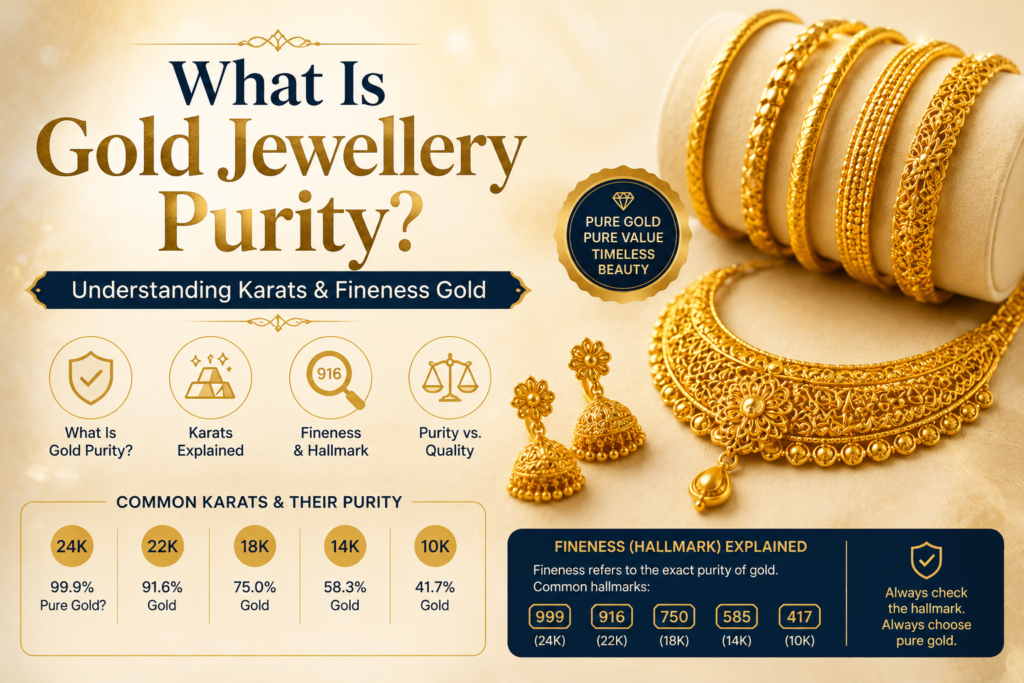
Gold purity measures how much pure gold is present in an item compared to other metals. Because pure gold (24K) is too soft for practical daily use, it is mixed with other metals like silver, copper, zinc, and palladium to create durable alloys. The purity of these alloys is measured using two international systems: karats (K) and millesimal fineness. The word “karat” comes from the carob seed, which ancient traders used as a counterweight when weighing gold. Today, the karat system divides gold purity into 24 parts. 24 karat (24K) is pure gold — 24 out of 24 parts gold. 18 karat (18K) is 18 parts gold and 6 parts other metals, making it exactly 75% pure. The millesimal system, used throughout Europe, expresses the same purity in parts per thousand — 750 for 18K, 585 for 14K, and 999 for 24K.Quick Karat Reference: • 24K = 99.9% pure (too soft for most jewelry) • 22K = 91.6% pure (traditional jewelry standard in Asia) • 18K = 75% pure (luxury jewelry: Cartier, Tiffany & Co.) • 14K = 58.3% pure (most common in US engagement rings) • 10K = 41.7% pure (minimum legal gold in the United States) • 9K = 37.5% pure (minimum legal gold in the United Kingdom)
Understanding gold purity is essential whether you are buying jewelry, selling scrap gold, or investing in bullion. The purity directly determines the melt value — the actual gold content value — and influences the durability, colour, and price of gold items. For a complete introduction to gold, read our What Is Gold? Complete Guide.
Gold Purity Chart: Complete Karat to Percentage Conversion
This comprehensive chart shows every common gold purity level, the corresponding millesimal fineness stamp, the percentage of pure gold, and where each purity is most commonly used.| Karat | Millesimal | Purity % | Parts/24 | Typical Use |
|---|---|---|---|---|
| 24K | 999 / 999.9 | 99.9% | 24/24 | Bullion bars, investment gold |
| 23K | 958 | 95.8% | 23/24 | Some sovereign coins |
| 22K | 916 | 91.6% | 22/24 | Indian jewelry, Krugerrands |
| 21K | 875 | 87.5% | 21/24 | Middle Eastern jewelry |
| 18K | 750 | 75.0% | 18/24 | Luxury jewelry, Cartier |
| 14K | 585 | 58.5% | 14/24 | US engagement rings |
| 10K | 417 | 41.7% | 10/24 | Budget jewelry (US minimum) |
| 9K | 375 | 37.5% | 9/24 | UK, Australian jewelry |
What Does Karat Mean? The History Behind the System
The term karat (spelled “carat” in British English, though “carat” now refers to gemstone weight) originates from the carob seed — Ceratonia siliqua. Ancient traders in the Mediterranean used carob seeds as counterweights on balance scales because the seeds have a remarkably uniform weight of approximately 0.2 grams each. The Roman solidus coin, weighing 24 carob seeds, established the 24-part system that became the standard for measuring gold purity. The millesimal system developed later in continental Europe as a more precise alternative. Instead of dividing purity into 24 parts, it expresses gold content in parts per thousand. This allows for more granular measurement — for example, the difference between 583 (the older European 14K standard) and 585 (the modern standard) is clearly visible in the millesimal system but would be lost in the karat system. Today, millesimal fineness is required by law for hallmarking in the European Union, while the karat system remains standard in the United States, United Kingdom, India, and the Middle East.Convert Any Gold Purity Instantly
Use our free karat converter to switch between karats, millesimal fineness, and percentage purity in any direction.
Karat Converter → Decode a Hallmark →24K vs 22K Gold: The Two High-Purity Standards
The choice between 24K and 22K gold is one of the most important decisions in gold buying. These two purities dominate the global gold market, and understanding their differences is essential whether you are buying jewelry, coins, or investment gold.24K Gold (99.9% Pure)
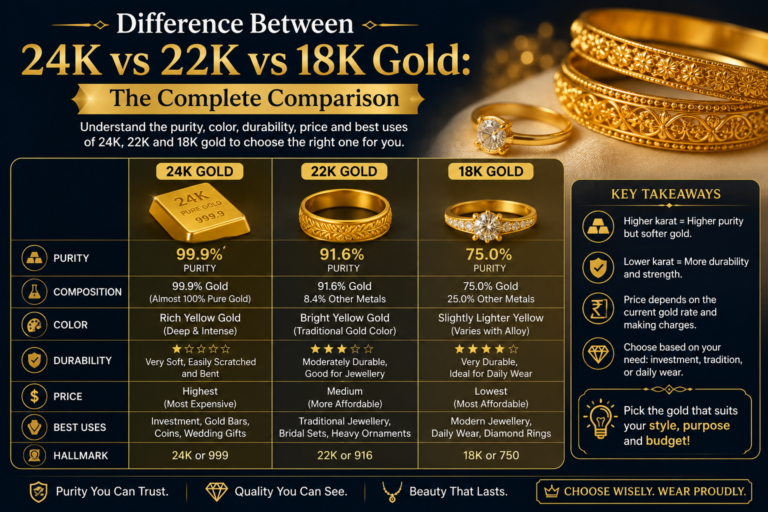
24K gold is the purest commercially available form of gold. Its colour is a deep, rich yellow-orange that cannot be replicated by lower-karat alloys. However, pure gold is extremely soft — it measures only 2.5 on the Mohs hardness scale, meaning it can be scratched with a fingernail and bent with minimal pressure. A 24K ring would deform significantly within months of daily wear. Key characteristics of 24K gold:- Colour: Rich, deep yellow-orange — the natural colour of pure gold
- Hardness: Very soft (2.5 Mohs) — unsuitable for rings or bracelets worn daily
- Value: Highest resale value — nearly 100% of the gold spot price
- Best for: Investment bars, bullion coins, special-occasion jewelry, gold savings accounts
- Common in: China (999 gold), India (24K coins and bars), Middle East, Thailand
22K Gold (91.6% Pure)
22K gold contains 22 parts pure gold and 2 parts other metals — typically silver, copper, or a combination. This small alloy addition significantly increases hardness while retaining the rich gold colour that makes high-karat gold desirable. 22K is the standard for Indian jewelry — over 70% of Indian gold jewelry is 22K — and is used in the world-famous South African Krugerrand coin. The alloy metals in 22K are carefully balanced to maintain a bright yellow colour that is visually very close to 24K. Key characteristics of 22K gold:- Colour: Bright yellow — nearly indistinguishable from 24K to most people
- Hardness: Noticeably harder than 24K — suitable for earrings, pendants, and occasional-wear rings
- Value: High resale value — 91.6% of the gold spot price
- Best for: Traditional jewelry, wedding ornaments, gold coins (Krugerrand, British Sovereign)
- Common in: India, Pakistan, Bangladesh, Middle East, Southeast Asia
| Feature | 24K Gold | 22K Gold |
|---|---|---|
| Purity | 99.9% | 91.6% |
| Hardness | Very soft (2.5 Mohs) | Moderate — wearable |
| Colour | Deep yellow-orange | Bright yellow |
| Resale Value | Highest (near spot) | Very high |
| Best For | Investment, special jewelry | Traditional jewelry, coins |
18K vs 14K Gold: The Western Jewelry Standards
In Western markets — particularly the United States, Europe, and the United Kingdom — 18K and 14K are the dominant gold purities for jewelry. These lower-karat options prioritize durability and affordability while maintaining significant gold value.18K Gold (75% Pure)
18K gold is the standard for luxury jewelry. Brands like Cartier, Tiffany & Co., Bvlgari, and Van Cleef & Arpels use 18K gold almost exclusively. At 75% pure gold, it offers a beautiful warm yellow colour with enough alloy content (25% other metals) to be durable for daily wear. 18K gold is also available in white gold (alloyed with palladium or nickel and plated with rhodium) and rose gold (alloyed with a higher proportion of copper for a pink hue). Best for: Fine jewelry, engagement rings, luxury watches, and investment-grade jewelry that balances gold value with wearability.14K Gold (58.3% Pure)
14K gold is the most popular gold purity in the United States, accounting for approximately 90% of gold jewelry sold. At 58.3% pure gold with 41.7% alloy metals, it is significantly harder and more scratch-resistant than 18K. This durability makes it ideal for engagement rings, wedding bands, and everyday jewelry that faces regular wear and tear. The trade-off is a paler colour and lower intrinsic gold value. Best for: Engagement rings, wedding bands, everyday jewelry, children’s jewelry, and budget-conscious buyers who still want genuine gold.| Feature | 18K Gold | 14K Gold |
|---|---|---|
| Purity | 75.0% | 58.3% |
| Durability | Good for daily wear | Excellent for daily wear |
| Colour | Warm yellow | Paler yellow |
| Resale Value | High | Moderate |
| Best For | Luxury jewelry, fine pieces | Engagement rings, daily wear |
How to Check Gold Purity: Hallmarks, Stamps & Testing
Verifying gold purity is essential before buying or selling. There are several methods ranging from simple visual checks to professional laboratory analysis.Reading Gold Hallmarks
The quickest way to check purity is to look for the hallmark or stamp on the gold item. Jewelry is typically stamped on the inside of rings, on the clasp of chains, or on the back of pendants. Coins and bars carry stamps on their face. The stamp will show either the karat (10K, 14K, 18K, 22K, 24K) or the millesimal fineness (417, 585, 750, 916, 999). UK hallmarks are the most detailed, including a purity mark, an assay office symbol (anchor for Birmingham, leopard’s head for London), a date letter, and a maker’s mark. European Union gold carries the Common Control Mark (CCM) — a balance scale symbol — alongside the millesimal number. Indian BIS hallmarks show the BIS logo, purity grade, assaying centre mark, and jeweler’s identification mark.Home Testing Methods
- Magnet test: Gold is non-magnetic. If a magnet attracts your item, it is not gold or has significant base metal content.
- Visual inspection: Look for discolouration, wearing through to a different-coloured metal underneath, or uneven colour — all signs of gold plating.
- Ceramic scratch test: Rub the item on unglazed ceramic. A gold streak indicates genuine gold; a black streak indicates pyrite (fool’s gold) or base metal.
- Acid test: Available in testing kits. Different acid solutions react with different gold purities. Reliable but slightly destructive — it requires scratching the item.
Professional Testing
Jewelers and refiners use X-Ray Fluorescence (XRF) analysis for non-destructive, instant purity readings accurate to 0.1%. Fire assay is the most accurate method, used by refineries, but destroys the sample. Electronic gold testers provide quick, reasonably accurate readings for most jewelry. For high-value items, professional testing is recommended.Decode Your Gold Hallmark Instantly
Type any stamp or hallmark into our free checker to verify purity, identify authenticity markers, and spot potential counterfeits.
Check Hallmark Now → Calculate Gold Value →Which Gold Purity Should You Buy?
The best gold purity depends entirely on your purpose. Here is a clear, practical guide to choosing the right karat for every situation.| If You Want To… | Best Purity | Why |
|---|---|---|
| Invest for wealth preservation | 24K bars or coins | Highest gold content, lowest premiums, most liquid |
| Buy traditional Indian jewelry | 22K | Cultural standard, excellent colour, high resale value |
| Buy an engagement ring | 14K or 18K | Durable for daily wear; 14K more affordable, 18K more prestigious |
| Buy luxury branded jewelry | 18K | Standard for Cartier, Tiffany, Bvlgari, Van Cleef & Arpels |
| Maximize durability on a budget | 10K or 14K | Hardest wearing, most affordable, still genuine gold |
| Sell scrap gold | Any purity | All gold has melt value; higher karat = higher payout |
Frequently Asked Questions About Gold Purity
What does 585 mean on gold jewelry?
585 is the millesimal fineness marking for 14K gold. It means 585 parts per thousand are pure gold — equivalent to 58.5% purity. This is the European standard marking for 14K gold. Older pieces may show 583 instead (the traditional 14K standard). Both are accepted as 14K gold.Is 750 gold the same as 18K?
Yes. 750 (millesimal) and 18K (karat) indicate exactly the same purity: 75% pure gold. 750 means 750 parts per thousand. 18K means 18 parts gold out of 24 parts total. European jewelry typically bears the 750 stamp while American jewelry may show 18K or 750.Why is 24K gold not used for engagement rings?
24K gold is too soft for daily wear. It measures only 2.5 on the Mohs hardness scale — similar to a fingernail. A 24K ring would bend, scratch, and deform within weeks of regular wear. 14K and 18K gold are alloyed with harder metals to withstand decades of daily use.What is the minimum karat to legally be called gold?
In the United States, 10K (41.7% pure) is the legal minimum. In the United Kingdom and many Commonwealth countries, 9K (37.5% pure) is the minimum. France requires 18K minimum. Below these thresholds, items cannot legally be sold as “gold” jewelry.Does higher karat gold tarnish?
Pure gold (24K) does not tarnish, rust, or corrode — ever. Lower karat gold can tarnish slightly over time because the alloy metals (especially copper and silver) react with air and moisture. 14K and 10K gold may develop a patina over many years, which can be polished away.How do I convert between karat and percentage?
Divide the karat number by 24 and multiply by 100. Example: 14K = 14 ÷ 24 × 100 = 58.33%. 18K = 18 ÷ 24 × 100 = 75%. For millesimal to karat, divide the millesimal number by 1000 and multiply by 24. Use our karat converter for instant results.What is the difference between white gold and yellow gold purity?
White gold and yellow gold can have the same purity (both can be 18K or 14K). The difference is in the alloy metals. White gold uses palladium, nickel, or silver as the alloy and is plated with rhodium for a bright white finish. Yellow gold uses copper and silver to maintain the warm gold colour. The purity and gold content are identical — only the colour differs.How can I tell 14K from 18K gold?
Look for the hallmark stamp: 585 = 14K, 750 = 18K. Visually, 18K has a warmer, richer yellow colour. An acid test kit can distinguish them (different acid solutions react at different purities). A jeweler with an electronic tester or XRF analyzer can provide instant, non-destructive verification.Explore Our Free Gold Tools
Calculate values, check purity, convert karats, and track live prices — all free and private.
Gold Value Calculator Purity Checker Karat Converter
About the author