Table of Contents
- Gold Coins Explained: A Beginner’s Guide to Buying Gold Coins
- What Are Gold Coins? Understanding Bullion vs. Numismatic Coins
- Gold Coin Purity: Karats and Fineness Explained
- Gold Coin Weights and Sizes: What You Can Buy
- The Most Popular Gold Coins for Beginners
- Gold Coin Premiums: Why Coins Cost More Than Spot
- How to Verify Gold Coin Authenticity
- How to Store Gold Coins Safely
- Frequently Asked Questions About Buying Gold Coins
Gold Coins Explained: A Beginner’s Guide to Buying Gold Coins
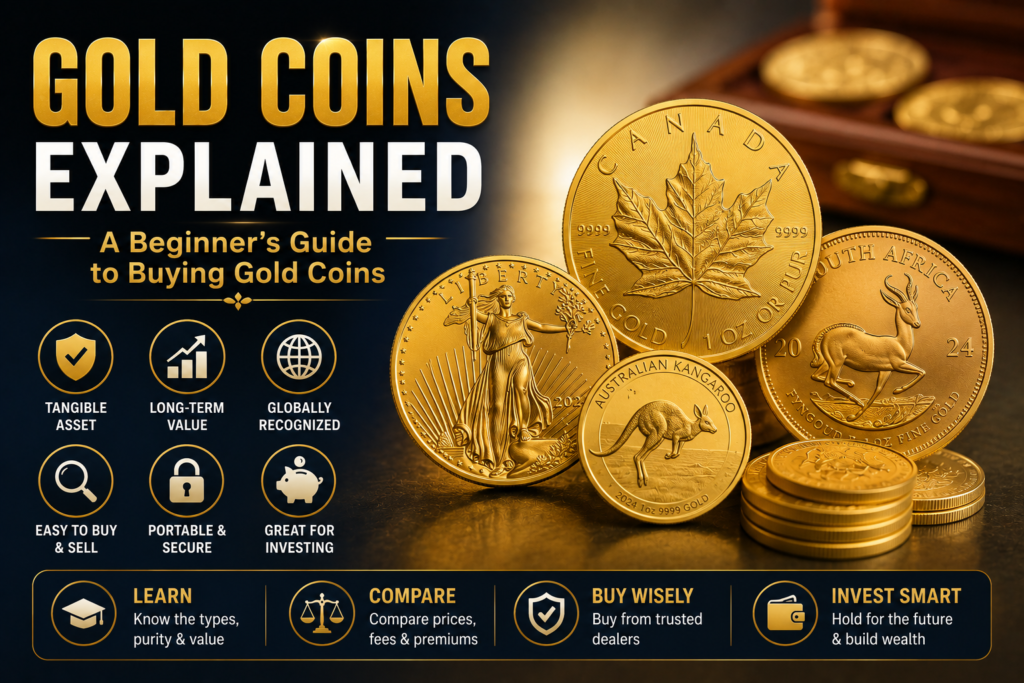
Buying gold coins is one of the most popular ways to invest in physical gold — and for good reason. Gold coins are sovereign-guaranteed for weight and purity, instantly recognizable worldwide, easily divisible into smaller units, and highly liquid. Whether you are buying your first 1-ounce American Gold Eagle or building a long-term gold coin collection, understanding how gold coins work is essential before you spend your money. This beginner’s guide to buying gold coins covers everything you need to know: the difference between bullion and numismatic coins, how coin purity and weight work, which coins are best for beginners, why coins carry premiums above spot price, how to verify authenticity, and how to store your coins safely. By the end, you will have the knowledge to make informed gold coin purchases with confidence.Gold Coins for Beginners: Key Takeaways
• Buy bullion coins — not numismatic coins — when you are starting out
• Stick to recognized sovereign coins: American Eagles, Krugerrands, Maple Leafs, Britannias
• 1 oz coins offer the best value; fractional coins have higher premiums
• Expect premiums of 3-8% above spot price for common bullion coins
• Buy from reputable dealers — never from unknown sellers on social media or auction sites
• Store securely: Home safe, bank deposit box, or professional vault
What Are Gold Coins? Understanding Bullion vs. Numismatic Coins
Gold coins fall into two broad categories, and understanding the difference between them is the most important first step when buying gold coins. The two types are bullion coins and numismatic coins — and they serve very different purposes.Bullion Gold Coins
Bullion coins are modern coins minted specifically for gold investment. Their value is based almost entirely on their gold content at the current spot price, plus a small premium for manufacturing and distribution. Bullion coins are produced in large quantities every year by sovereign governments, ensuring consistent supply and competitive premiums. They are what most investors mean when they talk about buying gold coins. Examples of bullion coins: American Gold Eagle (US), Canadian Gold Maple Leaf (Canada), South African Krugerrand (South Africa), British Gold Britannia (UK), Austrian Gold Philharmonic (Austria), Australian Gold Kangaroo (Australia). Bullion coins are the right choice for beginners buying gold coins for investment purposes.Numismatic Gold Coins
Numismatic coins are collector coins whose value exceeds their gold content due to rarity, historical significance, condition, or collector demand. A 1907 Saint-Gaudens Double Eagle might contain the same gold as a modern bullion coin, but its numismatic value could be thousands of dollars higher because of its age, rarity, and condition. Numismatic coins require specialized knowledge to buy correctly. Grading, authenticity verification, and market timing are far more complex than with bullion coins. Prices can be volatile, and selling can be challenging. Beginners buying gold coins should stick to bullion coins until they have developed the knowledge needed for numismatic investing. The US Mint’s collecting guide provides a good introduction to the difference between bullion and numismatic coins.Gold Coin Purity: Karats and Fineness Explained
Gold coin purity is expressed in two ways: karats (parts of gold out of 24) and millesimal fineness (parts of gold per 1,000). Understanding these markings helps you verify what you are buying when buying gold coins.| Coin | Purity | Fine Gold Content (1 oz Coin) |
|---|---|---|
| American Gold Eagle | 22K (.9167) | 1.0000 troy oz |
| Canadian Gold Maple Leaf | 24K (.9999) | 1.0000 troy oz |
| South African Krugerrand | 22K (.9167) | 1.0000 troy oz |
| British Gold Britannia | 24K (.9999) | 1.0000 troy oz |
| Austrian Philharmonic | 24K (.9999) | 1.0000 troy oz |
Gold Coin Weights and Sizes: What You Can Buy
Gold bullion coins are available in multiple weight denominations, making them accessible to investors with different budgets. The most common size is the 1 troy ounce coin, but fractional coins allow you to invest smaller amounts when buying gold coins.| Coin Size | Fine Gold Content | Typical Premium | Best For |
|---|---|---|---|
| 1 oz | 31.1035g | 3-8% | Best value — lowest percentage premium |
| 1/2 oz | 15.5517g | 5-10% | Moderate budget; more divisible than 1 oz |
| 1/4 oz | 7.7759g | 8-13% | Smaller gifts; incremental investing |
| 1/10 oz | 3.1103g | 10-20% | Smallest budget; gifts; emergency barter |
The Most Popular Gold Coins for Beginners
American Gold Eagle (United States)
The American Gold Eagle is the most popular gold bullion coin in the United States. Minted by the US Mint since 1986, it features Augustus Saint-Gaudens’ iconic Liberty design on the obverse and a family of eagles on the reverse. The Eagle is 22K gold (91.67% pure) with silver and copper alloy for durability. It contains exactly 1 troy ounce of fine gold. Eagles carry premiums of 5-8% — slightly higher than other coins due to strong US demand. Available in 1 oz, 1/2 oz, 1/4 oz, and 1/10 oz sizes. Eagles are IRA-eligible, making them popular for retirement accounts.Canadian Gold Maple Leaf (Canada)
The Canadian Gold Maple Leaf, produced by the Royal Canadian Mint since 1979, was the first .9999 fine (24K) gold bullion coin. It features the iconic maple leaf on the reverse and Queen Elizabeth II (now King Charles III) on the obverse. Maple Leafs are prized for their exceptional purity and advanced security features, including radial lines and a micro-engraved laser mark. Premiums typically run 3-5%, making them a cost-effective choice. Available in 1 oz, 1/2 oz, 1/4 oz, 1/10 oz, and 1/20 oz sizes.South African Krugerrand (South Africa)
The Krugerrand, first minted in 1967 by the South African Mint, is the world’s first modern gold bullion coin. It features Paul Kruger on the obverse and a springbok antelope on the reverse. The Krugerrand is 22K gold (91.67% pure) with a distinctive copper-tinged orange color from its copper alloy. It typically carries the lowest premiums of any major bullion coin — often 2-4% — making it the most cost-effective way to buy gold coins. Available in 1 oz, 1/2 oz, 1/4 oz, and 1/10 oz sizes.British Gold Britannia (United Kingdom)
The Gold Britannia, minted by the Royal Mint, features the allegorical figure of Britannia. Originally 22K when first issued in 1987, it became .9999 fine (24K) in 2013. Britannias are legal tender in the UK and are exempt from Capital Gains Tax for UK residents — a significant advantage. They feature advanced security elements including a latent image, surface animation, and micro-text. Premiums typically run 3-5%. Available in 1 oz, 1/2 oz, 1/4 oz, and 1/10 oz sizes.Austrian Gold Philharmonic (Austria)
The Gold Philharmonic, produced by the Austrian Mint since 1989, celebrates the Vienna Philharmonic Orchestra. It is .9999 fine (24K) and is the best-selling gold coin in Europe. The Philharmonic features musical instruments on the reverse and the Great Organ of the Golden Hall on the obverse. Premiums are competitive at 3-4%. Available in 1 oz, 1/2 oz, 1/4 oz, 1/10 oz, and 1/25 oz sizes.Gold Coin Premiums: Why Coins Cost More Than Spot
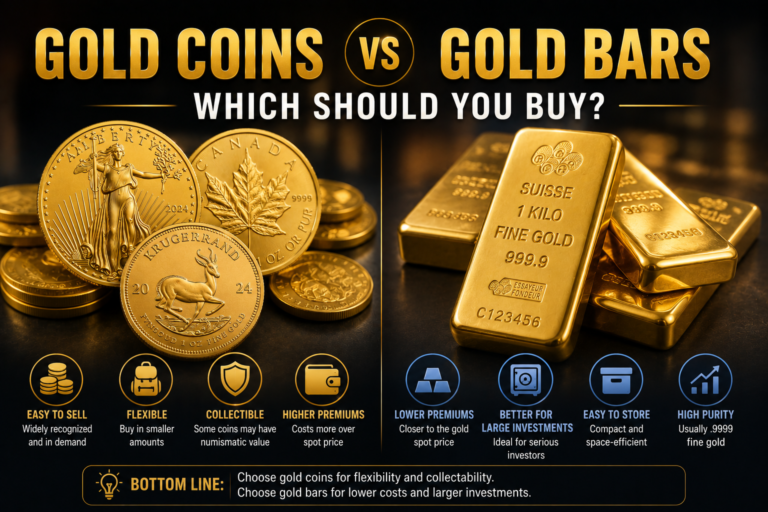
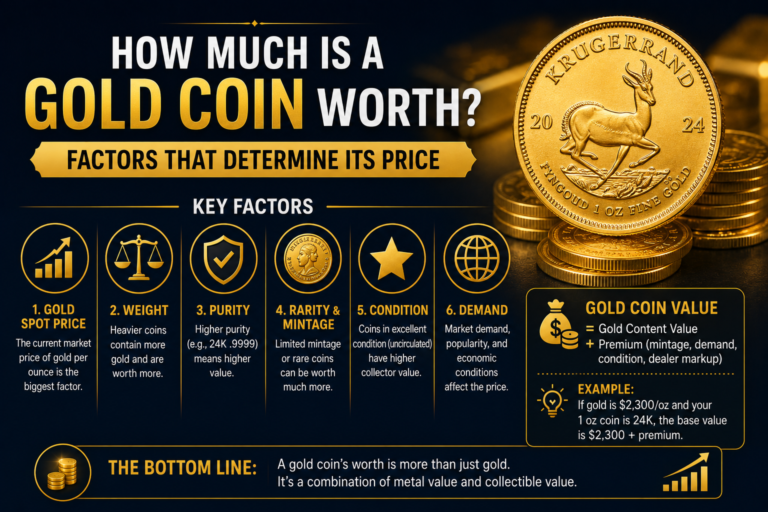
When buying gold coins, you will pay more than the spot price. This difference — the premium — covers the cost of minting, distribution, dealer overhead, and dealer profit. Understanding premiums helps you evaluate whether you are getting a fair price.What Determines Coin Premiums
- Coin size: Fractional coins have higher percentage premiums due to higher manufacturing costs relative to gold content. A 1/10 oz coin costs almost as much to produce as a 1 oz coin.
- Mint popularity: American Eagles command higher premiums (5-8%) due to strong US demand and recognition. Krugerrands carry lower premiums (2-4%) as high-volume international coins.
- Purity: 24K coins (Maple Leafs, Britannias) sometimes carry slightly lower premiums than 22K coins because refiners value pure gold more easily. However, this difference is usually minimal.
- Dealer competition: Online dealers with high volume typically offer lower premiums than local coin shops with limited stock.
- Market conditions: During periods of high demand (financial crises, gold rallies), premiums can spike. Conversely, during quiet markets, premiums narrow.
What Is a Fair Premium?
For common 1 oz bullion coins, expect premiums of 3-8%. Premiums under 5% are good. Premiums over 10% for common bullion coins are high — you should shop around. For fractional coins, expect 10-20% premiums on the smallest sizes. Use our gold coin value calculator to see the melt value and estimated premium for specific coins at live prices.How to Verify Gold Coin Authenticity
Counterfeit gold coins are a real problem, particularly when buying from unreputable sources. When buying gold coins, always verify authenticity before completing the purchase.Physical Characteristics to Check
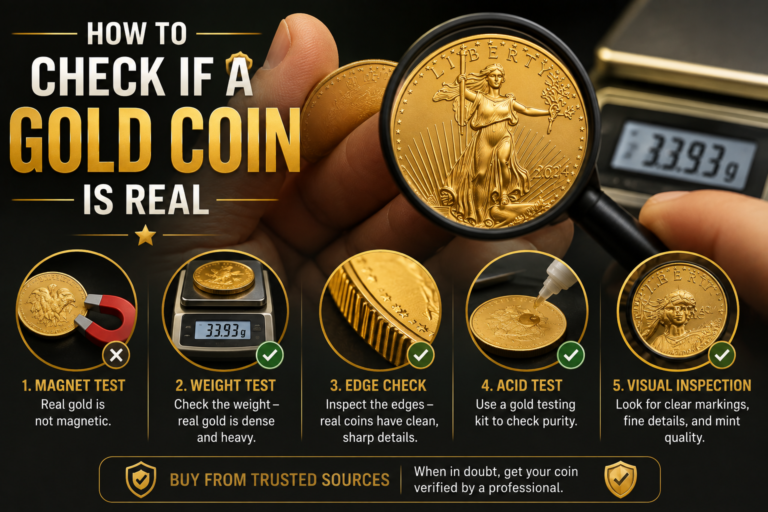
- Weight: Weigh the coin on a 0.01g precision scale. A genuine 1 oz gold coin weighs exactly its specified weight (31.1035g for pure gold coins, slightly more for 22K coins with alloy). Counterfeits often weigh differently.
- Diameter and thickness: Each coin has specific dimensions. Use calipers to verify against official specifications from the mint.
- Edge markings: Many coins have reeded edges or lettered inscriptions. The Krugerrand has 180 reeds. The American Eagle has a reeded edge. Missing or incorrect edge markings are red flags.
- Sound test: Gold coins produce a distinctive ringing sound when struck. Counterfeits made of base metal sound dull. This requires experience to judge reliably.
- Magnetic test: Gold is non-magnetic. If a coin sticks to a magnet, it is not gold.
Professional Verification
For definitive authentication, professional testing is essential. XRF (X-Ray Fluorescence) analysis provides instant, non-destructive purity verification. Many coin dealers offer this service. The Professional Coin Grading Service (PCGS) and Numismatic Guaranty Company (NGC) are the two leading third-party grading services for coins. For high-value purchases, buying coins already certified by these services provides the strongest authenticity guarantee.How to Store Gold Coins Safely
Once you have started buying gold coins, proper storage is essential to protect your investment. Gold coins can be scratched, damaged, or stolen — reducing their value and your peace of mind.Storage Options for Gold Coins
- Home safe: A high-quality safe (UL-rated, bolted down) provides convenient access. Suitable for moderate quantities. Insurance is essential for home storage.
- Bank safe deposit box: Affordable ($50-300/year) and highly secure. However, access is limited to bank hours, and contents are not FDIC-insured.
- Professional vault storage: Companies like Brinks, Loomis, and specialized bullion storage providers offer maximum security with insurance included. Costs 0.3-1% of value annually. Best for large collections.
- Dealer storage: Some dealers offer allocated storage for coins you purchase from them. Convenient but introduces counterparty risk.
Handling Gold Coins
- Hold coins by the edges — never touch the faces. Skin oils can damage coin surfaces over time.
- Use cotton gloves when handling high-value or proof coins.
- Store coins in protective capsules, tubes, or flips. Never store loose coins where they can rub against each other.
- Avoid cleaning gold coins. Improper cleaning can permanently scratch surfaces and significantly reduce numismatic value.
Frequently Asked Questions About Buying Gold Coins
What is the best gold coin for a beginner to buy?
For beginners buying gold coins for investment, the best choices are the 1 oz American Gold Eagle (most recognized in the US), the 1 oz Canadian Gold Maple Leaf (.9999 pure), or the 1 oz South African Krugerrand (lowest premiums). All three are highly liquid, widely recognized, and available from every major dealer. For the lowest cost per gram of gold, the Krugerrand is typically the cheapest. For maximum recognition in the US, the Eagle is best.Should I buy 1 oz coins or fractional coins?
For maximizing gold content per dollar, 1 oz coins are better — they carry the lowest percentage premiums (3-8% vs. 10-20% for fractional). However, fractional coins offer divisibility. If you may need to sell or gift small amounts of gold, holding some fractional coins alongside 1 oz coins provides flexibility. A common strategy is building a position primarily in 1 oz coins with a small allocation to fractional sizes for practical reasons. Use our coin value calculator to compare premiums across sizes.Are gold coins a good investment?
Gold coins are a good investment for wealth preservation, portfolio diversification, and inflation hedging — not for rapid growth or income. They provide direct ownership of physical gold with sovereign guarantees of weight and purity. Gold has historically preserved purchasing power over decades and performed well during economic crises. However, gold pays no dividends, prices can be volatile in the short term, and coins carry premiums that must be recovered through price appreciation. For a balanced perspective, read our Is Gold a Good Investment? guide.Where should I buy gold coins?
Buy buying gold coins from established, reputable sources: major online dealers (APMEX, JM Bullion, SD Bullion, BullionVault), government mints (US Mint, Royal Canadian Mint, Royal Mint), and established local coin shops. Compare premiums across dealers — they vary. Avoid buying from unknown sellers on eBay, Facebook Marketplace, or social media — counterfeit coins are common on these platforms. The US Mint’s official page lists authorized dealers for American Eagles.Do gold coins have any tax advantages?
In some countries, yes. In the UK, legal tender gold coins (Britannias, Sovereigns) are Capital Gains Tax exempt. In the US, gold coins can be held in a Self-Directed IRA, deferring taxes until withdrawal. American Eagles are specifically approved for IRA inclusion. In most countries, capital gains tax applies when selling gold coins at a profit. Tax treatment varies significantly by jurisdiction — consult a local tax professional before buying or selling gold coins.How do I sell gold coins when I am ready?
To sell gold coins, go to coin dealers, bullion dealers, or online precious metals platforms — not general gold buyers or pawn shops, which typically offer lower percentages. Gold bullion coins should sell for 95-100% of spot price. Get multiple quotes. For large quantities, online refiners may offer the best rates. Use our gold coin value calculator to determine fair value before selling. Read our complete guide on selling gold for step-by-step instructions.
About the author