Table of Contents
- How to Check if a Gold Coin Is Real
- Check the Hallmark: What Real Gold Coin Stamps Look Like
- Verify Weight and Dimensions of Gold Coins
- The Magnet Test for Gold Coins
- The Sound Test (Ping Test) for Gold Coins
- Density Test: Weighing Gold Coins in Water
- Acid Testing for Gold Coins
- XRF Analysis: Professional Gold Coin Verification
- Red Flags: Signs a Gold Coin May Be Fake
- Frequently Asked Questions About Checking Gold Coins
How to Check if a Gold Coin Is Real
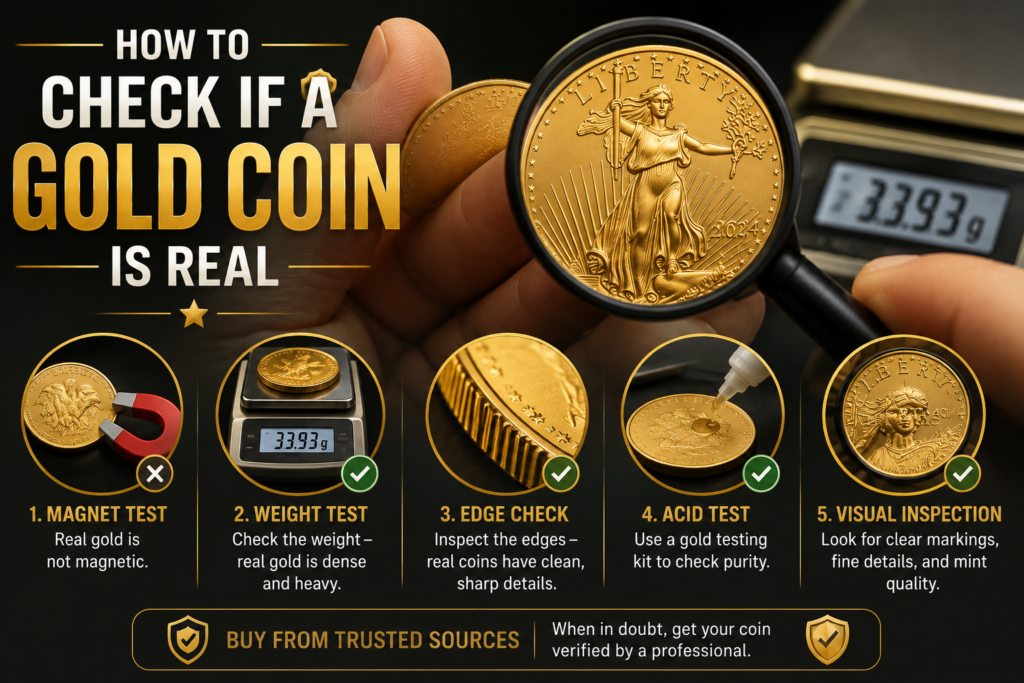
Counterfeit gold coins are a growing problem worldwide. As gold prices have risen, so too has the sophistication of fake coins flooding the market. Knowing how to check if a gold coin is real is essential whether you are buying coins for the first time, verifying a collection you inherited, or double-checking a purchase before selling. Counterfeit coins can be made from gold-plated tungsten, brass, copper, or lower-karat gold stamped with false markings. This guide covers 8 methods to verify gold coin authenticity — from simple visual checks you can do in seconds to professional testing techniques used by dealers and refiners. No single test is 100% definitive on its own, but combining multiple methods gives you a high degree of confidence in whether a gold coin is real or fake.How to Check if a Gold Coin Is Real: Quick Summary • Fastest (no tools): Check the hallmark, compare weight and dimensions to official specifications • Easy home tests: Magnet test, sound/ping test, visual inspection for discolouration • More advanced: Density test (water displacement), acid test, caliper measurements • Professional (most reliable): XRF analysis, ultrasound testing, electronic gold testers • Red flags: Wrong weight, magnetic attraction, dull sound, blurry details, incorrect dimensions • Always verify: Use our gold purity checker to decode coin hallmarks instantly
Check the Hallmark: What Real Gold Coin Stamps Look Like
Every genuine gold bullion coin carries identifying marks that indicate its purity, weight, and mint of origin. Checking these marks is the fastest first step in determining how to check if a gold coin is real.What to Look For on a Real Gold Coin
- Purity stamp: Look for the fineness marking — .9999, .999, .9167, or similar. This indicates the gold purity. 24K coins (Maple Leafs, Britannias) are stamped .9999. 22K coins (American Eagles, Krugerrands) are stamped .9167.
- Weight stamp: Many coins include the weight — “1 OZ FINE GOLD” or similar. This confirms the troy ounce content.
- Mint mark: The government mint’s identifying mark. American Eagles show “US Mint” marks. Maple Leafs show the Royal Canadian Mint logo.
- Year of issue: All bullion coins include the year they were minted.
- Face value: Legal tender coins show a denomination — American Eagles are $50 face value for the 1 oz size.
What Fake Coin Stamps Look Like
- Blurry or soft details: Genuine coin stamps are crisp and sharp. Fake coins often have slightly blurred or rounded details from inferior die quality.
- Wrong font or spacing: Counterfeiters often get the lettering slightly wrong — incorrect font, wrong letter spacing, or misspelled words.
- Missing marks: A genuine coin has consistent, complete markings. Missing mint marks, purity stamps, or year dates are red flags.
- Inconsistent depth: Genuine coins have uniform strike depth. Fakes may show uneven or shallow lettering.
Verify Weight and Dimensions of Gold Coins
One of the most reliable ways to check how to check if a gold coin is real is to compare its weight and dimensions against official specifications. Every government mint publishes exact specifications for its coins. Counterfeit coins almost always differ slightly in weight or size — because counterfeiters use metals with different densities than gold.Official Gold Coin Specifications
| Coin (1 oz) | Total Weight | Diameter | Thickness |
|---|---|---|---|
| American Gold Eagle | 33.931g | 32.70mm | 2.87mm |
| Canadian Gold Maple Leaf | 31.110g | 30.00mm | 2.87mm |
| South African Krugerrand | 33.930g | 32.77mm | 2.84mm |
| British Gold Britannia | 31.104g | 32.69mm | 2.79mm |
| Austrian Philharmonic | 31.103g | 37.00mm | 2.00mm |
How to Measure a Gold Coin
- Weight: Use a digital jewelry scale with 0.01g precision. Genuine coins should match the official weight within ±0.05g. A difference of 0.5g or more is a strong red flag.
- Diameter: Use digital calipers (available for $15-25) to measure the coin’s diameter across its widest point. Compare to official specifications.
- Thickness: Measure the coin’s thickness at the rim (not the raised design). Genuine coins match official thickness closely.
The Magnet Test for Gold Coins
Gold is non-magnetic. The magnet test is one of the quickest and easiest home methods for how to check if a gold coin is real — though it is not definitive on its own.How to Perform the Magnet Test
- Obtain a strong neodymium (rare earth) magnet — these are inexpensive ($5-15) and widely available online or at hardware stores.
- Hold the magnet close to the coin without touching it.
- Observe whether the coin is attracted to the magnet.
- If the coin sticks to the magnet or is strongly attracted, it is not genuine gold.
- If the coin shows no magnetic attraction, it passes this test.
Important Limitation
The magnet test only detects ferrous (iron-based) counterfeits. It will not catch fakes made from non-magnetic metals like brass, copper, or tungsten. A coin passing the magnet test could still be counterfeit. Always combine the magnet test with other verification methods. For more context on gold’s physical properties, see our gold purity guide.The Sound Test (Ping Test) for Gold Coins
Genuine gold coins produce a distinctive ringing sound when struck — a clear, sustained “ping” that lasts for several seconds. Counterfeit coins made from base metals produce a dull, short “thud.” This sound difference is one of the oldest methods for determining how to check if a gold coin is real.How to Perform the Sound Test
- Balance the coin on the tip of one finger, holding it gently at the edge.
- Tap the coin lightly with another coin, a small metal object, or a pencil.
- Listen carefully: A genuine gold coin produces a clear, musical ringing tone that sustains for 1-3 seconds. A fake coin produces a dull thud with minimal sustain.
Limitations
The sound test requires experience — you need to know what genuine gold sounds like to recognize the difference. Professional gold dealers often use electronic devices called “ping testers” that analyze the coin’s resonant frequency for more objective results. For beginners, this test is useful as a supplement to other methods rather than a primary test. For definitive results, combine with weight, dimension, and density testing.Density Test: Weighing Gold Coins in Water
Gold has a specific density of 19.3 g/cm³ — one of the highest of any metal. Measuring a coin’s density by weighing it in air and in water is one of the most reliable at-home methods for how to check if a gold coin is real.How the Density Test Works
- Weigh the coin dry on a precise digital scale (0.01g accuracy). Record this as the “dry weight.”
- Weigh the coin submerged in water. Place a cup of distilled water on the scale. Zero the scale. Suspend the coin in the water using a thin thread — it should be fully submerged but not touching the sides or bottom of the cup. Record this as the “submerged weight.”
- Calculate density: Density = Dry Weight ÷ (Dry Weight − Submerged Weight)
- Compare to expected values: Pure 24K gold = 19.3 g/cm³. 22K gold (Eagles, Krugerrands) = approximately 17.7-18.0 g/cm³. If the calculated density differs significantly, the coin may be counterfeit.
Important Note on Tungsten
Tungsten has a density of 19.25 g/cm³ — nearly identical to gold. Sophisticated counterfeiters drill out genuine gold coins and fill them with tungsten. These fakes pass weight and density tests because tungsten is so close to gold in density. Detecting tungsten-filled fakes requires XRF analysis (which only penetrates surface layers), ultrasound testing, or professional drilling. This is why buying from reputable dealers is essential — they source coins from mints and trusted distributors.Acid Testing for Gold Coins
Acid testing is a destructive but highly reliable method for checking gold purity. It is commonly used by jewelers, pawnbrokers, and gold buyers to verify karat levels. However, it is not recommended for collectible or numismatic coins — the test leaves permanent damage.How Acid Testing Works
- The coin is scratched against a testing stone (a black slate included in acid test kits) to leave a small streak of gold.
- A drop of acid solution is applied to the streak. Different acid strengths test for different karat levels.
- If the streak dissolves or changes color, the gold is below the karat level being tested. If the streak remains unchanged, the gold meets or exceeds that karat level.
When to Use Acid Testing
Acid testing is appropriate for scrap gold coins that will be melted down anyway — where a small scratch mark does not matter. It is NOT appropriate for collectible coins, proof coins, or any coin you intend to keep. The scratch permanently damages the coin’s surface and can significantly reduce its resale value. For valuable coins, use non-destructive testing methods (XRF, electronic testers) instead.XRF Analysis: Professional Gold Coin Verification
X-Ray Fluorescence (XRF) analysis is the gold standard for non-destructive gold testing. It is the most reliable method for how to check if a gold coin is real without damaging the coin in any way.How XRF Works
An XRF analyzer fires a beam of X-rays at the coin’s surface. This excites the atoms in the metal, causing them to emit fluorescent X-rays at energy levels unique to each element. The analyzer detects these emissions and calculates the exact elemental composition of the coin — including gold percentage, alloy metals, and any unexpected elements — in seconds.Advantages of XRF Testing
- Completely non-destructive: No scratches, no chemicals, no damage
- Instant results: Purity reading in 3-10 seconds
- Highly accurate: Within 0.1-0.5% of fire assay results
- Detects alloy composition: Shows not just gold content but which metals are present
- Identifies plating: Can detect gold plating over base metals
Where to Get XRF Testing
Many coin dealers, jewelry stores, and gold buyers have XRF analyzers — and many will test coins for free or a small fee, especially if you are considering selling. For high-value coins or large collections, XRF verification is strongly recommended before purchase or sale. The Professional Coin Grading Service (PCGS) offers authentication and grading services for valuable coins.Red Flags: Signs a Gold Coin May Be Fake
1. Wrong Weight or Dimensions
Genuine coins match official specifications within very tight tolerances. A coin that is 0.5g lighter or 1mm smaller than specification is almost certainly counterfeit.2. Blurry or Soft Details
Genuine coins feature crisp, sharp details. Fakes often show slightly blurred lettering, rounded edges on design elements, or overall loss of fine detail. Compare your coin to high-resolution images from the official mint website.3. Incorrect Color
Different gold coins have distinctive colors. Krugerrands have an orange-copper tint from their 22K alloy. Maple Leafs have a bright yellow 24K color. A Krugerrand that looks pale yellow or a Maple Leaf that looks orange is suspicious. 24K coins should never show copper-orange tones; 22K coins should never appear pale.4. Magnetic Attraction
Gold is non-magnetic. Any magnetic attraction on the coin itself (not clasp or mounting) is definitive proof it is not gold.5. Dull Sound
Gold coins ring with a sustained musical tone. A dull thud suggests base metal composition.6. Price Too Good to Be True
If someone is selling a $2,400 gold coin for $1,500, it is almost certainly fake. Legitimate gold coins sell at spot price plus a small premium. Discounts of 20% or more on bullion coins are the strongest possible red flag.7. Seller Is Unverified
Buy gold coins from reputable dealers — established companies with verifiable track records. Avoid unknown sellers on eBay, Facebook Marketplace, Craigslist, or social media. The US Mint maintains a list of authorized dealers for American Eagle coins.Frequently Asked Questions About Checking Gold Coins
How can I tell if a gold coin is real at home?
To check if a gold coin is real at home, combine these tests: check the hallmark (purity, weight, mint mark), weigh the coin on a 0.01g scale and compare to official specs, measure diameter and thickness with calipers, test with a magnet (gold is non-magnetic), and listen to the sound when tapped (gold rings, base metals thud). For definitive verification, use the density test or visit a professional with XRF equipment.Can a gold coin be magnetic?
No. Gold is never magnetic. If a coin is attracted to a magnet, it is not gold — or it is a gold-plated base metal with a ferromagnetic core. Some counterfeiters use non-magnetic metals (brass, copper, tungsten), so passing the magnet test does not prove authenticity. The magnet test is a screening tool, not a definitive answer for how to check if a gold coin is real.What is the most accurate way to test a gold coin?
The most accurate non-destructive test is XRF (X-Ray Fluorescence) analysis, which determines the exact elemental composition of the coin in seconds. The most accurate destructive test is fire assay, used by refiners to determine exact gold content by melting and chemical analysis. For practical purposes, XRF testing at a coin dealer or jeweler is the gold standard for verifying if a gold coin is real.Do fake gold coins pass the weight test?
Some sophisticated fakes pass the weight test. Tungsten-filled counterfeit coins have a tungsten core (density 19.25 g/cm³ — nearly identical to gold’s 19.3 g/cm³) encased in genuine gold plating. These fakes match genuine coins in both weight and dimensions. They can only be detected through XRF analysis, ultrasound testing, or by drilling into the coin (which destroys it). This is why buying from reputable, established dealers is the most important protection against counterfeit gold coins.How do professional dealers verify gold coins?
Professional coin dealers verify coins using a combination of methods: visual inspection under magnification (checking for correct design details and any signs of casting), weight and dimension verification against official specifications, XRF analysis for purity confirmation, ultrasound testing for detecting internal tungsten cores, and sometimes electronic gold testers for quick karat confirmation. For high-value numismatic coins, dealers rely on third-party authentication from PCGS or NGC.Should I buy gold coins from eBay or Facebook Marketplace?
It is not recommended for beginners. While some legitimate dealers sell on these platforms, they are also rife with counterfeit coins. Without the experience to verify if a gold coin is real, you are at significant risk. If you do purchase from these platforms, buy only from sellers with extensive positive feedback (thousands of transactions), verify the coin immediately upon receipt using multiple testing methods, and use payment methods with buyer protection. For most buyers, established coin dealers and major online bullion platforms are the safer choice.
About the author