Table of Contents
- How Much Is a Gold Coin Worth? Factors That Determine Its Price
- The Gold Coin Melt Value: The Foundation of All Coin Prices
- Premiums: Why Gold Coins Sell Above Spot Price
- How Coin Type Affects Gold Coin Value
- Rarity and Mintage: When Gold Coins Are Worth More Than Their Gold
- Condition and Grading: How They Affect Gold Coin Worth
- How to Calculate Gold Coin Value Step by Step
- Frequently Asked Questions About Gold Coin Worth
How Much Is a Gold Coin Worth? Factors That Determine Its Price
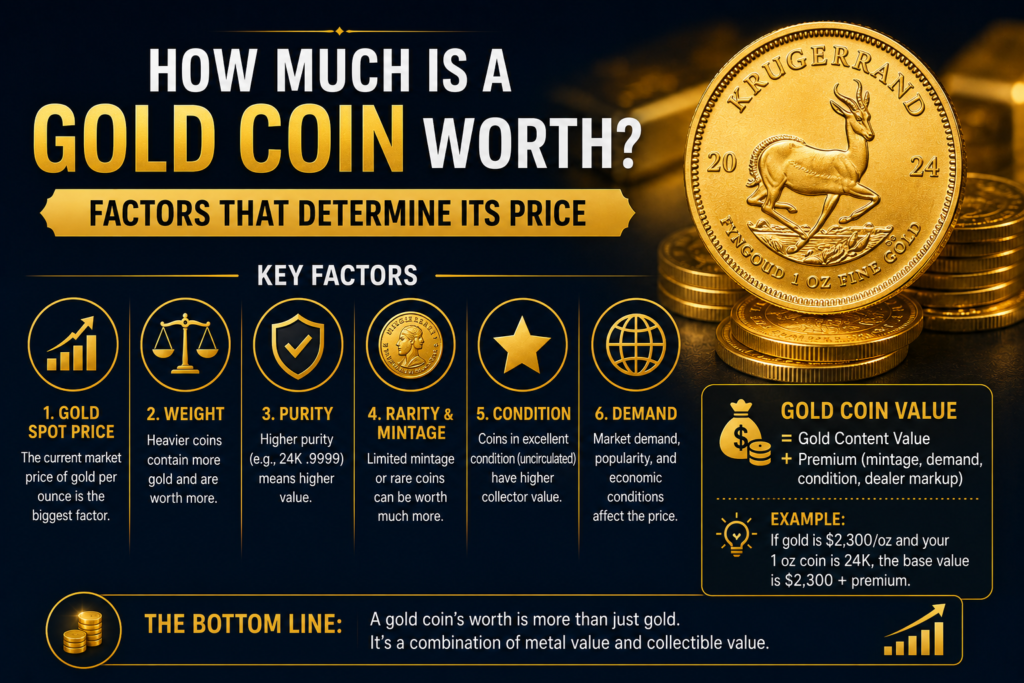
The value of a gold coin is determined by six key factors: the coin’s gold content (weight and purity), the current live gold spot price, the premium over spot, the coin type and recognition, its rarity and mintage, and its condition. Understanding how these factors interact is essential to knowing how much a gold coin is worth — whether you are buying, selling, or simply tracking your collection. This guide breaks down every factor that determines gold coin worth. We explain how to calculate melt value, why premiums exist and how they vary, how coin type affects resale value, when rarity transforms a coin from bullion to collectible, and how condition and grading influence price. By the end, you will be able to determine the value of any gold coin with confidence.Gold Coin Worth: The Six Factors • Gold content: Weight × Purity — determines the coin’s melt value • Live spot price: The current market price of gold per troy ounce • Premium: 2-8% for bullion coins; higher for fractional or special issues • Coin type: Recognized sovereign coins (Eagles, Maple Leafs) sell closer to spot than obscure issues • Rarity: Limited mintage or historical significance can add numismatic value above melt • Condition: Uncirculated coins are worth more than scratched or damaged coins
The Gold Coin Melt Value: The Foundation of All Coin Prices
The melt value is the starting point for determining how much a gold coin is worth. It represents the raw value of the pure gold content in the coin at the current spot price. Every gold coin — regardless of type, rarity, or condition — is worth at least its melt value.How to Calculate Gold Coin Melt Value
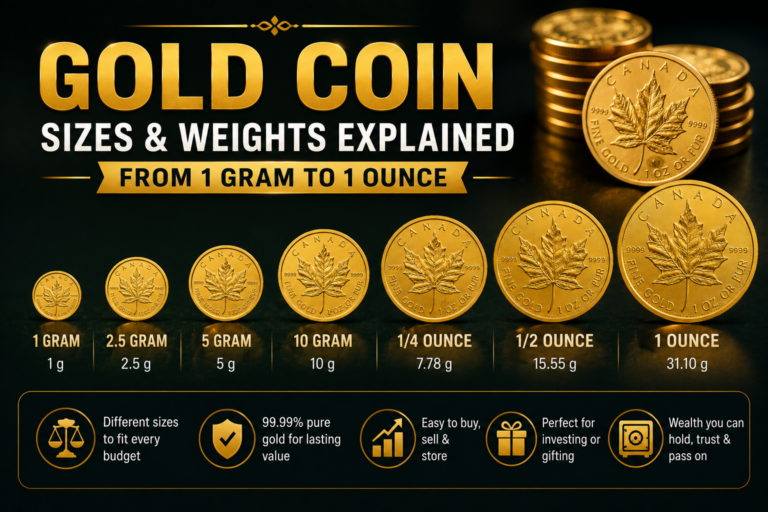
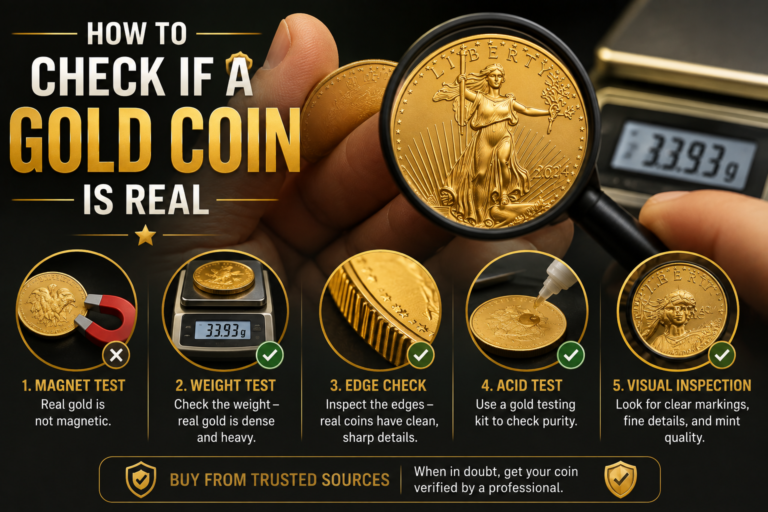
Melt Value = Fine Gold Content (in troy ounces) × Current Spot Price per Troy Ounce The key is knowing the coin’s fine gold content — not its total weight. A 1 oz American Gold Eagle weighs 33.93 grams total but contains exactly 1 troy ounce of fine gold. A 1 oz Canadian Maple Leaf weighs 31.10 grams total and also contains exactly 1 troy ounce of fine gold. Both have the same melt value at any given spot price.| Gold Coin | Fine Gold Content | Melt Value at $2,333/oz Spot |
|---|---|---|
| 1 oz American Gold Eagle | 1.0000 oz | $2,333.00 |
| 1 oz Canadian Maple Leaf | 1.0000 oz | $2,333.00 |
| 1 oz Krugerrand | 1.0000 oz | $2,333.00 |
| 1/2 oz American Gold Eagle | 0.5000 oz | $1,166.50 |
| 1/10 oz American Gold Eagle | 0.1000 oz | $233.30 |
Premiums: Why Gold Coins Sell Above Spot Price
When you buy a gold coin, you typically pay more than its melt value. When you sell, you typically receive less than melt value. This difference — the premium — is the second major factor in determining how much a gold coin is worth in practice.What Is a Gold Coin Premium?
A premium is the amount above (or below) spot price charged for a specific coin. Premiums exist because coins have production costs (die design, striking, packaging), distribution costs (dealer overhead), and profit margins built in. The premium also reflects market demand for specific coins.Typical Premiums by Coin Type
| Coin Type | Typical Buy Premium | Typical Sell Discount |
|---|---|---|
| Krugerrand (1 oz) | 2-4% | 0-2% below spot |
| Canadian Maple Leaf (1 oz) | 3-5% | 0-3% below spot |
| British Britannia (1 oz) | 3-5% | 0-3% below spot |
| American Gold Eagle (1 oz) | 5-8% | 1-4% below spot |
| Fractional Coins (1/10 oz) | 10-20% | 5-15% below spot |
How Coin Type Affects Gold Coin Value
Not all gold coins are created equal in the marketplace. The type of coin — its mint, country of origin, and recognition among buyers — significantly affects how much a gold coin is worth when you buy or sell.Most Recognized Gold Coins (Highest Resale Value)
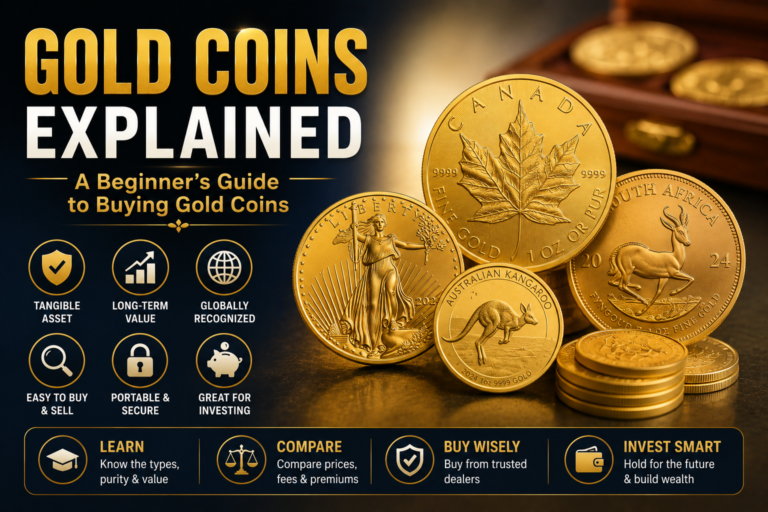
- American Gold Eagle: The most recognized gold coin in the US; strong domestic demand; slightly higher premiums but excellent liquidity
- Canadian Gold Maple Leaf: Globally recognized; .9999 pure; advanced security features; highly liquid worldwide
- South African Krugerrand: The original modern bullion coin; universally recognized; lowest premiums; excellent global liquidity
- British Gold Britannia: Strong European demand; CGT-exempt in UK; advanced security features
- Austrian Gold Philharmonic: Europe’s best-selling gold coin; excellent recognition throughout Europe
Less Recognized Coins (Lower Resale Value)
- Private mint coins: Coins from private refiners (not government mints) have lower recognition and often sell at larger discounts to spot
- Obscure government issues: Gold coins from smaller countries or limited international distribution may be harder to sell
- Commemorative coins: Special issue coins often have high initial premiums but poor resale value because demand is limited to collectors of that specific series
Rarity and Mintage: When Gold Coins Are Worth More Than Their Gold
Some gold coins are worth significantly more than their melt value — not because of their gold content, but because of their rarity, historical significance, or collector demand. These are numismatic coins, and their value is driven by factors entirely separate from the gold spot price.Factors That Add Numismatic Value
- Low mintage: Coins produced in limited quantities are inherently scarcer. A gold coin with a mintage of 5,000 will be worth more than an identical coin with a mintage of 500,000.
- Historical significance: Coins from significant historical periods or events command premiums. A 1907 Saint-Gaudens Double Eagle — considered one of the most beautiful US coins ever produced — sells for many multiples of its gold value.
- Age: Older coins, particularly those in good condition, carry numismatic premiums. A 100-year-old gold coin in uncirculated condition is rare because most were used in circulation.
- Mint errors: Coins with production errors — doubled dies, off-center strikes, wrong planchets — are highly sought after by collectors and can sell for enormous premiums.
- Key dates: Certain years within a coin series are scarcer than others and command higher prices. Collectors pay significant premiums for “key date” coins to complete their collections.
Bullion vs. Numismatic: Understanding the Difference
Modern bullion coins (Eagles, Maple Leafs, Krugerrands from recent years) have minimal numismatic value — they are traded primarily on gold content. Older coins, rare dates, and proof issues can have significant numismatic value that far exceeds their melt value. If you are uncertain whether a coin has numismatic value, have it evaluated by a professional coin dealer or grading service. The Professional Coin Grading Service provides authentication and valuation for numismatic coins.Condition and Grading: How They Affect Gold Coin Worth
The condition of a gold coin — how well it has been preserved — affects its value differently depending on whether it is a bullion coin or a numismatic coin.Condition for Bullion Coins
For modern bullion coins, condition has minimal impact on value. A scratched 2020 American Gold Eagle is worth essentially the same as a pristine 2020 American Gold Eagle — both are valued primarily on gold content. Minor wear, scratches, or handling marks do not significantly affect the melt value. The only exception is severe damage (dents, bends, holes, cleaning) which may cause a small discount when selling.Condition for Numismatic Coins
For numismatic coins, condition is everything. The difference between a heavily circulated coin and an uncirculated coin can be 10x or more. Professional grading services evaluate coins on the Sheldon Scale, from 1 (poor) to 70 (perfect). Key grades include:- MS-60 to MS-70 (Mint State): Uncirculated coins. MS-65 and above command significant premiums. MS-70 (perfect) is extremely rare and commands enormous premiums.
- AU-50 to AU-58 (About Uncirculated): Coins with very slight wear visible only under magnification. Premiums decrease as grade decreases.
- XF-40 to XF-45 (Extremely Fine): Light wear on high points. Moderate numismatic value for scarcer coins.
- VF-20 to VF-35 (Very Fine): Moderate wear. Reduced numismatic value.
- F-12 to F-15 (Fine): Significant wear. Minimal numismatic value for most coins.
Proof Coins
Proof coins are specially minted with polished dies and planchets, creating a mirror-like finish. They are produced in limited quantities for collectors and command significant premiums over bullion coins of the same gold content. Proof coins are graded on the same Sheldon Scale, with PR-70 being the highest grade.How to Calculate Gold Coin Value Step by Step
Step 1: Determine the Fine Gold Content
Identify the coin and its fine gold content in troy ounces. For a 1 oz American Eagle, this is 1.0000 oz. For a 1/4 oz Maple Leaf, this is 0.2500 oz. If you are unsure, look up the coin’s specifications from its mint. For a guide to coin weights, see our coin sizes guide.Step 2: Get the Current Gold Spot Price
Check the current gold spot price per troy ounce on our live gold price page. Gold prices change continuously during market hours, so use the most recent price available for accurate valuation.Step 3: Calculate the Melt Value
Melt Value = Fine Gold Content (oz) × Spot Price ($/oz) Example: 1 oz American Eagle at $2,333/oz spot = 1.0 × $2,333 = $2,333 melt value.Step 4: Add or Subtract the Premium
If you are buying, add the typical premium: Melt Value × (1 + Premium%). An American Eagle with a 6% premium would cost $2,333 × 1.06 = $2,472.98. If you are selling, subtract the typical discount: Melt Value × (1 – Discount%). Selling to a coin dealer, you might receive $2,333 × 0.98 = $2,286.34.Step 5: Consider Numismatic Value (If Applicable)
For older, rare, or proof coins, add any numismatic value above melt value. This requires specialist knowledge or professional appraisal. Numismatic value can range from a small percentage above melt to many multiples of melt value.Calculate Your Gold Coin’s Exact Value
Use our free coin value calculator to get the live melt value and estimated premium for specific gold coins at current spot prices.
Gold Coin Value Calculator → Gold Value Calculator →Frequently Asked Questions About Gold Coin Worth
How much is a 1 oz gold coin worth today?
The exact value depends on the current spot price and the specific coin. At a spot price of $2,333 per ounce, a 1 oz gold coin has a melt value of $2,333. If you are buying, expect to pay $2,400-2,520 depending on the coin type (Krugerrands are cheapest, American Eagles are most expensive). If you are selling, expect to receive $2,286-2,333 — approximately 98-100% of spot from a coin dealer. Use our gold coin value calculator for exact live values.Do gold coins lose value over time?
Gold coins retain their gold value (melt value) indefinitely — gold does not corrode or degrade. However, the market price of gold fluctuates, so the dollar value of your coin rises and falls with gold prices. Additionally, the premium you paid when buying is typically not recovered when selling — you buy at a premium and sell closer to spot. Over decades, gold’s long-term price appreciation typically more than compensates for the initial premium cost.Is a gold coin worth more than its melt value?
Modern bullion coins are generally worth close to their melt value — typically within 2-8% above (when buying) or 0-4% below (when selling). Numismatic coins — old, rare, proof, or collectible coins — can be worth significantly more than melt value, sometimes many multiples more. A 1907 Saint-Gaudens Double Eagle might have a melt value of $2,333 but sell for $5,000-20,000+ depending on condition and rarity. If your coin may have numismatic value, have it professionally evaluated before selling it as bullion.What makes a gold coin valuable beyond its gold content?
Five factors add value above gold content: rarity (low mintage, scarce dates), historical significance (coins from important eras), condition (uncirculated or proof coins command premiums), mint errors (production mistakes sought by collectors), and design beauty (aesthetically significant coins). Coins combining multiple factors — a rare, historically important coin in perfect condition — can sell for enormous premiums above melt value.How can I find out what my old gold coin is worth?
For an initial assessment: identify the coin (country, year, denomination), determine its fine gold content, calculate the melt value using current spot price, and then check whether it may have numismatic value. For a definitive valuation, take the coin to a professional coin dealer or submit it to a third-party grading service like PCGS or NGC. They can provide both authentication and valuation. Do not sell an old or potentially rare coin without first getting a professional assessment — selling a rare coin as scrap is one of the most costly gold selling mistakes.
About the author