Table of Contents
- Gold Coins vs Gold Bars: Which Should You Buy?
- Gold Coins vs Gold Bars: Key Differences at a Glance
- Premiums: Where Gold Bars Have the Advantage
- Liquidity and Resale: Why Coins Are Easier to Sell
- Available Sizes: Flexibility of Coins vs Efficiency of Bars
- Storage Considerations for Coins and Bars
- Authenticity and Verification Differences
- Gold Coins vs Gold Bars: How to Choose
- Frequently Asked Questions About Gold Coins vs Gold Bars
Gold Coins vs Gold Bars: Which Should You Buy?
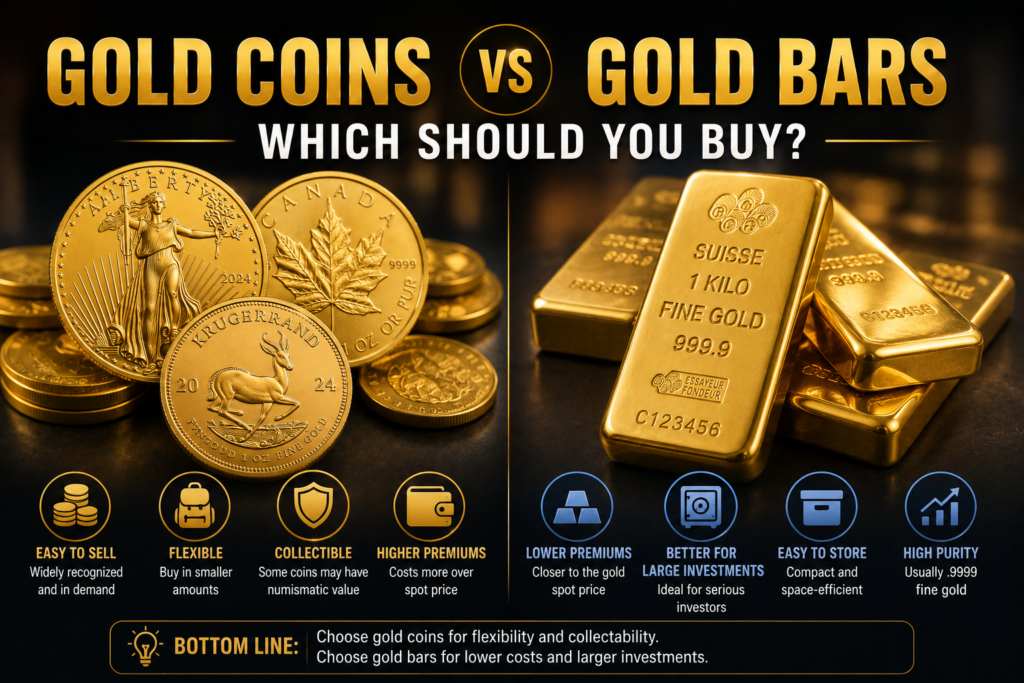
One of the most common questions from gold investors is whether to buy gold coins vs gold bars. Both are excellent forms of physical gold ownership, but they serve different purposes and offer different trade-offs. Gold bars generally provide more gold for your money with lower premiums. Gold coins offer greater flexibility, recognizability, and ease of resale. Understanding the differences between gold coins vs gold bars is essential before you make your first purchase. This guide provides a comprehensive comparison of gold coins vs gold bars across six key factors: premiums, liquidity, available sizes, storage, authenticity verification, and suitability for different investment goals. By the end, you will know exactly which form of physical gold is right for your portfolio — or whether a combination of both is the smartest approach.Gold Coins vs Gold Bars: Quick Answer • Buy gold bars if you want maximum gold content per dollar and are investing larger amounts ($5,000+) • Buy gold coins if you want recognizability, divisibility, and easier resale in smaller amounts • Best approach for most investors: A mix — primarily bars for value, some coins for flexibility • For budgets under $2,000: Coins are usually more practical (fractional sizes available) • For budgets over $10,000: Bars offer significantly better value on premiums
Gold Coins vs Gold Bars: Key Differences at a Glance
| Feature | Gold Coins | Gold Bars |
|---|---|---|
| Typical Premium | 3-8% (1 oz); 10-20% (fractional) | 0.5-3% (100g+); 3-8% (small bars) |
| Liquidity | Very high — recognized worldwide | High for major brands; lower for obscure refiners |
| Available Sizes | 1/20 oz to 1 oz (fractional available) | 1g to 1kg+ (larger sizes available) |
| Sovereign Guarantee | Yes — guaranteed by government mints | Yes — from LBMA-approved refiners only |
| Counterfeit Risk | Moderate — security features help | Higher for large bars — tungsten filling known |
| Storage Efficiency | Good — small and stackable | Excellent — most compact form of gold |
| Tax Advantages | CGT-exempt in UK; IRA-eligible in US | Varies; generally no special treatment |
| Best For | Smaller budgets, gifts, divisibility, ease of resale | Larger investments, lowest cost per gram |
Premiums: Where Gold Bars Have the Advantage
The most significant financial difference between gold coins vs gold bars is the premium — the amount you pay above the spot price. Gold bars consistently offer lower premiums than gold coins of comparable size, especially in larger denominations.Gold Bar Premiums
Gold bars are straightforward products — a refined piece of gold with minimal manufacturing cost. The premium on a 1 oz gold bar from a major refiner (PAMP Suisse, Valcambi, Perth Mint) is typically 2-4% above spot. Larger bars offer even better value: a 100-gram bar carries premiums of 1-2%, and a 1-kilogram bar may carry as little as 0.5-1% premium. For investors seeking maximum gold per dollar, bars are the clear winner in the gold coins vs gold bars comparison.Gold Coin Premiums
Gold coins cost more to produce than bars — they require detailed dies, multiple strikes, edge lettering, and quality control. A 1 oz American Gold Eagle carries a premium of 5-8%. A 1 oz Canadian Maple Leaf carries 3-5%. A 1 oz Krugerrand carries 2-4%. Fractional coins (1/10 oz, 1/4 oz) carry premiums of 10-20% because their manufacturing cost is similar to a 1 oz coin but spread over far less gold. The premium difference is significant: on a $10,000 investment, the gap between a 3% bar premium and a 6% coin premium is $300. Over time, as gold appreciates, this initial cost difference compounds. For pure investment efficiency, bars win the gold coins vs gold bars debate. For more on premiums and pricing, read our gold selling fees guide.Liquidity and Resale: Why Coins Are Easier to Sell
While bars win on purchase price, coins win on liquidity. Gold coins are recognized worldwide, verified by sovereign mints, and accepted by virtually every gold buyer, coin dealer, and jeweler. This universal recognition makes coins easier — and sometimes more profitable — to sell.Why Coins Are More Liquid
- Instant recognition: An American Gold Eagle or Krugerrand is identifiable at a glance. Buyers do not need to test it extensively to be confident in its authenticity.
- Sovereign guarantee: Government mints guarantee coin weight and purity. This eliminates the testing and verification burden that bars sometimes require.
- Wider buyer pool: Coins appeal to both investors and collectors. A coin dealer, bullion dealer, jewelry store, or private buyer will all purchase coins. Bars have a narrower market — primarily bullion dealers and refiners.
- Smaller denominations: Fractional coins can be sold individually for smaller transactions. A 1 oz bar must be sold as one piece.
When Bars Are Less Liquid
Large gold bars (100g, 1kg) can be harder to sell — and sometimes require testing or assay verification before a buyer will accept them. This is because large bars are the primary target of sophisticated counterfeiters using tungsten-filled cores. A buyer purchasing a 1 kg bar (worth $75,000+) must verify it has not been filled with tungsten. This verification process is less necessary for coins, whose security features and sovereign backing make counterfeiting more difficult. When you sell coins, you can often recover most of your initial premium — especially for popular coins with strong demand. When you sell bars, you typically receive close to spot price. This premium recovery partially offsets the higher initial cost of coins in the gold coins vs gold bars comparison.Available Sizes: Flexibility of Coins vs Efficiency of Bars
The gold coins vs gold bars comparison also differs in available sizes. Gold coins top out at 1 oz (with some exceptions like the 2 oz Queen’s Beast series). Gold bars are available in sizes from 1 gram all the way to 400 oz London Good Delivery bars.Gold Coin Sizes
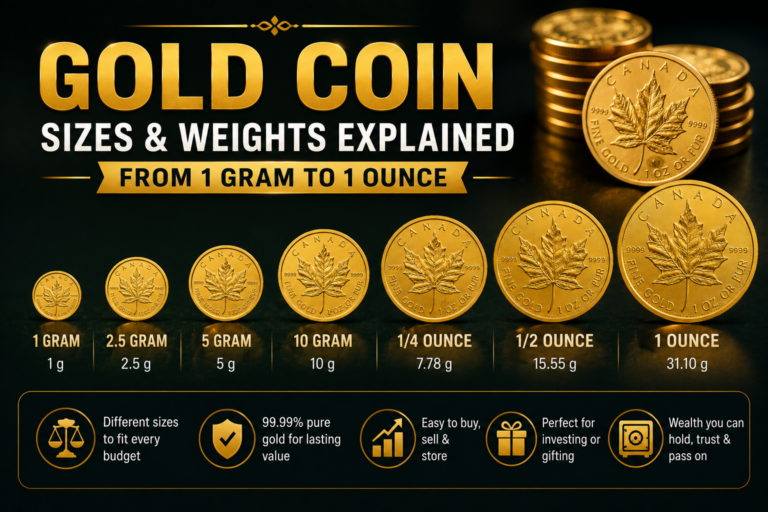
- 1 oz: The standard gold coin — best value for coins
- 1/2 oz, 1/4 oz, 1/10 oz: Fractional coins for smaller budgets and divisibility
- 1/20 oz: Available in Maple Leafs — very small, high premium
- Larger coins (2 oz, 5 oz, 1 kg coins): Limited edition collector coins with significant premiums
Gold Bar Sizes
- 1g, 5g, 10g: Small bars — affordable but high percentage premiums (5-15%)
- 20g, 50g: Mid-size bars — moderate premiums (3-8%)
- 100g: The sweet spot for bar investing — premiums of 1-2%
- 1 oz (31.1g): Popular small bar size — premiums of 2-4%
- 250g, 500g, 1kg: Large bars — lowest premiums (0.5-1.5%)
Storage Considerations for Coins and Bars
Both gold coins vs gold bars require secure storage, but they present slightly different storage challenges.Storage Efficiency
Gold bars are more space-efficient than coins. A 1 oz gold bar is smaller than a 1 oz gold coin because the coin’s design (detailed relief, reeded edge) adds volume. For large holdings, bars pack more gold value into less space. A $100,000 gold position in 1 oz bars fits in a small box. The same value in coins requires significantly more space.Storage Protection
Gold coins are more delicate than bars and require more careful handling. Coin surfaces can be scratched, damaging both their appearance and any numismatic value. Coins should be stored in individual capsules, tubes, or flips. Bars are more durable and can be stacked more freely — though handling gold bars of any size can cause scratches that slightly reduce resale value.Storage Costs
Storage costs are similar for gold coins vs gold bars on a per-dollar basis. Professional vault storage charges 0.3-1% of value annually regardless of form. Bank safe deposit box fees are flat rates. The practical difference is space: bars require less physical room for the same gold value. For home storage, a small safe can hold significantly more value in bars than in coins.Authenticity and Verification Differences
Both gold coins vs gold bars can be counterfeited, but the risks and verification methods differ.Gold Coin Authenticity
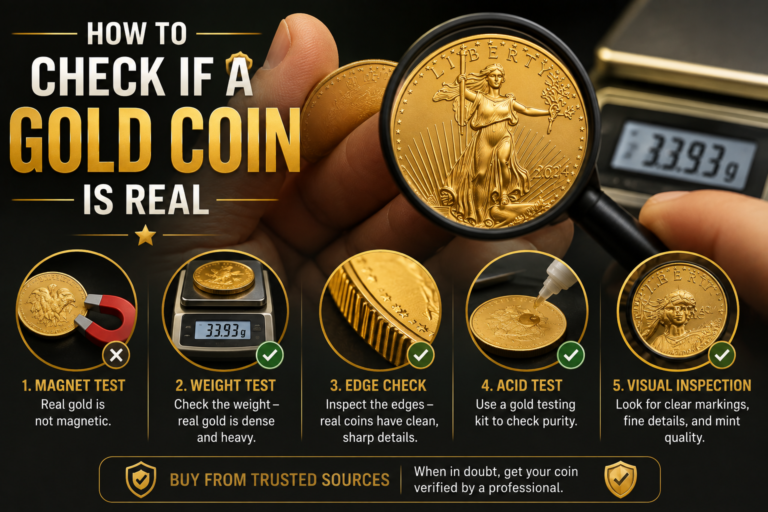
Gold coins feature advanced security elements that make them relatively difficult to counterfeit convincingly. Modern coins include micro-engraved marks, radial lines, latent images, and other anti-counterfeiting features. The sovereign guarantee of government mints provides additional confidence. When verifying coins, check weight, dimensions, edge markings, and security features. XRF testing provides definitive verification.Gold Bar Authenticity
Gold bars are simpler products — and therefore easier to counterfeit. The biggest risk is tungsten-filled bars: genuine gold bars that have been drilled out and filled with tungsten (which has nearly the same density as gold). These sophisticated fakes pass weight and density tests. They can only be detected through XRF analysis (which only penetrates a few microns), ultrasound testing, or drilling. For this reason, buy bars only from reputable dealers who source from LBMA-approved refiners. For large bars (100g+), request XRF verification. For gold coins vs gold bars authenticity, coins have the edge for individual buyers due to their security features and sovereign guarantees.Gold Coins vs Gold Bars: How to Choose
Buy Gold Coins If:
- Your budget is under $2,000 — fractional coins are more practical than small bars
- You want easy resale — coins sell faster and to more buyers than bars
- You may want to sell or gift in small amounts — coins are divisible into smaller units
- You value recognizability and security — sovereign coins are instantly trusted
- You are in the UK — Britannias and Sovereigns are CGT-exempt
- You are in the US and want IRA eligibility — American Eagles are IRA-approved
- You are buying your first gold — coins are the accessible, confidence-building starting point
Buy Gold Bars If:
- Your budget is $5,000 or more — bars offer significantly lower premiums at this scale
- You want maximum gold content per dollar — bars are the most efficient form of gold
- You are investing for the long term and do not anticipate selling soon
- You have limited storage space — bars pack more value into less space
- You are building a large position (100g+ bars) — the premium savings are substantial
The Hybrid Approach (Recommended for Most Investors)
Many experienced gold investors hold both coins and bars: primarily bars for the bulk of their position (taking advantage of lower premiums), plus some coins for liquidity, divisibility, and recognition. A typical allocation might be 70% bars and 30% coins. This gives you the efficiency of bars with the flexibility of coins — the best of both worlds in the gold coins vs gold bars decision.Calculate Your Gold Coin or Bar Value
Use our calculators to determine melt value and estimated premiums for coins and bars at live gold prices.
Gold Coin Value Calculator → Gold Value Calculator →Frequently Asked Questions About Gold Coins vs Gold Bars
Which is better: gold coins or gold bars?
Neither is universally “better” — the gold coins vs gold bars decision depends on your budget, goals, and preferences. Gold bars are better for maximizing gold content per dollar (lower premiums, especially in larger sizes). Gold coins are better for liquidity, divisibility, recognition, and tax advantages in some countries. Most investors benefit from a mix: bars for value, coins for flexibility. For budgets under $2,000, coins are usually more practical. For budgets over $5,000, bars offer superior value.Why do gold coins cost more than gold bars?
Gold coins cost more than bars because of higher manufacturing costs. Coins require detailed die design, multiple strikes, edge lettering, and quality control. These production costs are spread over the coin’s gold content as a premium. A 1 oz coin carries a 3-8% premium; a comparable 1 oz bar carries a 2-4% premium. In the gold coins vs gold bars comparison, coins carry higher premiums due to their more complex production process.Are gold bars easier to sell than gold coins?
No — gold coins are generally easier to sell than bars. Coins are recognized worldwide, carry sovereign guarantees, and appeal to both investors and collectors. They can be sold to coin dealers, bullion dealers, jewelers, and private buyers. Large bars (100g+) have a narrower buyer pool because they require more rigorous authenticity verification. In the gold coins vs gold bars liquidity comparison, coins win.Can I buy both gold coins and gold bars?
Yes — and this is often the smartest approach. A hybrid strategy of gold coins vs gold bars — rather than choosing one exclusively — gives you the best of both. Use bars for the core of your gold position (efficiency and lower premiums) and coins for a portion (liquidity, divisibility, and recognition). A common allocation is 70% bars / 30% coins. Read our gold investment strategies guide for more allocation guidance.What is the cheapest way to buy gold?
The cheapest way to buy gold per gram is large gold bars (100g, 250g, 1kg) from reputable dealers. These carry the lowest premiums (0.5-2%). The next cheapest is 1 oz gold bars at 2-4% premium. For coins, the Krugerrand typically has the lowest premium among sovereign coins (2-4%). In the gold coins vs gold bars cost comparison, bars consistently win on a per-gram basis.Do gold bars have any advantages over coins for storage?
Yes. Gold bars are more space-efficient than coins. A 1 oz bar is physically smaller than a 1 oz coin because coins have raised designs and reeded edges that add volume. For large holdings, this space efficiency matters — $100,000 of gold in bars occupies significantly less volume than the same value in coins. Bars are also more durable and less prone to surface damage from stacking. In the gold coins vs gold bars storage comparison, bars are more efficient.
About the author