Table of Contents
- Gold Market Explained: How the Global Gold Market Works
- The Global Gold Market Structure at a Glance
- The Spot Price: How the Global Gold Market Sets Prices
- Gold Exchanges: COMEX, LBMA, and Trading Venues Explained
- Central Banks: The Largest Players in the Gold Market
- Refiners and the Physical Gold Supply Chain
- Dealers, Distributors, and the Retail Gold Market
- Jewelry Demand: The Biggest Consumer of Gold
- Investors, ETFs, and Institutional Gold Market Participants
- Frequently Asked Questions About the Gold Market
Gold Market Explained: How the Global Gold Market Works
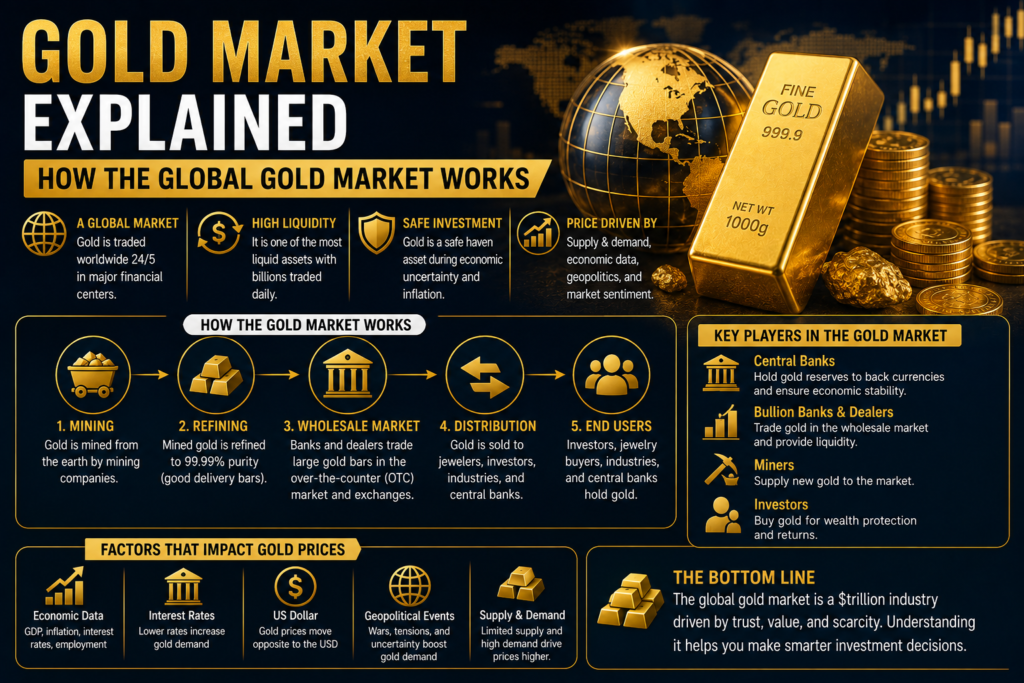
The global gold market is the largest precious metals market in the world — with daily trading volumes exceeding $150 billion. It is a complex, interconnected system spanning mines, refiners, wholesale trading centers, central banks, financial exchanges, retail dealers, and millions of individual buyers and sellers across every continent. Understanding how the global gold market works helps you make smarter decisions about buying, selling, and investing in gold. This guide provides a comprehensive overview of the gold market — from how spot prices are set in London and New York, to the role of central banks and refiners, to how gold flows from mines to jewelry stores and investment portfolios around the world. By the end, you will understand the full ecosystem of the global gold market and where you fit into it.The Global Gold Market: Key Facts • Daily trading volume: $150-200 billion — larger than most stock exchanges • Total above-ground gold: Approximately 205,000 tonnes — fits into a 23-meter cube • Annual mine production: ~3,000 tonnes, adding only 1.5% to existing supply annually • Central bank reserves: 35,000+ tonnes held by governments worldwide • Jewelry demand: 45-50% of annual gold consumption • Primary price-setting centers: London (LBMA) and New York (COMEX)
The Global Gold Market Structure at a Glance
The global gold market is best understood as a layered ecosystem. At the top are the price-setting institutions — the London Bullion Market and COMEX futures exchange. Below them are the wholesale market participants — central banks, commercial banks, refiners, and large trading firms. In the middle are distributors and dealers who move gold from wholesale to retail. At the base are end consumers — jewelry buyers, investors, and collectors worldwide. This structure matters because the price you pay for a gold coin or jewelry piece is determined by forces at every level of this market. Understanding how the gold market works at each level reveals why prices move, why premiums exist, and where your gold comes from.The Spot Price: How the Global Gold Market Sets Prices
The gold spot price is the foundation of the entire gold market. It represents the price for one troy ounce of pure gold for immediate delivery in the wholesale market. Every other gold price — for coins, bars, jewelry, futures contracts, and even gold mining stocks — is derived from the spot price.How the Spot Price Is Determined
The spot price is set through continuous trading and auction processes in two primary venues:- The London Bullion Market (LBMA Gold Price): Set twice daily (10:30 AM and 3:00 PM London time) through an electronic auction. Participating banks — including HSBC, JPMorgan, UBS, and others — submit buy and sell orders. The price that balances supply and demand becomes the LBMA Gold Price, used as the global benchmark for physical gold transactions, central bank deals, and long-term contracts.
- COMEX Futures (New York): The COMEX division of CME Group operates the world’s largest gold futures market. Gold futures contracts trade nearly 24 hours a day, providing continuous price discovery. The COMEX price is what you see on financial news tickers and live gold price websites throughout the trading day.
Gold Exchanges: COMEX, LBMA, and Trading Venues Explained
The London Bullion Market (LBMA)
The London Bullion Market is the world’s largest over-the-counter (OTC) gold market. Unlike a traditional exchange, the LBMA does not have a central trading floor. Instead, transactions occur directly between member banks and trading firms. The LBMA establishes the Good Delivery List — the gold standard for refined gold bars that meet strict specifications (typically 400 oz bars of 99.5%+ purity). Only bars from LBMA-approved refiners are accepted in the international wholesale market. The LBMA publishes the twice-daily benchmark gold price used in contracts worldwide.COMEX (New York)
COMEX, part of the CME Group, is the world’s largest gold futures exchange. COMEX gold futures trade in standard contracts of 100 troy ounces each. These contracts allow traders to buy or sell gold at a specified future date at a predetermined price. While most futures contracts are settled in cash (never taking physical delivery), the COMEX price is the most widely quoted gold price in financial media. COMEX trading occurs nearly 24 hours a day, Sunday evening through Friday afternoon (New York time). For more on COMEX, visit the CME Group’s gold market page.Other Gold Exchanges
- Shanghai Gold Exchange (SGE): China’s official gold exchange — the largest physical gold exchange in the world. Sets the benchmark price for the Chinese gold market.
- Tokyo Commodity Exchange (TOCOM): Japan’s primary gold futures venue.
- Multi Commodity Exchange (MCX): India’s largest commodity exchange for gold futures.
- Dubai Gold & Commodities Exchange (DGCX): The Middle East’s primary gold trading venue.
Central Banks: The Largest Players in the Gold Market
Central banks are among the most important — and least understood — participants in the global gold market. Collectively, they hold over 35,000 tonnes of gold — approximately 17% of all above-ground gold. Their buying and selling decisions significantly influence gold prices and market sentiment.Why Central Banks Hold Gold
- Diversification: Gold provides a hedge against currency risk and reduces reliance on any single currency (particularly the US dollar)
- Inflation protection: Gold preserves purchasing power when paper currencies lose value
- Crisis insurance: Gold is a liquid asset that can be sold in emergencies without counterparty risk
- National prestige: Large gold reserves signal financial strength and sovereignty
The Top Central Bank Gold Holders
The United States holds the largest gold reserves at 8,133 tonnes — approximately 70% of its total foreign reserves. Germany holds 3,352 tonnes. Italy holds 2,452 tonnes. France holds 2,437 tonnes. Russia holds 2,333 tonnes. China officially reports 2,192 tonnes, though actual holdings may be higher. Since 2010, central banks globally have been net buyers of gold every year — a shift from the 1990s and 2000s when many central banks were selling. The World Gold Council publishes detailed data on central bank gold reserves and their quarterly changes.Refiners and the Physical Gold Supply Chain
Between the gold mine and the final consumer lies a critical link: gold refiners. These companies take raw gold — from mines, scrap collectors, and recycled jewelry — and purify it into the standardized bars and coins that trade in the global gold market.What Refiners Do
- Assay and test raw gold: Determine the exact purity of incoming gold using XRF analysis and fire assay
- Melt and purify: Refine gold to 99.5% or higher purity through chemical processes
- Produce standard bars: Cast 400 oz London Good Delivery bars and smaller retail bars (1g to 1kg)
- Supply mints: Provide refined gold to government mints for coin production
- Recycle scrap: Process scrap gold from jewelry, electronics, and industrial waste
Major Gold Refiners
The largest gold refiners are concentrated in Switzerland, which refines approximately 70% of the world’s gold. Major refiners include Valcambi, PAMP Suisse, Argor-Heraeus, and Metalor (all in Switzerland), Rand Refinery in South Africa, and Perth Mint in Australia. LBMA accreditation is the gold standard for refiners — only LBMA-approved refiners can produce bars accepted in the international wholesale market.Dealers, Distributors, and the Retail Gold Market
Gold dealers and distributors form the bridge between the wholesale gold market and individual buyers. They purchase gold from refiners and mints, add their margin, and sell to the public through retail locations, online platforms, and bullion services.Types of Gold Dealers
- Bullion dealers: Specialize in gold coins and bars. Examples: APMEX, JM Bullion, SD Bullion in the US; BullionByPost and Atkinsons in the UK
- Coin shops: Local retailers selling coins, often with a focus on both bullion and numismatic coins
- Bank bullion services: Major banks in some countries sell gold coins and bars to customers
- Online platforms: Digital gold platforms and precious metals trading websites that sell gold online
- Gold “We Buy” operations: Retailers focused on purchasing gold from the public
How Dealer Margins Work
When you buy gold, you pay the spot price plus a premium covering the dealer’s acquisition cost, overhead, and profit. Typical premiums are 2-8% for coins and 1-5% for bars, depending on size and product. When you sell, you receive the spot price minus a discount. This spread between buy and sell prices is the dealer’s margin. Understanding these margins is essential to getting fair pricing in the gold market. For more detail, read our gold selling fees and dealer margins guide.Jewelry Demand: The Biggest Consumer of Gold
Jewelry is the largest single source of gold demand, accounting for 45-50% of annual consumption. Two countries — India and China — together represent over 50% of global gold jewelry demand. Understanding jewelry demand is essential to understanding the gold market because consumer buying patterns directly influence gold prices.Where Jewelry Demand Comes From
- India: The world’s largest gold jewelry market. Gold is deeply embedded in Indian culture — weddings, festivals (Diwali, Akshaya Tritiya), and traditional savings all drive demand. Indian jewelry is predominantly 22K gold.
- China: The second-largest market. Gold jewelry is purchased for weddings, Chinese New Year, and as a store of wealth. 24K (999) gold is popular in China.
- Middle East: Gold souks in Dubai, Riyadh, and other cities serve regional and tourist demand. 21K and 22K are common purities.
- Southeast Asia: Thailand (23K), Indonesia, and Vietnam have strong gold traditions.
- Western markets: US and European jewelry demand focuses on 14K and 18K gold for fashion jewelry, engagement rings, and everyday wear.
How Jewelry Demand Affects Prices
Jewelry demand is price-sensitive. When gold prices drop, jewelry demand typically increases as consumers take advantage of lower prices. When prices rise sharply, jewelry demand may fall as consumers defer purchases. This creates a natural balancing mechanism in the gold market. For more on choosing gold jewelry, read our complete gold jewelry guide.Investors, ETFs, and Institutional Gold Market Participants
Beyond central banks, refiners, and jewelers, the global gold market includes a wide range of investors — from individual coin collectors to massive institutional funds managing billions in gold assets.Gold ETFs (Exchange-Traded Funds)
Gold ETFs are among the largest institutional holders of physical gold. The SPDR Gold Shares (GLD) — the world’s largest gold ETF — holds over 800 tonnes of gold in vaults in London. Gold ETFs allow investors to buy and sell gold exposure through stock exchanges without handling physical metal. Total gold ETF holdings exceed 3,000 tonnes globally. ETF buying and selling directly moves physical gold in and out of vaults, influencing market supply and demand.Institutional Investors
- Pension funds and endowments: Allocate 2-5% of portfolios to gold for diversification
- Hedge funds: Trade gold futures and options for short-term gains
- Sovereign wealth funds: Government investment funds that include gold in their portfolios
- Insurance companies: Hold gold as part of investment portfolios
Individual Investors
Individual investors participate in the gold market through physical gold (coins, bars, jewelry), gold ETFs, gold mining stocks, futures contracts, and digital gold platforms. Individual investment demand fluctuates with economic conditions — typically rising during periods of inflation, geopolitical uncertainty, and financial market volatility. For investment guidance, read our gold investment for beginners guide.Frequently Asked Questions About the Gold Market
Who controls the gold market?
No single entity controls the gold market — it is a decentralized global market influenced by many participants. The London Bullion Market Association (LBMA) sets the benchmark price through a twice-daily auction. COMEX in New York provides continuous futures pricing. Central banks influence the market through their buying and selling. Jewelry demand from India and China shapes physical consumption. No government or institution can set gold prices unilaterally, which is one of gold’s key characteristics as an asset. The LBMA publishes detailed information on how the benchmark gold price is set.Is the gold market open 24 hours?
Yes — effectively. The global gold market operates nearly 24 hours a day, five days a week. Trading begins in Sydney and Tokyo, moves through Singapore and Hong Kong, continues to London, and finishes in New York. COMEX futures trade from Sunday evening through Friday afternoon (New York time), with brief daily maintenance breaks. Over-the-counter trading in London occurs during London business hours. This continuous trading means gold prices are always moving in response to global events.How big is the global gold market?
The global gold market is enormous. Daily trading volume exceeds $150 billion, making gold one of the most liquid assets in the world. The total value of all above-ground gold (205,000 tonnes) is approximately $12-13 trillion at current prices. To put this in perspective, the total gold market is larger than the GDP of all but two countries (US and China). The World Gold Council publishes comprehensive gold market statistics.Who are the biggest gold buyers and sellers?
The biggest gold market buyers are: central banks (1,000+ tonnes annually in recent years), jewelry manufacturers (2,200+ tonnes annually), gold ETFs (variable, but significant), and technology companies (300+ tonnes annually for electronics). The biggest sellers are: gold mines (3,000+ tonnes annually), recyclers (1,200+ tonnes annually from scrap gold), and occasionally central banks selling reserves. For real-time market data, see our live gold prices.What is the difference between the spot price and the futures price?
The spot price is the price for immediate delivery of physical gold — the price you would pay today for gold delivered now. The futures price is the price for gold delivered at a specified future date. The two prices are closely linked but can differ slightly due to cost of carry (interest rates, storage costs) and market expectations. For most individual buyers and sellers of physical gold, the spot price is the relevant benchmark. For traders, the futures price provides additional information about market expectations for future gold prices.
About the author