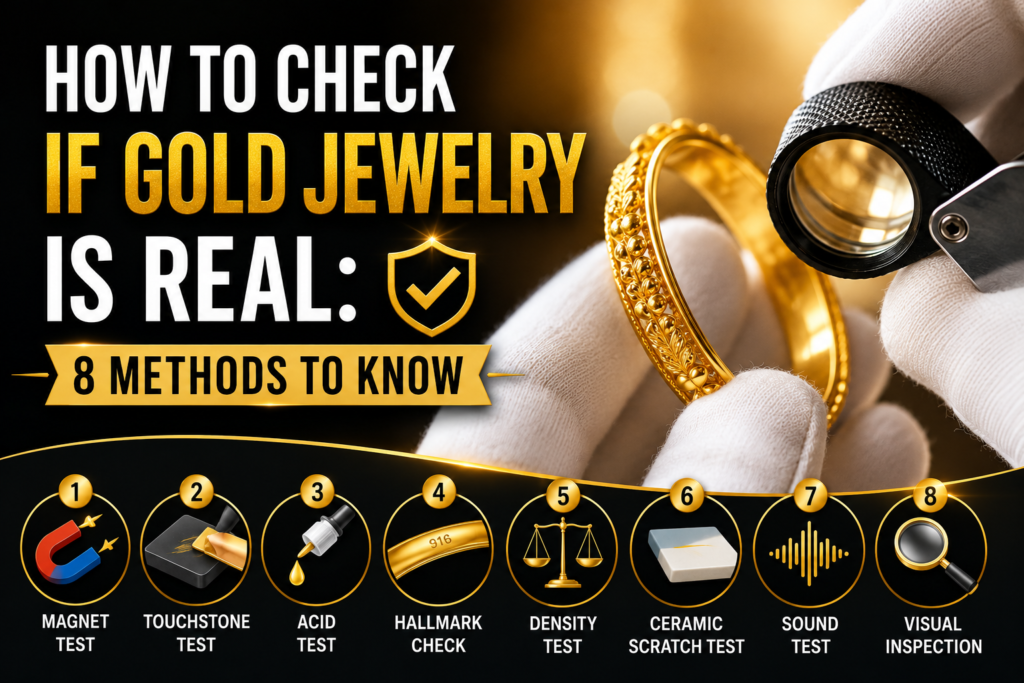
How to Check if Gold Jewelry Is Real: 8 Methods to Know
Counterfeit gold jewelry is a multi-billion-dollar global problem. From gold-plated brass sold as solid 18K to tungsten-filled bars passing as pure gold, fake gold has become increasingly sophisticated. Knowing how to check if gold jewelry is real protects you from overpaying, being scammed, or unknowingly selling fake gold that has no melt value. This guide covers 8 practical methods to verify gold authenticity — ranging from simple at-home tests you can do in seconds to professional laboratory techniques used by jewelers and refiners. No single method is 100% definitive on its own, but combining multiple tests gives you a high degree of confidence in your gold’s authenticity.Quick Gold Testing Summary:
• Easiest (no tools): Check hallmarks, use a magnet, inspect visually for discolouration
• Moderate (inexpensive tools): Acid test kit, ceramic scratch test, density/water displacement test
• Professional (most accurate): XRF analysis, electronic gold tester, fire assay (destructive)
• Red flags: Missing/blurry hallmarks, magnetic attraction, discolouration revealing base metal, price too good to be true
• Always verify: Use our free gold purity checker to decode hallmarks instantly
Method 1: Check the Hallmark or Stamp
The fastest and easiest way to check if gold is real is to look for an official hallmark or purity stamp. Every genuine gold jewelry piece should carry a stamp indicating its karat purity or millesimal fineness.What to Look For
- Karat stamps: 24K, 22K, 18K, 14K, 10K, 9K — these indicate the gold purity in the karat system
- Millesimal stamps: 999, 916, 750, 585, 417, 375 — these indicate purity in parts per thousand
- Manufacturer or maker’s mark: A symbol or initials identifying the jeweler or manufacturer
- Assay office mark: In the UK and some countries, an additional symbol indicating which assay office tested and certified the gold
- Country of origin stamps: “ITALY,” “CHINA,” “INDIA,” etc. — common on imported gold jewelry
Where to Find the Hallmark
On rings, look on the inside of the band. On chains and necklaces, check the clasp or the small tag near the clasp. On earrings, examine the post or backing. On bracelets, look near the clasp or on the inside. On pendants, check the back or the bail (the loop where the chain passes through). You may need a magnifying glass or jeweler’s loupe — hallmarks are often very small.Red Flags with Hallmarks
- Missing hallmark entirely: Most genuine gold jewelry carries a stamp. Some antique or handmade pieces may not, but this is the exception, not the rule.
- Blurry, uneven, or misaligned stamps: Genuine hallmarks are crisp, straight, and professionally applied. Sloppy stamping suggests counterfeiting.
- Stamps that say GP, GEP, GF, RGP, or HGP: These indicate gold plating or gold filling — NOT solid gold. The item has minimal gold value.
- Stamps that look hand-scratched: Genuine hallmarks are machine-stamped. Hand-etched purity marks are highly suspicious.
- “999” on jewelry that looks too pale: 24K gold has a deep yellow-orange color. If a piece stamped “999” looks pale or brassy, it is likely fake.
Decode Any Gold Hallmark Instantly
Type any stamp or hallmark into our free checker to verify purity, identify authenticity markers, and spot potential counterfeits.
Check Hallmark Now →Method 2: The Magnet Test
Gold is non-magnetic. If a magnet attracts your jewelry strongly, it is either not gold or contains significant ferrous (iron-based) metals. This is one of the quickest preliminary tests you can perform at home with a simple refrigerator magnet or a stronger neodymium magnet from a hardware store.How to Perform the Magnet Test
- Obtain a strong magnet — a neodymium (rare earth) magnet works best and costs only a few dollars
- Hold the magnet close to your gold item without touching it
- Observe whether the item is attracted to the magnet
- If the item jumps to the magnet or is strongly attracted, it is not solid gold
- If the item shows no attraction at all, it passes the magnet test
Limitations of the Magnet Test
The magnet test is useful but not definitive. Some counterfeit gold uses non-magnetic metals like copper, brass, or high-quality stainless steel. A piece passing the magnet test could still be fake. Additionally, gold jewelry with magnetic clasps (some chains use steel springs in the clasp) may show slight magnetism at the clasp only — this does not mean the gold itself is fake. Always combine the magnet test with other methods.Method 3: Visual Inspection for Discoloration
Genuine gold maintains a consistent color throughout. Gold-plated or gold-filled items will eventually show signs of the underlying base metal, particularly in high-wear areas. A careful visual inspection can reveal these telltale signs.What to Look For
- Worn edges revealing a different color: Check the edges of rings, the tips of earring posts, and the backs of pendants. If you see a silver, grey, reddish, or brassy color appearing through the gold surface, the item is gold-plated.
- Discoloration in recessed areas: Gold-plated items often show darkening or a different color in crevices, engraving, and areas that are difficult to plate evenly.
- Uneven color: Genuine gold has a uniform color across the entire piece. Variations in shade or patches of different color indicate plating or counterfeit material.
- Green or black marks on skin: When gold-plated jewelry reacts with sweat and skin oils, it can leave green or black marks. Genuine high-karat gold (14K+) rarely causes skin reactions.
- Bubbling or flaking: Gold plating can bubble, flake, or peel over time, revealing the base metal underneath. This is definitive proof the item is not solid gold.
Method 4: The Ceramic Scratch Test
The ceramic scratch test is a simple, slightly destructive method that can help distinguish real gold from pyrite (fool’s gold) and base metals. It involves rubbing the gold item against an unglazed ceramic surface and observing the color of the streak it leaves.How to Perform the Ceramic Test
- Find an unglazed ceramic tile or plate — the unglazed bottom ring of a coffee mug works perfectly
- Gently rub the gold item against the unglazed ceramic surface, leaving a streak
- Observe the color of the streak: — Gold-colored streak: Suggests genuine gold — Black or dark grey streak: Indicates pyrite (fool’s gold), base metal, or counterfeit
⚠️ Important: The ceramic scratch test will leave a small scratch mark on your gold item. Do not perform this test on valuable jewelry, heirloom pieces, or items with sentimental value. It is best reserved for scrap gold, coins, or items you are willing to potentially damage. Always test in an inconspicuous area.
Method 5: Acid Testing
Acid testing is the most reliable at-home method for verifying gold purity. Gold testing kits are widely available online and at jewelry supply stores for $20-50. The test uses nitric acid and aqua regia solutions that react differently with different gold purities.How Acid Testing Works
- The gold item is scratched against a testing stone (a black slate-like surface included in testing kits) to leave a small gold streak.
- A drop of acid solution is applied to the streak. Different acid strengths are used for different karat levels.
- If the streak disappears or changes color, the gold is below the karat level being tested. If the streak remains unchanged, the gold meets or exceeds that karat level.
Types of Acid Tests
- 10K acid: Dissolves gold below 10K; 10K and above remains
- 14K acid: Dissolves gold below 14K; 14K and above remains
- 18K acid: Dissolves gold below 18K; 18K and above remains
- 22K acid: Dissolves gold below 22K; 22K and above remains
Method 6: The Density Test (Water Displacement)
Gold is one of the densest metals on Earth at 19.3 g/cm³. Measuring an item’s density by weighing it in air and then in water can help determine if it is genuine gold. This test requires a precise digital scale (0.01g accuracy) and is non-destructive.How the Density Test Works
- Weigh the item dry on a precise digital scale. Record the dry weight in grams.
- Weigh the item submerged in water. Place a container of water on the scale, zero the scale, then suspend the gold item in the water (not touching the sides or bottom) using a thin thread. Record the submerged weight.
- Calculate the density: Divide the dry weight by the difference between dry and submerged weight. Formula: Density = Dry Weight ÷ (Dry Weight – Submerged Weight)
- Compare to gold’s density: Pure gold = 19.3 g/cm³. 18K gold ≈ 15.5-16.5 g/cm³. 14K gold ≈ 13-14 g/cm³. If the calculated density is significantly different, the item may not be genuine gold.
Limitations
This test works best for solid, single-metal items — coins and bars. Hollow jewelry, items with gemstones, and pieces with non-gold components (springs, clasps) will give inaccurate readings. The test requires a precise scale and careful measurement. Tungsten has a similar density to gold (19.25 g/cm³) and can fool density tests — this is how sophisticated counterfeit gold bars are made.Method 7: Electronic Gold Testing
Electronic gold testers use electrical conductivity to estimate gold purity. They are non-destructive, provide instant results, and are widely used by jewelers, pawn shops, and gold buyers. Handheld electronic testers cost $200-500+ and can test most gold purities from 6K to 24K.How Electronic Testers Work
The tester applies a small electrical current to the gold item through a probe. Different gold purities conduct electricity differently. The tester compares the conductivity reading to its internal calibration and displays an estimated karat value. Most testers require the item to be cleaned first (oils and dirt affect readings) and work best on smooth, flat surfaces.Accuracy
Electronic testers provide good accuracy for most jewelry but can be fooled by certain counterfeit techniques. Heavy gold plating over a conductive base metal may give a false reading. Tungsten cores cannot be detected. For the most accurate results, use an electronic tester alongside other verification methods. This is the tool most professional gold buyers use for routine testing.Method 8: XRF Analysis (Professional Testing)
X-Ray Fluorescence (XRF) analysis is the gold standard for non-destructive gold testing. It provides instant, highly accurate purity readings without damaging the item in any way. XRF analyzers are used by professional refiners, major jewelers, and assay offices worldwide.How XRF Works
The XRF analyzer fires a beam of X-rays at the gold item. This excites the atoms in the metal, causing them to emit fluorescent X-rays at specific energy levels unique to each element. The analyzer detects these emissions and calculates the exact elemental composition of the item — including the gold percentage and which alloy metals are present — in seconds.Advantages of XRF Testing
- Completely non-destructive: No scratches, no chemicals, no damage whatsoever
- Instant results: Purity readings in 3-10 seconds
- Highly accurate: Typically within 0.1-0.5% of fire assay results
- Detects alloy composition: Shows not just gold purity but also which metals are in the alloy
- Can detect plating and filled items: XRF penetrates only a few microns, so thick plating may mask base metals — but experienced operators can identify plating signatures
Gold Testing Methods Compared
| Method | Accuracy | Destructive? | Cost | Best For |
|---|---|---|---|---|
| Hallmark Check | Moderate | No | Free | Quick first check |
| Magnet Test | Low | No | $2-10 | Quick screening |
| Visual Inspection | Moderate | No | Free | Spotting plated items |
| Ceramic Scratch | Moderate | Yes (minor) | Free | Scrap gold only |
| Acid Test | Good | Yes (minor) | $20-50 | Best at-home accuracy |
| Density Test | Good | No | $15-30 (scale) | Coins, bars, solid items |
| Electronic Tester | Good-Very Good | No | $200-500+ | Professional jewelers |
| XRF Analysis | Excellent | No | Free at many jewelers | High-value items, definitive |
Common Types of Fake Gold
- Gold-plated jewelry: A microscopically thin layer of gold (0.5-5 microns) electroplated onto brass, copper, or steel. Stamped GP, GEP, or HGP. Negligible gold value.
- Gold-filled jewelry: A thicker gold layer mechanically bonded to a base metal core. Stamped GF. Contains 5-10% gold by weight — more than plated, but still not solid gold.
- Tungsten-filled bars: Professional counterfeits where a tungsten core (density nearly identical to gold) is encased in genuine gold. Can fool density tests and some electronic testers. Detected by XRF or by drilling.
- Brass or copper alloys: Gold-colored base metals with no gold content. Detectable by magnet test (sometimes), acid test, or XRF.
- Gold-plated tungsten jewelry: Similar to filled bars but in jewelry form. Increasingly common in counterfeit chains and bracelets from unverified online sellers.
- Lower-karat gold stamped as higher: 10K gold stamped “18K” or “22K.” The item is genuine gold but at a lower purity than claimed. Acid testing or XRF reveals the true purity.
Frequently Asked Questions About Testing Gold
How can I test gold at home without damaging it?
The best non-destructive home tests are: checking hallmarks with a magnifying glass, the magnet test, and careful visual inspection for discolouration, uneven color, or signs of plating. The density test is also non-destructive if you have a precise scale. For definitive results without damage, visit a jeweler for XRF testing — most will test items for free or a small fee.Is the bite test reliable for testing gold?
No. The “bite test” — biting gold to see if it dents — is a Hollywood myth. While pure gold is soft enough to show teeth marks, this test is unreliable, unhygienic, and can damage both your teeth and the jewelry. Gold-plated lead (which is toxic) is also soft. Do not use the bite test. Use proper testing methods instead.Can real gold be magnetic?
Pure gold is never magnetic. However, some gold jewelry may show slight magnetism at the clasp because the spring mechanism inside the clasp is made of steel. This does not mean the gold itself is fake — only the clasp spring. If the entire chain, ring, or bracelet is attracted to a magnet, the piece is not solid gold.How do jewelers test gold?
Professional jewelers typically use a combination of methods. Most will start with a visual inspection and hallmark check, then use an electronic gold tester for routine verification. For high-value items, they use XRF analysis for definitive, non-destructive purity readings. Acid testing is still used by some jewelers and pawn shops, particularly for scrap gold. Fire assay is used by refiners for the most accurate results when melting gold.What should I do if I think my gold is fake?
First, do not panic — perform multiple tests before concluding the item is fake. A single failed test is not definitive. Check hallmarks, use a magnet, inspect visually, and if possible, visit a jeweler for professional XRF testing. If the item is confirmed fake and you purchased it recently from a retailer, contact them for a refund. If you bought from an individual seller, your options may be limited. Always buy gold from reputable sources and test high-value purchases immediately.Does real gold leave a mark on skin?
Real high-karat gold (14K and above) rarely leaves marks on skin. Green or black marks on skin are typically caused by gold-plated or gold-filled jewelry where the base metal (usually copper or brass) reacts with sweat, lotions, and skin oils. Some people’s body chemistry can cause a reaction even with lower-karat genuine gold (10K), but this is less common.
About the author