Table of Contents
- Gold Market Trends: What Is Driving Gold Prices in 2026?
- Monetary Policy: The Rate Cut Cycle and Gold in 2026
- Central Bank Gold Buying: The Record Trend Continues
- Geopolitical Uncertainty: Safe-Haven Demand in 2026
- Gold ETF Flows: Institutional Money Returns
- Investor Sentiment: A New Generation Discovers Gold
- Supply Constraints and Mining Challenges in 2026
- Gold Price Outlook for the Rest of 2026
- Frequently Asked Questions About Gold Market Trends 2026
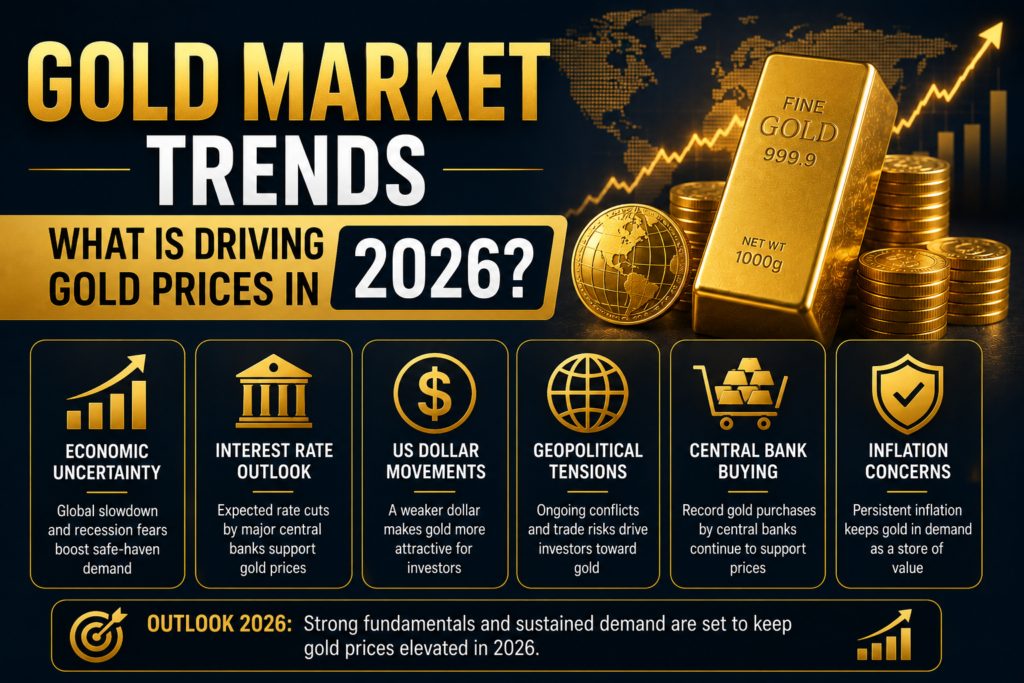
Gold Market Trends: What Is Driving Gold Prices in 2026?
Gold enters 2026 on the back of an extraordinary multi-year bull run — and the forces that have driven gold prices to record highs remain firmly in place. Understanding the gold market trends shaping 2026 is essential for investors, sellers, and anyone considering adding gold to their portfolio. From a pivotal shift in global monetary policy and unprecedented central-bank buying to geopolitical instability and a new wave of investor interest, the factors driving gold prices in 2026 are powerful, structural, and mutually reinforcing. This analysis examines the major forces driving gold prices in 2026. We look at where interest rates are heading, why central banks continue buying gold at record pace, how geopolitical uncertainty is fueling safe-haven demand, and what the return of ETF inflows and a new generation of investors means for the market. Whether you are buying, selling, or holding, these gold market trends provide the context you need.Gold Market Trends 2026: The Big Picture • Monetary policy: Global rate cuts support gold; real rates trending lower • Central banks: Third consecutive year of 1,000+ tonne purchases expected • Geopolitics: Multiple active conflicts and trade tensions drive safe-haven demand • ETF flows: Institutional investors returning to gold after a period of outflows • New investors: Digital gold and fractional platforms broadening gold ownership • Supply: Mining production stagnant; recycling responds to higher prices • Overall trend: Bullish — structural forces support continued gold strength
Monetary Policy: The Rate Cut Cycle and Gold in 2026
The single most important gold market trend in 2026 is the ongoing shift in global monetary policy. After the aggressive rate-hiking cycle of 2022-2023 — which created significant headwinds for gold — major central banks have shifted toward rate cuts and accommodative policy. This pivot is exceptionally bullish for gold, which thrives when interest rates fall and real yields decline.The Federal Reserve and US Rates
The US Federal Reserve began cutting interest rates in late 2024, and the trajectory continues into 2026. Each rate cut reduces the opportunity cost of holding gold — the yield investors forgo by owning non-interest-bearing gold instead of bonds or cash. As rates fall toward historically normal levels, gold becomes increasingly attractive. Markets are pricing in continued easing through 2026, creating a supportive backdrop for gold prices.Real Interest Rates
The most important measure is real interest rates — nominal rates minus inflation. Even with nominal rates falling, inflation remains above pre-2020 levels in most economies. This combination — falling nominal rates plus stubborn inflation — means real rates are negative or close to zero in many countries. Negative real rates are the most bullish monetary environment for gold in history. When cash and bonds guarantee a loss of purchasing power, gold’s non-yielding nature becomes an advantage, not a disadvantage.Global Rate Cuts
The rate-cutting trend is global. The European Central Bank, Bank of England, Bank of Canada, and other major central banks have all begun easing. This synchronized monetary loosening weakens currencies against gold and reinforces gold’s appeal worldwide. The Federal Reserve’s meeting calendar and the ECB’s policy calendar are closely watched by gold traders for rate decisions.Track Live Gold Prices as Trends Unfold
Check current gold prices to see how 2026 trends are affecting the market in real time.
Live Gold Prices → Investment Calculator →Central Bank Gold Buying: The Record Trend Continues
One of the most powerful gold market trends driving prices in 2026 is the unprecedented wave of central-bank gold buying. Central banks have been net buyers of gold every year since 2010, but the scale of buying has accelerated dramatically in recent years — exceeding 1,000 tonnes annually for three consecutive years heading into 2026.Why Central Banks Are Buying Gold in 2026
The motivations have shifted. Historically, central banks bought gold for diversification. But the 2022 Western sanctions on Russia’s foreign reserves fundamentally changed how central banks view gold. The freezing of Russian assets demonstrated that reserves held in other countries’ currencies could be seized — and gold, held within a country’s own borders, is immune to such seizure. This lesson has driven a strategic shift toward gold that continues in 2026.- De-dollarization: Central banks in China, India, Turkey, and other emerging economies are actively reducing dollar dependence by increasing gold reserves
- Sovereign security: Gold held domestically cannot be frozen or seized by other governments
- Reserve diversification: Gold provides a hedge against currency risk and geopolitical uncertainty
- Institutional confidence: Central banks buying gold signals to markets that gold is a legitimate, strategic reserve asset
Key Central Bank Buyers in 2026
China continues its quiet accumulation — officially reporting over 2,200 tonnes but widely believed to hold significantly more in undisclosed accounts. Poland has been one of the most aggressive buyers, targeting gold as 20% of its reserves. India, Turkey, Singapore, and several Middle Eastern central banks have also been consistent buyers. The World Gold Council publishes quarterly data on central bank gold purchases.Geopolitical Uncertainty: Safe-Haven Demand in 2026
The gold market trend of safe-haven demand remains powerful in 2026. The world faces multiple active conflicts, elevated trade tensions, and significant political uncertainty in major economies. Each escalation reinforces gold’s role as the ultimate safe-haven asset.Key Geopolitical Drivers in 2026
- Ongoing conflicts: The Russia-Ukraine war and Middle East tensions continue, with no clear resolution in sight
- Trade wars: Escalating US-China trade tensions and new tariff regimes create economic uncertainty
- Political transitions: Major elections and policy shifts in key economies add to uncertainty
- De-globalization: The fracturing of global supply chains and economic blocs increases risk — and gold demand
Gold ETF Flows: Institutional Money Returns
After a period of significant outflows during the 2022-2023 rate-hiking cycle, gold ETFs are seeing renewed inflows in 2026 — a major gold market trend that indicates institutional investors are returning to the gold market. When ETFs buy, they purchase physical gold to back new shares, directly adding to market demand.Why ETF Investors Are Returning
- Falling rates: Lower interest rates make non-yielding gold more attractive relative to bonds
- Inflation persistence: Above-target inflation supports gold’s hedging appeal
- Record prices: Momentum attracts institutional investors seeking exposure to a rising asset
- Portfolio diversification: Continued equity market volatility reinforces gold’s role as a portfolio stabilizer
Investor Sentiment: A New Generation Discovers Gold
One of the more interesting gold market trends in 2026 is the broadening of gold’s investor base. Gold is no longer the exclusive domain of traditional bullion buyers and institutional funds. A new generation of investors — many of them digital-native millennials and Gen Z — is entering the gold market through new, accessible platforms.What Is Driving New Investor Interest
- Digital gold platforms: Apps allowing fractional gold purchases starting at $10 have made gold accessible to young investors
- Economic anxiety: High housing costs, inflation, and job market uncertainty have made young investors more interested in tangible, stable assets
- Social media: Gold investing content has proliferated on platforms like TikTok, YouTube, and Reddit, reaching new audiences
- Record prices: The news of gold reaching record highs attracts attention — and investment — from people who never previously considered gold
Supply Constraints and Mining Challenges in 2026
While demand-side gold market trends dominate the 2026 narrative, the supply side provides crucial structural support. Gold mining production has been essentially flat for the past five years — and the challenges that have constrained supply are not going away.Why Gold Mine Supply Is Stagnant
- Depleting reserves: Existing mines are aging, with declining ore grades requiring more material to produce each ounce of gold
- Rising costs: Energy, labour, environmental compliance, and regulatory costs continue to rise, squeezing mine margins
- Long development timelines: New mines take 7-10 years from discovery to production — exploration investment has been insufficient
- Environmental opposition: Permitting for new mines faces increasing environmental and community resistance worldwide
- Declining discoveries: Major new gold discoveries have become rare; the era of easy-to-find gold is over
Gold Price Outlook for the Rest of 2026
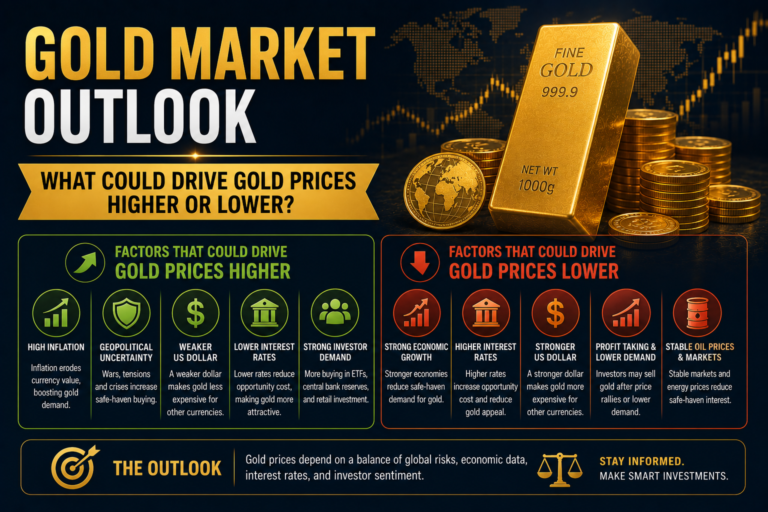
Based on the gold market trends outlined above, the outlook for gold through the remainder of 2026 remains broadly constructive. The combination of falling interest rates, persistent inflation, record central-bank buying, ongoing geopolitical uncertainty, returning ETF inflows, and constrained supply creates a powerful alignment of bullish forces.Factors That Could Drive Gold Higher
- Accelerated Fed rate cuts if the US economy weakens
- Further escalation of geopolitical conflicts or new crises
- Continued central-bank buying at or above 1,000 tonnes annually
- Sustained ETF inflows as institutional investors return
- A significant weakening of the US dollar
Factors That Could Pressure Gold Lower
- A stronger-than-expected US economy delaying rate cuts
- A sharp decline in inflation reducing gold’s hedging appeal
- A major equity market rally drawing investor money from gold
- Unexpected central-bank gold sales (currently very unlikely)
- Profit-taking after the extended bull run
What This Means for Investors
For investors, the gold market trends of 2026 reinforce gold’s role as a portfolio stabilizer and wealth-preservation asset. The structural forces driving gold — central-bank buying, geopolitical risk, constrained supply — are not short-term phenomena. They represent a fundamental shift in how the world views gold as a monetary asset. Most investment frameworks suggest a 5-15% portfolio allocation to gold. For guidance on how much gold to own, read our gold investment strategies guide. For historical context on how current prices compare to past cycles, see our gold price history.Make Informed Gold Decisions in 2026
Use our free tools to track gold prices, calculate your gold’s value, and project investment returns based on current market trends.
Live Gold Prices → Investment Calculator → Gold Value Calculator →Frequently Asked Questions About Gold Market Trends 2026
Will gold prices go up in 2026?
No one can predict gold prices with certainty, but the gold market trends driving 2026 are predominantly bullish. Falling interest rates, persistent inflation, record central-bank buying, geopolitical uncertainty, returning ETF inflows, and constrained mine supply all support higher gold prices. That said, gold is volatile — corrections of 10-20% can occur within bull markets. The structural trend favours gold, but short-term movements are unpredictable. Use our investment calculator to model different scenarios without relying on exact predictions.Why are central banks buying so much gold?
Central banks are buying record amounts of gold primarily because of geopolitical risk and de-dollarization. The 2022 Western sanctions on Russia demonstrated that reserves held in other countries’ currencies could be frozen. Gold, held domestically, is immune to such seizure. Additionally, central banks in emerging economies are diversifying away from dollar dependence. This strategic shift — not speculative trading — is why central-bank buying has exceeded 1,000 tonnes annually in recent years and continues as a key gold market trend in 2026.How do interest rates affect gold prices in 2026?
Interest rates affect gold prices through opportunity cost. Gold pays no interest. When interest rates are high, investors can earn yield from bonds and cash, making gold less attractive. When rates fall — as they are doing in 2026 — gold becomes more appealing. The most important measure is real interest rates (nominal minus inflation). With rates falling and inflation remaining above pre-2020 levels, real rates are near zero or negative in many countries — the most bullish environment for gold. This is a key driver among gold market trends in 2026.What is the biggest risk to gold prices in 2026?
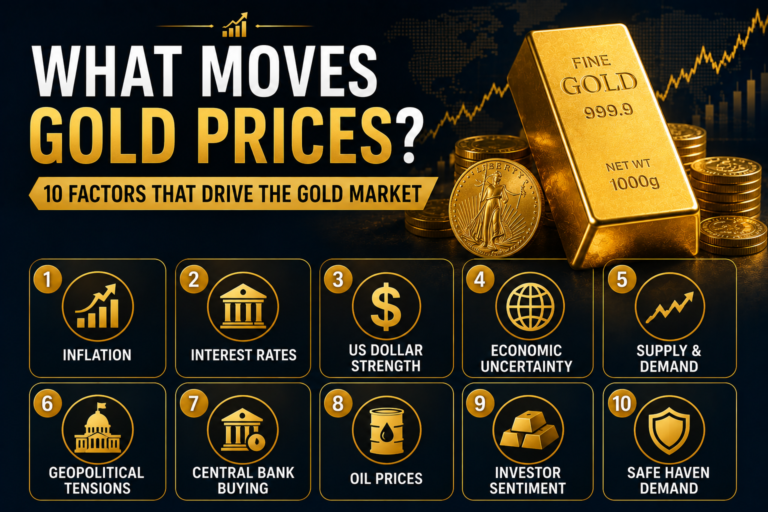
The biggest downside risk to gold prices in 2026 is a stronger-than-expected US economy. If US growth remains robust and inflation falls faster than expected, the Federal Reserve may slow or pause its rate-cutting cycle. This would keep real interest rates positive and reduce gold’s appeal. A sharp equity market rally could also draw investor money away from gold. Other risks include unexpected central-bank gold sales (currently unlikely) and profit-taking after gold’s extended bull run. Understanding what moves gold prices helps you monitor these risks.Is now a good time to buy gold in 2026?
Whether now is a good time to buy gold depends on your individual circumstances — not on short-term price predictions. The gold market trends of 2026 create a favourable long-term environment, but gold should be purchased as part of a diversified, long-term investment strategy — not as a short-term trade. For most investors, dollar-cost averaging — investing a fixed amount regularly regardless of price — is the smartest approach. It removes the stress of timing and builds a position gradually. Read our beginner’s guide to gold investing or use our investment calculator to model a DCA strategy.How does the US dollar affect gold trends in 2026?
Gold is priced in US dollars, so the dollar’s strength significantly affects gold market trends in 2026. A weakening dollar makes gold cheaper for international buyers, increasing demand and supporting higher prices. A strengthening dollar has the opposite effect. The US Dollar Index (DXY) is closely watched by gold traders. In 2026, the combination of Fed rate cuts and large US fiscal deficits is putting downward pressure on the dollar — a bullish factor for gold. For more on currency dynamics and gold, read our guide on what moves gold prices.
About the author