Table of Contents
- Gold Market Outlook: What Could Drive Gold Prices Higher or Lower?
- Bullish Factors: What Could Drive Gold Prices Higher?
- Bearish Factors: What Could Drive Gold Prices Lower?
- Interest Rates and Yields: The Central Battle for Gold
- The US Dollar: Gold’s Great Inversion
- Economic Growth: Strong vs. Weak Economy Gold Scenarios
- Geopolitical Risk: The Wild Card for Gold Prices
- Central Bank Demand: The Structural Support
- Gold Price Scenarios: Bull, Bear, and Base Case
- Frequently Asked Questions About Gold Market Outlook
Gold Market Outlook: What Could Drive Gold Prices Higher or Lower?
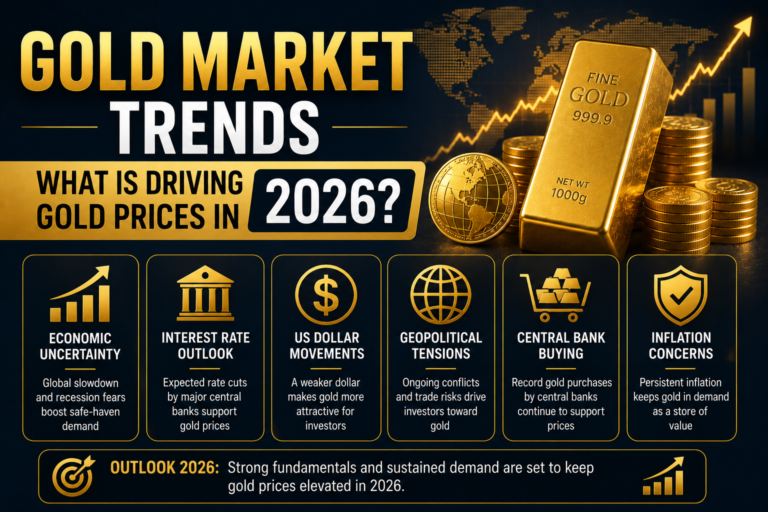
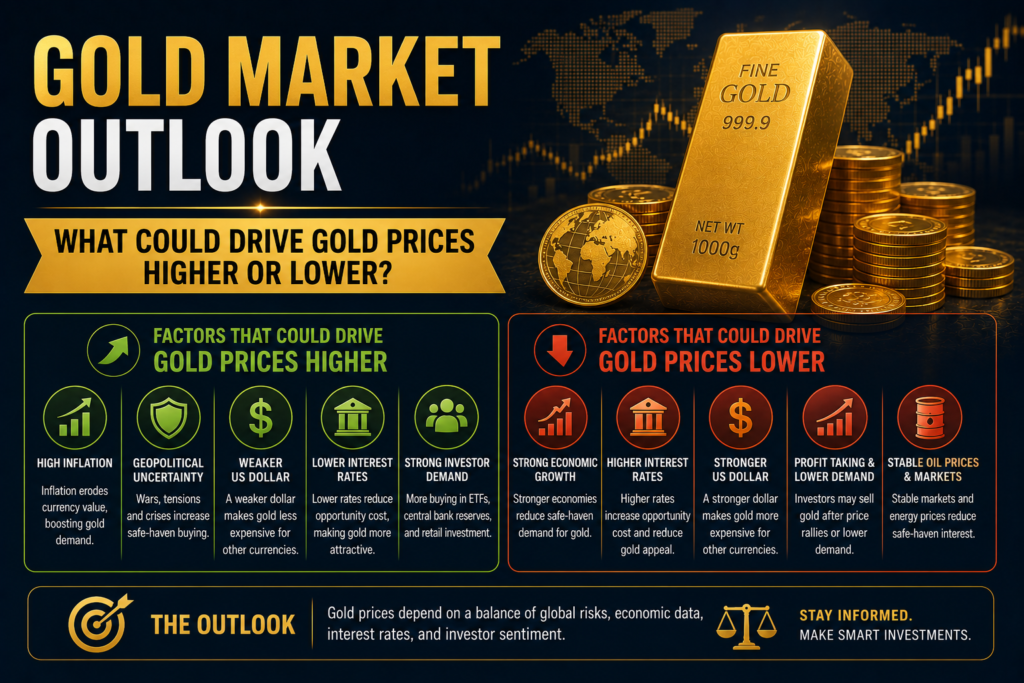
The gold market outlook is shaped by competing bullish and bearish forces. On one side, falling interest rates, persistent inflation, record central-bank buying, geopolitical instability, and constrained mine supply support higher gold prices. On the other side, a resilient US economy, a strengthening dollar, rising real yields, and investor rotation toward risk assets could pressure gold lower. Understanding both sides of the gold market outlook — and the scenarios that could play out — is essential for making informed investment decisions. This analysis examines the major bullish and bearish factors that could drive gold prices in the period ahead. We look at interest rates and yields, the US dollar, economic growth, geopolitical risk, and central-bank demand — the forces most likely to determine gold’s next major move. By the end, you will have a clear framework for understanding the range of possible outcomes in the gold market outlook.Gold Market Outlook: The Key Forces at Play
Bullish (Push Gold Higher):
• Rate cuts — lower interest rates reduce gold’s opportunity cost
• Negative real yields — inflation above interest rates supports gold
• Weak US dollar — makes gold cheaper for international buyers
• Central-bank buying — 1,000+ tonnes annually provides structural demand
• Geopolitical crises — wars, conflicts, and uncertainty drive safe-haven buying
• Stagnant mine supply — constrained production supports higher prices
Bearish (Push Gold Lower):
• Rising real interest rates — makes gold less attractive vs. bonds
• Strong US dollar — makes gold more expensive internationally
• Strong economic growth — draws investment toward risk assets
• Falling inflation — reduces gold’s hedging appeal
• Equity market rally — competition for investor capital
• Profit-taking after extended bull runs
Bullish Factors: What Could Drive Gold Prices Higher?
1. Falling Interest Rates and Dovish Central Banks
The most powerful bullish force in the current gold market outlook is the global shift toward lower interest rates. Gold pays no interest, so it becomes relatively more attractive when rates fall. The Federal Reserve, European Central Bank, Bank of England, and other major central banks have begun easing — and markets expect continued rate cuts. Each cut reduces the opportunity cost of holding gold and supports higher prices. If central banks cut faster than expected — perhaps due to economic weakness — gold could rally strongly.2. Negative Real Yields
The most bullish monetary environment for gold is negative real interest rates — when inflation exceeds nominal interest rates. In this scenario, holding cash or bonds guarantees a loss of purchasing power, making gold’s non-yielding nature a feature rather than a bug. With inflation remaining above pre-2020 levels in most economies while central banks cut nominal rates, real yields are near zero or negative in many countries. If inflation proves stickier than expected while rates fall, deeply negative real yields could drive gold substantially higher.3. Continued Central-Bank Gold Buying
Central banks have been net buyers of gold every year since 2010, with purchases exceeding 1,000 tonnes annually in recent years. This structural demand is driven by de-dollarization, geopolitical risk, and the desire for sovereign assets that cannot be frozen or seized. There is no sign of this trend reversing — if anything, it is accelerating. Continued central-bank buying at or above current levels provides a powerful floor under gold prices and is a key bullish factor in the gold market outlook.4. Geopolitical Instability and Safe-Haven Demand
Gold is the ultimate safe-haven asset. Active conflicts (Russia-Ukraine, Middle East tensions), trade wars (US-China), political transitions in major economies, and broader de-globalization all create uncertainty that drives investors toward gold. Each escalation in geopolitical tensions tends to trigger a gold price spike. If new crises emerge — or existing conflicts escalate — safe-haven demand could push gold significantly higher. For more on this dynamic, read our guide on what moves gold prices.5. Stagnant Mine Supply
Gold mine production has been flat for a decade, with annual output stuck near 3,000 tonnes. Declining ore grades, rising costs, long development timelines, and a lack of new discoveries all constrain supply. This means that when demand increases, supply cannot quickly respond — creating sustained upward pressure on prices. Supply constraints are a slow-burning but powerful bullish factor in the gold market outlook. For more on supply dynamics, read our gold supply and demand guide.6. A Weakening US Dollar
Gold is priced in US dollars, so a weakening dollar is bullish for gold — it makes gold cheaper for international buyers and increases global demand. The dollar faces structural headwinds from large US fiscal deficits, high government debt, and the gradual shift toward de-dollarization among emerging economies. If the dollar enters a sustained decline, gold could benefit significantly. The ICE US Dollar Index is a key indicator to watch.Bearish Factors: What Could Drive Gold Prices Lower?
1. Higher Real Interest Rates
The most powerful bearish force for gold is rising real interest rates. If inflation falls faster than expected while central banks hold nominal rates steady — or raise them — real rates would rise. This makes gold less attractive relative to interest-bearing assets and could trigger significant gold selling. This scenario is the primary risk to the bullish gold market outlook.2. A Strong US Dollar
If the US dollar strengthens — perhaps due to stronger-than-expected US economic growth, higher US rates relative to other countries, or global capital flows into US assets — gold prices typically come under pressure. A stronger dollar makes gold more expensive for international buyers, reducing demand. Conversely, dollar weakness supports gold. The dollar’s trajectory is one of the most important variables in the gold market outlook.3. Strong Economic Growth and Equity Market Rally
Gold faces competition from risk assets. When the global economy is growing strongly and equity markets are rallying, investors prefer stocks and other growth assets over gold. A prolonged equity bull market draws capital away from gold, limiting its upside. If economic growth proves more resilient than expected — and stock markets continue setting records — gold could struggle to gain momentum despite other supportive factors.4. Rapidly Falling Inflation
Gold’s appeal is closely tied to its role as an inflation hedge. If inflation falls back to — or below — central-bank targets (2%), the demand for inflation protection diminishes. Gold would lose one of its primary demand drivers. While current inflation remains above target in most economies, a faster-than-expected disinflation could remove a key pillar of gold’s bull case. The US Bureau of Labor Statistics publishes the CPI data that gold traders watch closely.5. Profit-Taking After Extended Bull Runs
Gold has experienced an extended bull market, reaching multiple record highs. After such runs, profit-taking is natural — investors who bought at lower prices sell to lock in gains. This can trigger corrections of 10-20% even within a longer-term bull market. Gold’s history is full of sharp corrections during secular bull runs. Understanding this helps investors avoid panic selling during normal pullbacks. For context on past corrections, read our gold price history.Interest Rates and Yields: The Central Battle for Gold
The single most important variable in the gold market outlook is the trajectory of interest rates and bond yields. Gold’s performance is most strongly correlated with real yields — the return on government bonds after adjusting for inflation.The Bullish Scenario: Rates Fall While Inflation Persists
In this scenario, central banks continue cutting rates to support economic growth, while inflation remains above target due to structural factors (de-globalization, fiscal deficits, energy transition costs). The result is negative real yields — the most bullish environment for gold. When bonds cannot keep pace with inflation, gold’s lack of yield becomes irrelevant. Investors buy gold because both bonds and cash are losing purchasing power in real terms.The Bearish Scenario: Inflation Falls While Rates Stay Higher
In this scenario, inflation falls back to target faster than expected, but central banks maintain higher rates to ensure inflation stays contained. The result is positive real yields — the most bearish environment for gold. When bonds offer returns that exceed inflation, holding gold means forgoing real income. Investors rotate from gold into bonds. This scenario would likely trigger significant gold price declines. The battle between these two scenarios is the central question of the gold market outlook. Current market expectations lean toward the bullish scenario (rates falling while inflation remains above target), but the bearish scenario cannot be ruled out if inflation surprises to the downside.The US Dollar: Gold’s Great Inversion
The US dollar is the second most important factor in the gold market outlook — and its relationship with gold is consistently inverse. Gold is priced in dollars, so dollar strength makes gold more expensive for international buyers (bearish) while dollar weakness makes gold cheaper (bullish).What Could Weaken the Dollar (Bullish for Gold)
- Fed rate cuts: Lower US rates reduce the dollar’s yield advantage over other currencies
- Large US fiscal deficits: Sustained government borrowing undermines confidence in the dollar over time
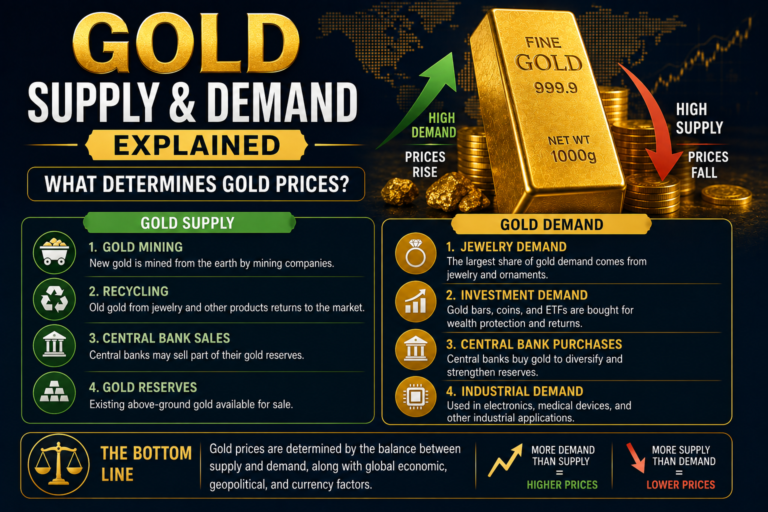
- De-dollarization: Central banks diversifying away from dollars reduces structural demand for the currency
- Geopolitical isolation: US sanctions policies drive other countries to seek alternatives to dollar-based trade
What Could Strengthen the Dollar (Bearish for Gold)
- Stronger-than-expected US growth: US economic outperformance attracts global capital
- Higher US rates: If the Fed cuts slower than other central banks, the dollar’s yield advantage persists
- Global risk aversion: In times of stress, investors often flee to the dollar as a safe haven
- Capital repatriation: US investors pulling money home from international markets
Economic Growth: Strong vs. Weak Economy Gold Scenarios
The state of the global economy is a crucial variable in the gold market outlook — but its relationship with gold is nuanced. Gold can perform well in both weak and strong economic environments, depending on the circumstances.Weak Economy — Two Gold Scenarios
Scenario A: Recession with rate cuts (Bullish for gold). If the economy weakens and central banks respond with aggressive rate cuts and stimulus, gold typically benefits. Lower rates and increased money supply support gold. This was the 2008-2011 and 2020 pattern — recessions followed by aggressive easing drove gold to record highs. Scenario B: Recession with deflation (Bearish for gold). If the economy weakens but inflation collapses into deflation, gold may struggle. In a deflationary environment, cash increases in purchasing power, and real interest rates may actually rise despite nominal rate cuts. This was the 1930s pattern, when gold performed poorly in real terms despite nominal price stability.Strong Economy — Two Gold Scenarios
Scenario C: Growth without inflation (Bearish for gold). If the economy grows steadily with low inflation and rising real interest rates, gold typically underperforms. Investors prefer stocks and bonds, which offer returns. This was the 1990s pattern — strong growth, low inflation, and a long gold bear market. Scenario D: Growth with inflation (Bullish for gold). If the economy grows but inflation runs hot — the stagflation-lite scenario — gold can perform well. This was the 1970s pattern and increasingly describes conditions in the mid-2020s. Growth supports demand while inflation drives hedging.Geopolitical Risk: The Wild Card for Gold Prices
Geopolitical risk is the least predictable but often most immediate driver in the gold market outlook. Gold prices respond instantly — often within minutes — to geopolitical events. Wars, terror attacks, sanctions, coups, trade disputes, and political crises all trigger safe-haven gold buying.Current Geopolitical Risks in the Gold Market Outlook
- Russia-Ukraine conflict: Ongoing with no clear resolution — periodic escalations trigger gold spikes
- Middle East tensions: Multiple active conflicts with potential for regional escalation
- US-China tensions: Trade wars, technology restrictions, and the Taiwan question create persistent uncertainty
- De-globalization: Supply-chain fractures, sanctions, and the formation of competing economic blocs increase systemic risk
- Sanctions risk: The weaponization of the dollar-based financial system drives other nations toward gold
Central Bank Demand: The Structural Support
Central-bank gold buying is the most structurally reliable bullish factor in the gold market outlook. Unlike investment demand, which ebbs and flows with market sentiment, central-bank demand is strategic and long-term. Central banks are not speculating — they are diversifying reserves away from dollar dependence and building sovereign financial security.Why Central-Bank Demand Is Sustainable
- De-dollarization momentum: The trend toward multi-polar currency arrangements accelerates each year
- Sanctions lessons: The 2022 freezing of Russian reserves permanently changed how countries view reserve assets
- Emerging-market reserve growth: Growing economies in Asia, the Middle East, and Africa are building gold reserves as their economic weight increases
- Limited alternatives: Gold is the only reserve asset that is simultaneously liquid, universally recognized, and free from counterparty risk
Gold Price Scenarios: Bull, Bear, and Base Case
| Scenario | Key Conditions | Gold Price Impact |
|---|---|---|
| Bull Case | Accelerated rate cuts; inflation persists; dollar weakens; central banks buy 1,000+ tonnes; new geopolitical crisis | Strong rally — gold significantly higher; new record highs likely |
| Base Case | Gradual rate cuts; inflation gradually declining; neutral dollar; steady central-bank buying; no major new crises | Modest gains or consolidation; gold holds recent gains with moderate upside |
| Bear Case | Inflation collapses; real yields rise; dollar strengthens; central-bank buying slows; strong equity rally | Correction — gold could fall 15-25% from recent highs |
Position Yourself for Any Gold Market Scenario
Use our tools to track prices, calculate your gold’s value, and model investment returns across different scenarios.
Live Gold Prices → Investment Calculator →Frequently Asked Questions About Gold Market Outlook
Will gold prices go up or down?
No one can predict gold prices with certainty, but the current gold market outlook leans bullish. Falling interest rates, persistent inflation, record central-bank buying, geopolitical instability, and constrained mine supply all support higher prices. However, gold is volatile — corrections of 10-20% occur within bull markets. The most likely outcome is continued strength with periodic corrections, though a bearish scenario (rapidly falling inflation, rising real yields) cannot be ruled out. For a balanced view, read our analysis of whether gold is a good investment.What is the strongest bullish factor for gold right now?
The strongest bullish factor in the current gold market outlook is central-bank gold buying. Central banks have purchased over 1,000 tonnes annually for three consecutive years — driven by de-dollarization, geopolitical risk, and the desire for sovereign assets immune to sanctions. This demand is structural, strategic, and independent of market sentiment. It provides a consistent price floor under gold and a reliable source of demand regardless of economic conditions. Track central-bank buying through the World Gold Council.What is the biggest risk to gold prices?
The biggest risk to gold prices is rising real interest rates. If inflation falls faster than expected while central banks maintain or raise nominal rates, real yields would rise — making bonds attractive relative to gold and triggering gold selling. A related risk is a strong US dollar, which makes gold more expensive internationally. Other risks include a powerful equity market rally that draws investment away from gold and significant profit-taking after gold’s extended bull run.How should I position for the current gold market outlook?
For most investors, the best response to the gold market outlook is not to attempt to predict short-term price moves but to hold gold as a long-term portfolio diversifier and insurance asset. Research suggests a 5-15% allocation to gold optimizes risk-adjusted returns. Use dollar-cost averaging — investing a fixed amount regularly regardless of price — to build your position over time without timing the market. For detailed guidance, read our gold investment strategies and beginner’s guide to gold investing.Does a recession help or hurt gold prices?
It depends on the type of recession. A recession accompanied by aggressive central-bank easing, high inflation, and financial system stress is typically bullish for gold — this was the pattern in 2008 and 2020. However, a recession accompanied by deflation — falling prices and rising real interest rates — can be bearish for gold, as was the case in the 1930s. In the current gold market outlook, most analysts expect that any recession would likely be met with aggressive monetary easing, which would be supportive for gold. For more context, read our analysis of what drives gold prices.How reliable are gold price predictions?
Gold price predictions are notoriously unreliable — even from major financial institutions. Gold is influenced by hundreds of variables, many of which are unpredictable (geopolitical events, central-bank decisions, market psychology). Analysts frequently revise forecasts, and long-term predictions are often wrong. The most honest approach is to understand the factors that influence gold prices, recognize the range of possible outcomes, and position your portfolio to perform acceptably across scenarios — rather than betting on a specific prediction. Our investment calculator allows you to model different return assumptions without relying on predictions.
About the author