Table of Contents
- What Moves Gold Prices? 10 Factors That Drive the Gold Market
- Factor 1: Interest Rates — The Most Powerful Gold Price Driver
- Factor 2: Inflation — Gold as a Purchasing Power Hedge
- Factor 3: US Dollar Strength — The Currency Connection
- Factor 4: Central Bank Buying and Selling
- Factor 5: Geopolitical Events and Crisis Demand
- Factor 6: Mine Supply and Physical Gold Availability
- Factor 7: Jewelry and Consumer Demand
- Factor 8: Gold ETF Flows — Institutional Money Movement
- Factor 9: Investor Sentiment and Market Psychology
- Factor 10: Oil Prices and Equity Market Performance
- Frequently Asked Questions About What Moves Gold Prices
What Moves Gold Prices? 10 Factors That Drive the Gold Market
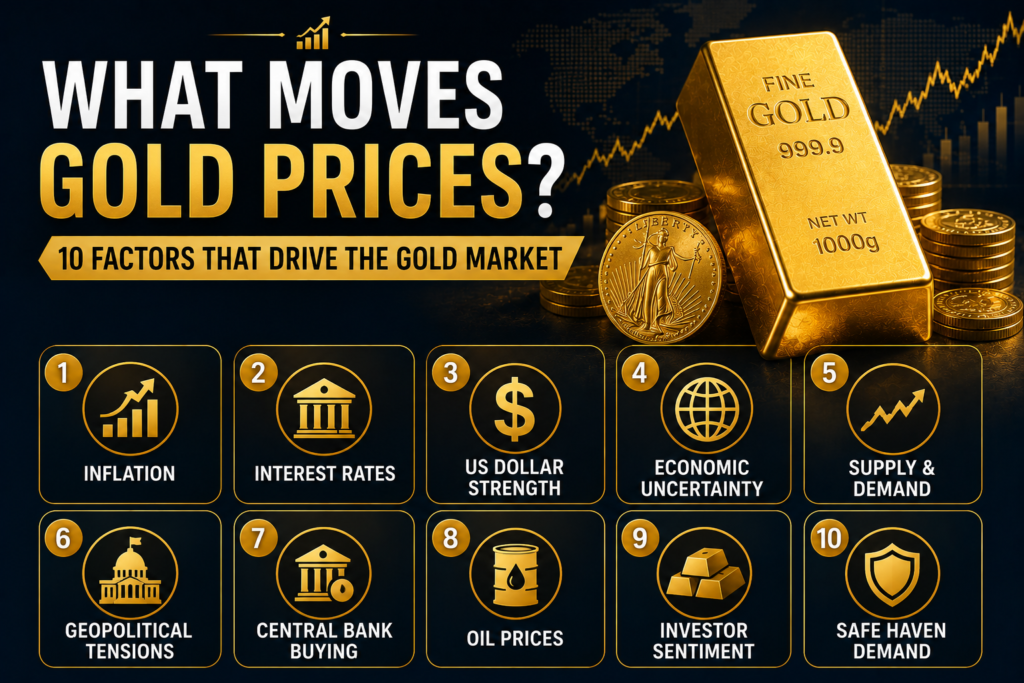
Gold prices are not random — they respond to a complex interplay of economic forces, monetary policy, geopolitical events, and human psychology. Understanding what moves gold prices is essential for anyone buying, selling, or investing in gold. When you know why gold prices rise and fall, you can make better decisions about when to buy, when to sell, and how to position gold within your portfolio. This guide examines the 10 most important factors that drive gold prices — from interest rates and inflation to central bank buying, geopolitical crises, and investor sentiment. Each factor is explained with historical examples showing how it has moved gold prices in the past. By the end, you will have a clear framework for understanding what moves gold prices and how to anticipate gold market movements.The 10 Factors That Move Gold Prices: 1. Interest rates — the single most powerful driver (lower rates = higher gold) 2. Inflation — gold’s role as a purchasing power hedge 3. US dollar strength — gold is priced in dollars; strong dollar = lower gold 4. Central bank buying/selling — the “smart money” of the gold market 5. Geopolitical events — wars, crises, and safe-haven demand 6. Mine supply — constrained supply supports higher prices 7. Jewelry demand — India and China drive physical consumption 8. Gold ETF flows — institutional money moving in and out 9. Investor sentiment — fear, greed, and market psychology 10. Oil prices and equities — interconnected market forces
Factor 1: Interest Rates — The Most Powerful Gold Price Driver
Interest rates are the single most powerful factor that moves gold prices. The relationship is straightforward: gold pays no interest or dividends. When interest rates are high, investors can earn significant yield from bonds, savings accounts, and other income-generating assets — making non-yielding gold less attractive. When interest rates are low or negative, the opportunity cost of holding gold diminishes, and gold becomes more appealing. This relationship has consistently driven gold prices throughout modern history. The massive gold bull market from 2001 to 2011 coincided with the Federal Reserve cutting rates from 6.5% to near zero and holding them there for years. The 2020 gold price surge to record highs occurred as the Fed cut rates to zero and launched unprecedented quantitative easing. Conversely, the Fed’s aggressive rate hikes in 2022 created significant headwinds for gold prices, which fell from $2,050 to $1,630 during the tightening cycle. The most important measure is real interest rates — nominal rates minus inflation. When real rates are negative (inflation exceeds interest rates), gold tends to perform strongly because holding cash or bonds guarantees a loss of purchasing power. When real rates are positive and rising, gold struggles. The Federal Reserve’s monetary policy decisions are therefore among the most closely watched gold price catalysts. For historical context, see our gold price history guide.Factor 2: Inflation — Gold as a Purchasing Power Hedge
Gold is one of the most reliable hedges against inflation in the investment world. When the purchasing power of paper currency declines — as it has in every fiat currency system in history — gold tends to maintain or increase its real value. This inflation-hedging property is one of the most enduring reasons gold holds value, and inflation is a major factor in what moves gold prices. The historical evidence is compelling. During the high-inflation 1970s, when US CPI averaged 7.1% annually and peaked at 14.8% in 1980, gold rose from $35 to $850 per ounce — a gain of over 2,300%. During the post-COVID inflation surge of 2021-2023, when US inflation reached 9.1%, gold reached new all-time highs. The mechanism is psychological as much as economic: when investors see their currency losing value, they seek assets that preserve purchasing power across generations. Gold has served this function for 6,000 years. However, the relationship between inflation and gold prices is not always immediate or mechanical. Gold responds most strongly to inflation expectations — what investors believe future inflation will be — rather than current inflation data alone. If investors believe central banks will successfully control inflation, gold may not rally despite high current inflation readings. If investors believe inflation is out of control, gold rallies even before inflation shows up in official statistics. For more on gold’s role as an inflation hedge, see our guide on why gold is valuable.Factor 3: US Dollar Strength — The Currency Connection
Gold is priced globally in US dollars. This creates a fundamental inverse relationship: when the dollar strengthens against other currencies, gold becomes more expensive for international buyers, reducing demand and putting downward pressure on prices. When the dollar weakens, gold becomes cheaper for non-US buyers, increasing demand and supporting higher prices. The US Dollar Index (DXY) — which measures the dollar against a basket of major currencies — is one of the most closely watched indicators by gold traders. Periods of dollar weakness, such as 2002-2008 and 2017-2018, have coincided with strong gold rallies. Periods of dollar strength, such as 2014-2015 and 2022, have created headwinds for gold. This relationship explains what moves gold prices in currency terms. However, the inverse relationship between the dollar and gold is not absolute. During periods of extreme global uncertainty, both the dollar and gold can rise simultaneously as investors seek safety in both assets. This occurred during the 2008 financial crisis and the 2020 COVID pandemic. The ICE US Dollar Index provides real-time dollar strength data that gold traders monitor closely.Factor 4: Central Bank Buying and Selling
Central banks are among the largest participants in the gold market, collectively holding over 35,000 tonnes of gold. Their buying and selling decisions are a significant factor in what moves gold prices. When central banks are net buyers — as they have been every year since 2010 — they create consistent, large-scale demand that supports gold prices. When they sell, they add supply that can pressure prices downward. The shift in central bank behaviour has been dramatic. During the 1990s and early 2000s, many central banks — including the Bank of England, the Swiss National Bank, and others — were selling gold, contributing to the 20-year bear market. Since 2010, central banks have reversed course, becoming net buyers. The buying accelerated sharply after 2022, when Western sanctions on Russia’s foreign reserves demonstrated the political risk of holding reserves in other countries’ currencies. China, Poland, India, Turkey, and Singapore have been among the largest recent buyers. Central bank buying matters because it represents strategic, long-term demand — not speculative trading. Central banks buy gold to diversify reserves, reduce dollar dependence, and hedge against currency devaluation. Their purchases are typically large (100-500 tonnes annually in recent years) and consistent. The World Gold Council tracks central bank gold reserves and quarterly changes.Factor 5: Geopolitical Events and Crisis Demand
Gold is the ultimate safe-haven asset — the investment that investors flee to when the world becomes uncertain. Geopolitical events, wars, terrorist attacks, financial crises, and political instability consistently drive gold prices higher as investors seek safety. This crisis-driven demand is one of the most reliable factors in what moves gold prices.Historical Examples of Geopolitical Gold Rallies
- 1979-1980: The Iranian Revolution and Soviet invasion of Afghanistan drove gold from $200 to $850
- 2001: 9/11 attacks caused a sharp gold price spike as markets plunged
- 2008: The global financial crisis drove gold up as confidence in the banking system collapsed
- 2011: The Eurozone debt crisis and US debt downgrade pushed gold to then-record highs of $1,895
- 2020: COVID-19 pandemic drove gold to new all-time highs above $2,067
- 2022: Russia’s invasion of Ukraine caused immediate gold price spikes
Factor 6: Mine Supply and Physical Gold Availability
Gold’s supply is extraordinarily constrained — and this scarcity is a fundamental factor in what moves gold prices. Unlike paper currency, which can be created at will, gold cannot be manufactured. All the gold ever mined fits into a 23-meter cube. Annual mine production adds only about 3,000 tonnes — approximately 1.5% of existing above-ground supply.Why Gold Supply Is Constrained
- Geological limits: The easy gold deposits have already been found. New discoveries are increasingly rare, deeper, and more expensive to extract.
- Rising extraction costs: Mine operating costs (energy, labour, environmental compliance) have risen, making gold production more expensive.
- Long development timelines: From discovery to production, a new gold mine takes 7-10 years to develop.
- Recycling: Scrap gold recycling provides additional supply (~1,200 tonnes annually), but recycling responds to price — higher prices incentivize more recycling, which moderates price increases.
Factor 7: Jewelry and Consumer Demand
Jewelry is the largest single source of gold demand, accounting for 45-50% of annual consumption. Two countries — India and China — together represent over 50% of global gold jewelry demand. This consumer demand is a major factor in what moves gold prices, particularly during seasonal buying periods.How Jewelry Demand Affects Gold Prices
Jewelry demand is price-sensitive. When gold prices drop, jewelry demand typically increases as consumers take advantage of lower prices for weddings, festivals, and gifts. When prices spike, jewelry demand may decline as consumers defer purchases. This creates a natural balancing mechanism in the gold market.Seasonal Patterns in Jewelry Demand
- India — Diwali and wedding season: October to March is the peak gold-buying season, driven by Diwali, Dhanteras, and wedding celebrations
- China — Chinese New Year: January-February sees significant gold buying for gifts and savings
- Middle East — Ramadan and Eid: Gold buying increases during religious holidays
- Western markets — Christmas: Holiday gift-giving supports year-end jewelry demand
Factor 8: Gold ETF Flows — Institutional Money Movement
Gold ETFs (Exchange-Traded Funds) have become one of the most visible and measurable factors in what moves gold prices. These funds hold physical gold in vaults on behalf of investors, and their buying and selling directly moves gold in and out of the market. Total gold ETF holdings exceed 3,000 tonnes — roughly 15% of all above-ground gold.How ETF Flows Move Gold Prices
When investors buy shares of a gold ETF, the ETF must purchase physical gold to back those shares. When investors sell, the ETF sells gold. These flows are large and visible — reported daily — and provide a real-time picture of institutional investor sentiment. Major inflows into gold ETFs signal rising investor confidence in gold and typically accompany rising prices. Major outflows signal declining confidence and typically accompany falling prices. The largest gold ETFs include SPDR Gold Shares (GLD) with over 800 tonnes, iShares Gold Trust (IAU), and Aberdeen Physical Gold Shares (SGOL). The World Gold Council publishes regular data on gold ETF holdings and flows.Factor 9: Investor Sentiment and Market Psychology
Like all markets, the gold market is driven not just by fundamentals but by human psychology. Fear, greed, panic, and euphoria all play roles in what moves gold prices. Understanding the psychological factors at work helps explain why gold prices sometimes move faster and further than fundamentals alone would suggest.Key Psychological Drivers
- Fear of currency collapse: When investors worry about their currency’s future, they rush to gold — creating self-reinforcing price momentum
- Fear of missing out (FOMO): Rising gold prices attract new buyers who fear they will miss gains — pushing prices higher
- Herd behaviour: Investors follow the crowd. When prominent investors or institutions publicly embrace gold, others follow
- Media coverage: Gold price movements receive heavy media attention during rallies, amplifying momentum
- Market memory: Gold’s performance during the 1970s and 2008 crisis shapes how investors view it today
Factor 10: Oil Prices and Equity Market Performance
Oil Prices
Gold and oil have a historically positive correlation because oil prices are a major driver of inflation. When oil prices rise, inflation expectations increase, supporting gold demand as an inflation hedge. The 1970s exemplify this relationship: oil shocks drove inflation to double-digit levels while gold surged from $35 to $850. Higher oil prices also increase gold mining costs, supporting higher gold prices through the supply side. The US Energy Information Administration provides oil price data that gold traders monitor.Equity Market Performance
Gold and equities have a low or negative correlation over long periods. When stock markets crash, investors often rotate into gold as a safe-haven asset — driving gold prices higher while equities fall. This was clearly demonstrated in 2008 (S&P 500 -38%, gold +5%) and 2020 (S&P 500 crashed 34% in a month, gold reached record highs). Gold provides portfolio insurance against equity market declines — one of its most valuable investment functions. For a complete comparison, see our gold vs silver guide or read about whether gold is a good investment.Frequently Asked Questions About What Moves Gold Prices
What is the biggest factor that moves gold prices?
The biggest factor that moves gold prices is real interest rates — nominal interest rates minus inflation. When real rates are negative (inflation exceeds interest rates), gold tends to perform strongly because holding cash or bonds guarantees a loss of purchasing power. When real rates are positive and rising, gold tends to struggle. This single factor has explained more gold price movement than any other over modern history. However, in the short term, geopolitical events and investor sentiment can override interest rate dynamics.Why does gold go up when the dollar goes down?
Gold is priced globally in US dollars. When the dollar weakens against other currencies, gold becomes cheaper for international buyers using euros, pounds, yen, or other currencies. Lower prices for international buyers increase demand, which pushes gold prices higher. Conversely, when the dollar strengthens, gold becomes more expensive internationally, reducing demand and pressuring prices downward. The inverse relationship between gold and the dollar is one of the most reliable patterns in what moves gold prices.Do central banks really affect gold prices?
Yes, significantly. Central banks collectively hold over 35,000 tonnes of gold and have been net buyers every year since 2010. Their buying creates large-scale, consistent demand that supports gold prices. The acceleration of central bank buying after 2022 — driven by Western sanctions on Russia — has been one of the most important factors supporting gold’s recent price strength. Central bank demand matters because it is strategic and long-term, not speculative. Track central bank gold purchases through the World Gold Council.How quickly do gold prices react to news events?
Gold prices react to news events almost instantly. The gold market operates nearly 24 hours a day, and price discovery is continuous. Major events — central bank rate decisions, inflation reports, geopolitical crises, economic data releases — are priced into gold within seconds or minutes of the news breaking. This rapid response is why gold traders closely monitor economic calendars and news feeds. For live prices, check our gold price page, updated continuously during market hours.What causes gold prices to drop?
Gold prices typically drop when: interest rates rise (increasing gold’s opportunity cost), the dollar strengthens (making gold more expensive internationally), inflation falls (reducing gold’s hedging appeal), equity markets rally strongly (drawing investor money away from gold), central banks sell gold (adding supply), and investor sentiment shifts negative (triggering ETF outflows and momentum selling). Gold corrections of 20-40% are normal within longer-term bull markets. Understanding what moves gold prices downward helps you prepare for inevitable corrections. For more on gold’s risks, read our Is Gold a Good Investment? guide.Can anyone predict gold prices?
No one can predict gold prices with certainty. The gold market is influenced by hundreds of variables — interest rates, inflation, currency movements, geopolitical events, central bank behaviour, supply constraints, and human psychology — many of which are themselves unpredictable. The best approach is not to try to predict gold prices but to understand the factors that influence them and position accordingly. For most investors, gold is best viewed as a long-term portfolio diversifier and insurance asset, not a short-term trading vehicle. Use our gold investment calculator to model different scenarios without needing to predict exact price movements.
About the author