Table of Contents
- Gold Supply and Demand Explained: What Determines Gold Prices?
- Gold Supply and Demand: The Basics
- Gold Supply: Mine Production and Exploration
- Gold Supply: Recycling and Scrap Gold
- Gold Demand: Jewelry — The Largest Consumer
- Gold Demand: Investment — Coins, Bars, and ETFs
- Gold Demand: Central Banks — The Strategic Buyer
- Gold Demand: Technology and Industrial Uses
- How Supply and Demand Balance Determines Gold Prices
- Frequently Asked Questions About Gold Supply and Demand
Gold Supply and Demand Explained: What Determines Gold Prices?
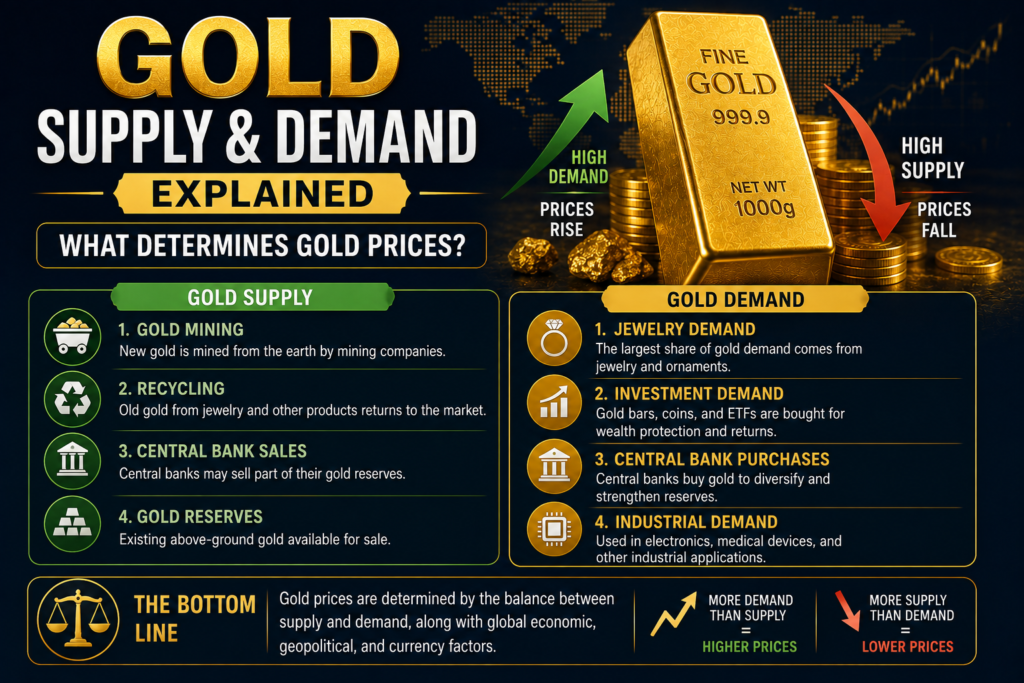
At its most fundamental level, the price of gold — like the price of anything else — is determined by supply and demand. When demand exceeds supply, prices rise. When supply exceeds demand, prices fall. But the global gold market’s unique characteristics make its supply and demand dynamics unlike any other commodity. Gold is virtually indestructible — nearly all the gold ever mined still exists. This means supply and demand work differently than for consumable commodities like oil or wheat. This guide explains gold supply and demand in detail: where gold comes from (mine production and recycling), where it goes (jewelry, investment, central banks, technology), and how the balance between these forces determines gold prices. Understanding gold supply and demand is essential for anyone who wants to understand why gold prices move and where they may be heading.Gold Supply and Demand: The Big Numbers
• Total above-ground gold: ~205,000 tonnes — fits into a 23-meter cube
• Annual mine production: ~3,000 tonnes (adds 1.5% to existing supply annually)
• Annual recycling: ~1,200 tonnes — responds to price changes
• Jewelry demand: 45-50% of annual consumption (~2,200 tonnes)
• Investment demand: 20-30% of annual consumption (coins, bars, ETFs)
• Central bank purchases: 1,000+ tonnes annually in recent years
• Technology demand: ~8% of annual consumption (~300 tonnes)
Gold Supply and Demand: The Basics
Unlike most commodities that are consumed — oil is burned, wheat is eaten, steel rusts away — gold is accumulated. Nearly all the gold ever mined throughout human history still exists in some form. This fundamental characteristic changes everything about how gold supply and demand operates. The result is that gold’s price is determined less by the flow of new supply (annual mine production) and more by how existing gold changes hands. When investors decide to buy gold, they are not creating new demand for new gold — they are competing for ownership of gold that already exists. Similarly, when investors sell, they are not destroying gold — they are transferring ownership. This is why investment sentiment and central-bank behaviour can move gold prices dramatically despite relatively stable mine production. To understand gold supply and demand, it is helpful to think of two levels: the physical market (actual gold being mined, refined, fabricated, and consumed) and the investment market (existing gold being bought and sold for investment purposes). Both levels affect the price, but the investment market often dominates price discovery in the short term. For a complete overview of how the gold market functions, see our gold market explained guide.Gold Supply: Mine Production and Exploration
Mine production is the largest source of new gold supply, adding approximately 3,000 tonnes per year to the global market. This represents about 75% of total annual gold supply, with recycling providing the remaining 25%.Where Gold Is Mined
Gold is mined on every continent except Antarctica, but production is concentrated in a relatively small number of countries. The largest gold producers are:- China: The world’s largest gold producer at approximately 370 tonnes annually
- Australia: Second-largest producer at approximately 310 tonnes annually
- Russia: Third-largest producer at approximately 300 tonnes annually
- Canada: Approximately 200 tonnes annually
- United States: Approximately 170 tonnes annually
- Ghana, South Africa, Peru, Mexico, Uzbekistan: Other significant producers (100-150 tonnes each)
Why Gold Mine Supply Is Constrained
Gold mine supply has been essentially flat for the past decade — and there are structural reasons it is unlikely to increase significantly:- Declining ore grades: Mines are extracting lower-grade ore, requiring more material to produce each ounce of gold
- Rising costs: Energy, labour, and environmental compliance costs continue to increase
- Long development timelines: New mines take 7-10 years from discovery to production
- Fewer discoveries: Major new gold deposits have become increasingly rare
- Environmental opposition: New mine permits face increasing community and environmental resistance
Gold Supply: Recycling and Scrap Gold
The second major source of gold supply is recycling — the processing of scrap gold from old jewelry, electronics, dental gold, and industrial waste. Recycling provides approximately 1,200 tonnes of gold annually, about 25% of total supply.How Gold Recycling Responds to Price
Unlike mine production, which responds slowly to price changes, gold recycling is highly price-elastic. When gold prices rise sharply, more people sell their old gold — bringing more scrap into the market. When prices fall, recycling slows as sellers hold onto their gold hoping for higher prices. This creates a natural moderating effect on gold price movements. For example, during the 2020 gold price surge, recycling increased significantly as consumers sold old jewelry to take advantage of record prices. Conversely, during low-price periods, recycling declines. Understanding when to sell scrap gold is important — read our guide on how to sell gold for timing advice. Use our scrap gold calculator to estimate the value of your scrap gold at current prices.Gold Demand: Jewelry — The Largest Consumer
Jewelry is the largest single source of gold demand, accounting for 45-50% of annual consumption — approximately 2,200 tonnes per year. Understanding jewelry demand is essential to understanding gold supply and demand because consumer behavior directly influences the physical gold market.Where Jewelry Demand Comes From
Two countries dominate global gold jewelry demand:- India (approximately 600-700 tonnes annually): Gold is deeply embedded in Indian culture. Weddings, festivals (Diwali, Dhanteras), and traditional savings all drive demand. Indian jewelry is predominantly 22K gold. Gold serves dual purposes in India: adornment and financial security.
- China (approximately 500-600 tonnes annually): Gold jewelry is purchased for weddings, Chinese New Year, and as a store of wealth. 24K (999) gold is popular in China for both jewelry and investment.
How Jewelry Demand Affects Gold Prices
Jewelry demand is price-sensitive. When gold prices drop, jewelry demand typically increases as consumers take advantage of lower prices. When prices spike, demand may decline as consumers defer purchases. This creates a natural balancing mechanism in gold supply and demand. For help choosing gold jewelry, read our gold jewelry guide.Gold Demand: Investment — Coins, Bars, and ETFs
Investment demand is the second-largest source of gold demand, accounting for 20-30% of annual consumption. Investment demand comes in two forms: physical investment (coins and bars) and paper investment (ETFs and similar products).Physical Investment: Gold Coins and Bars
Physical gold investment — buying coins and bars — represents the most direct form of gold ownership. Individual investors buy gold coins and bars as a store of value, a hedge against inflation, and a form of financial insurance. Physical investment demand is driven by:- Economic uncertainty: When the economy is uncertain, people buy more physical gold
- Inflation fears: Gold is seen as a hedge against currency devaluation
- Geopolitical risk: Wars, crises, and political instability drive safe-haven buying
- Interest rates: Lower rates make gold more attractive relative to income-generating assets
- Currency weakness: In countries with weak currencies, gold demand rises
Gold ETFs and Institutional Investment
Gold ETFs (Exchange-Traded Funds) provide investors with exposure to gold prices without owning physical metal. When investors buy ETF shares, the ETF purchases physical gold to back those shares. Total gold ETF holdings exceed 3,000 tonnes — approximately 15% of all above-ground gold. ETF flows are a significant driver of gold supply and demand — major inflows remove gold from the market into vault storage, while major outflows return gold to the market. The World Gold Council tracks ETF holdings and flows.Gold Demand: Central Banks — The Strategic Buyer
Central banks have become one of the most important sources of gold demand — and the most consistent large-scale buyer in the modern gold supply and demand equation. Since 2010, central banks have been net buyers of gold every year, with annual purchases exceeding 1,000 tonnes in recent years.Why Central Banks Buy Gold
- Reserve diversification: Gold reduces reliance on any single currency, particularly the US dollar
- Sovereign security: Gold held domestically cannot be frozen or seized by other governments — a lesson reinforced by 2022 sanctions on Russia
- De-dollarization: Emerging economies (China, India, Turkey) are reducing dollar exposure by increasing gold holdings
- Inflation protection: Gold preserves central-bank purchasing power over the long term
- National prestige: Large gold reserves signal financial strength and sovereignty
Key Central Bank Buyers
China has been the most consistent large buyer, officially reporting over 2,200 tonnes. Poland has been aggressively accumulating, targeting 20% of reserves in gold. India, Turkey, Singapore, and several Middle Eastern central banks have also been active buyers. Central-bank demand is strategic and long-term, providing a stable foundation for gold prices. The World Gold Council publishes quarterly central-bank gold statistics.Gold Demand: Technology and Industrial Uses
While smaller than jewelry or investment demand, technology demand for gold is a meaningful and consistent component of gold supply and demand — accounting for approximately 8% of annual consumption (300+ tonnes per year).Where Gold Is Used in Technology
- Electronics: Gold’s excellent conductivity and corrosion resistance make it essential in smartphones, computers, tablets, and circuit boards. Every smartphone contains a small amount of gold.
- Medical devices: Gold is used in pacemakers, stents, and diagnostic equipment due to its biocompatibility.
- Aerospace: Gold coatings on satellite components and spacecraft protect against radiation and reflect heat.
- Dentistry: Gold alloys are still used in dental restorations.
How Supply and Demand Balance Determines Gold Prices
The interaction between all these sources of supply and demand determines gold prices. When central banks buy 1,000+ tonnes, when ETFs see major inflows, when Indian jewelry demand peaks during wedding season, when recycling slows because sellers hold for higher prices — all of these factors influence the balance between what is available and what is wanted.The Key Dynamic: Price Insensitivity of Supply
One of the most important characteristics of gold supply and demand is that gold supply is relatively price-insensitive. Mine production responds slowly (years) to price changes due to long development timelines. Recycling responds more quickly but can only provide what already exists. This means that when demand increases sharply — as it has from central banks and investors in recent years — supply cannot quickly expand to meet it. The result is sustained upward pressure on prices.The Role of Above-Ground Stocks
Unlike most commodities, where annual production sets the price, gold’s price is influenced by the 205,000 tonnes of above-ground gold that already exists. At any moment, holders of existing gold — central banks, investors, jewelry owners — decide whether to hold or sell. When most holders decide to hold (as during periods of uncertainty), even small increases in demand can move prices significantly. When holders rush to sell (as during periods of financial panic when investors need liquidity), prices can fall sharply despite limited new supply.Current Market Conditions
As we analyze gold supply and demand today, the balance tilts bullish: mine supply is stagnant, central banks are buying at record pace, ETF inflows are returning, jewelry demand remains robust in India and China, and geopolitical uncertainty supports safe-haven demand. These conditions have produced gold’s extended bull market and continue to provide structural support for gold prices. For current price information, see our live gold price page. For historical context, read our gold price history guide.Frequently Asked Questions About Gold Supply and Demand
What determines the price of gold?
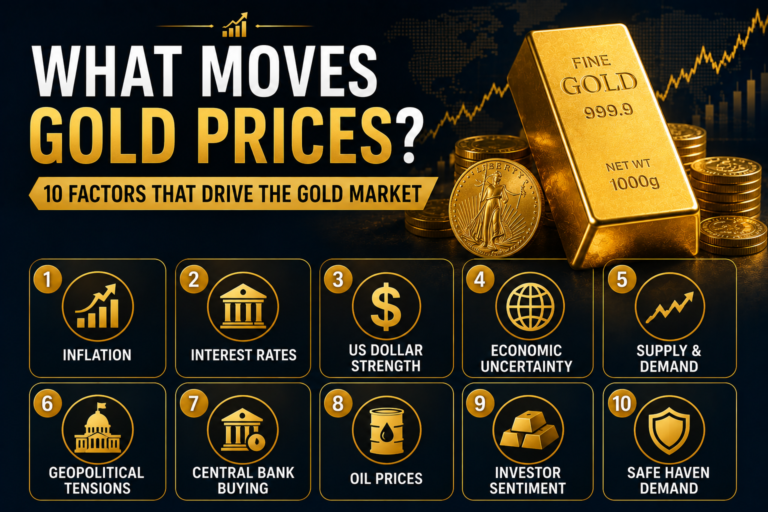
The price of gold is determined by supply and demand in the global gold market. Key demand sources include jewelry (45-50% of consumption), investment (20-30%), central banks (1,000+ tonnes annually), and technology (8%). Key supply sources include mine production (~3,000 tonnes annually) and recycling (~1,200 tonnes annually). The price balances these forces. When demand exceeds supply — as it has in recent years with strong central-bank buying — prices rise. When supply exceeds demand, prices fall. For more detail, see our guide on what moves gold prices.Who buys the most gold?
The largest buyers of gold are: jewelry manufacturers (purchase ~2,200 tonnes annually, mostly in India and China), central banks (purchase 1,000+ tonnes annually — the most consistent large-scale buyers), gold ETFs and institutional investors (variable but significant), and individual investors buying coins and bars (~1,000-1,200 tonnes annually). The World Gold Council provides detailed breakdowns of gold demand by sector.How much gold is mined each year?
Approximately 3,000 tonnes of gold are mined each year globally. This represents about 75% of annual gold supply, with recycling providing the remaining 25%. Mine production has been essentially flat for the past decade due to declining ore grades, rising costs, and a lack of new major discoveries. Annual mine production adds only about 1.5% to existing above-ground gold stocks — a key factor in gold’s scarcity value.Why does gold demand increase during crises?
Gold demand increases during crises because gold is viewed as a safe-haven asset. During periods of financial instability, geopolitical conflict, or economic uncertainty, investors lose confidence in traditional assets (stocks, bonds) and paper currencies. They turn to gold because it is tangible, universally recognized, has no counterparty risk, and has preserved value through every crisis in human history. This crisis-driven demand is a key component of gold supply and demand — and explains why gold prices often surge during wars, recessions, and financial panics.Does gold recycling affect gold prices?
Yes, gold recycling plays a moderating role in gold prices. When gold prices rise sharply, more people sell their old gold (jewelry, scrap, dental gold) — increasing recycling supply and helping to moderate price increases. When prices fall, recycling slows as sellers hold onto gold hoping for higher prices. Recycling provides approximately 1,200 tonnes annually (25% of supply) but is highly price-elastic. If you are considering selling scrap gold, use our scrap gold calculator to determine fair value at current prices.How does India and China’s gold demand affect prices?
India and China together account for over 50% of global gold jewelry demand — making their buying patterns a major force in gold supply and demand. When Indian wedding season (October-March) or Chinese New Year approaches, gold demand spikes, supporting prices. When economic conditions in these countries weaken, gold demand may slow. Additionally, both countries have strong cultural traditions of gold ownership that transcend purely economic considerations — gold is viewed as a store of wealth and a key component of family savings. This deep-rooted demand provides a consistent price floor for the gold market.
About the author